

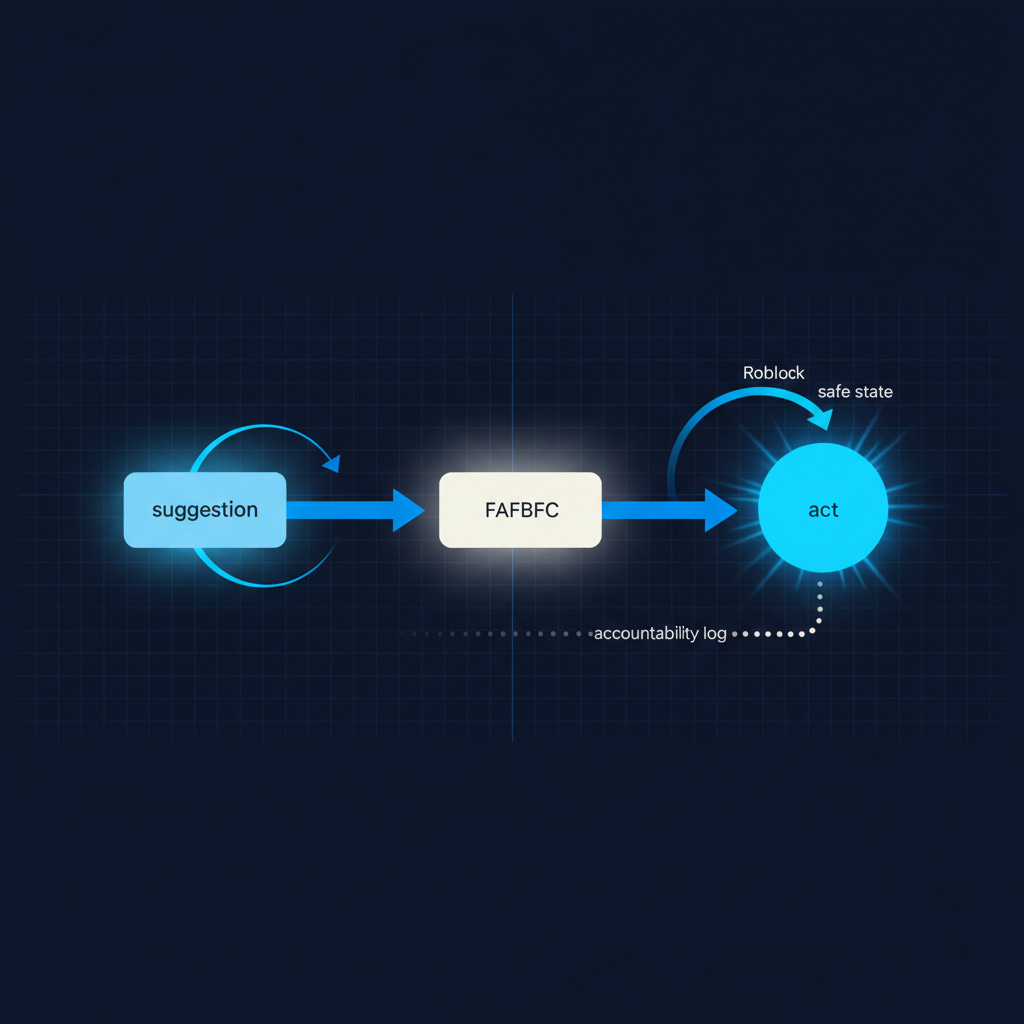
Executive Summary
Operator Trilogy, Part 2 of 3: what changes when AI moves from suggestion to action—and the minimum bar for accountability, logging, and rollback.
About the series. Part 1 covers prompting for decision-grade output; Part 3 is the playbook for running a system of agents (governance, safety, scaling). Each part stands alone; reading all three in order builds the full arc.
Purpose. This article focuses on what changes when the system doesn't only answer—it uses tools and takes actions. That shift, from Generative AI to agentic AI, is where many organizations are heading next. You will learn what "agentic" means in plain terms, how the operator's job changes (same interface, new layer), and what to clarify before deploying systems that act on your behalf. Theme: the shift to agency—when AI doesn't just return text but executes within boundaries you define. It is the second of a three-part series; the first covers prompting for decision-grade output; the third covers how to run a system of agents with governance, safety, and scaling.
Why now. Research and industry practice show that generative AI is moving beyond answering questions to expanding capabilities—taking actions in workflows, calling tools, and operating with greater autonomy [2, 3, 6]. Understanding where Generative AI ends and agentic AI begins is the first step toward governing what you build or buy.
Why This Matters Now
Once you can get decision-grade output by framing intent, context, constraints, examples, and evaluation, a natural next question is: What happens when the system doesn't just return text—it acts?
It might call an API, update a record, send a message, or trigger a workflow. The same interface (language) is still there, but a new layer appears: autonomy over actions. That's the shift to agentic AI. Understanding it clarifies what you need to govern and scale when systems act on your behalf.
What "Agentic" Means in Plain Terms
Agentic AI refers to systems that don't only process a prompt and return a response. Definitions from IBM and Google Cloud [2, 3] align on a small set of core capabilities: such systems perceive their environment (data, APIs, tools), reason (e.g., with an LLM) about what to do next, plan by breaking goals into steps, act by calling tools and taking real-world steps, and reflect on outcomes to adjust behavior. Research on ReAct (reasoning + acting) [1] shows that interleaving explicit reasoning steps with external actions—rather than reasoning or acting alone—improves task performance and interpretability, and has become a common pattern in agentic systems.
The key difference for operators: traditional AI gives you an answer; agentic AI can execute on your behalf within boundaries you define.
A simple mental model:
Generative AI: You ask → model responds → you decide what to do with the answer.
Agentic AI: You set intent and boundaries → system reasons, uses tools, and takes actions → you govern what it's allowed to do and review outcomes.
Agentic systems can be designed to support intelligent choice architecture [12]: instead of only executing end-to-end, they can surface options, recommendations, and trade-offs so humans retain decision rights where it matters. That human-centric design—presenting choices rather than replacing them—aligns with research on how AI can empower better decisions [12]. The same prompting discipline—clear intent, context, and constraints—still applies. But now those constraints don't only shape what the model says; they shape what the system is allowed to do. This article reframes "how we ask" into "what we allow the system to do when it acts."
Same Interface, New Layer
The interface is still language. You (or your workflows) still specify what you want in natural language. The change is that the system can call tools and take actions as part of fulfilling that request.
For example:
Generative AI: "Summarize the top five risks from this report." → Model returns text. You act (or not).
Agentic AI: "Using our risk database and email system, identify the top five risks from this report and notify the risk owner for each." → System may query the database, run analysis, and send notifications—within guardrails you've defined.
So the operator's job shifts: you still need clear prompts and good evaluation criteria. You also need to think about which actions are in scope, which tools the system can use, and where human review or approval is required. Designing for intelligent choice architecture [12] keeps humans at the center and supports trust. Harvard Business Review and MIT Sloan Management Review [4, 5] stress that trust in AI—especially in systems that act autonomously—erodes without transparency and governance. Running these systems so they remain trustworthy and auditable requires clear ownership, approval workflows, and accountability—the subject of a dedicated governance playbook.
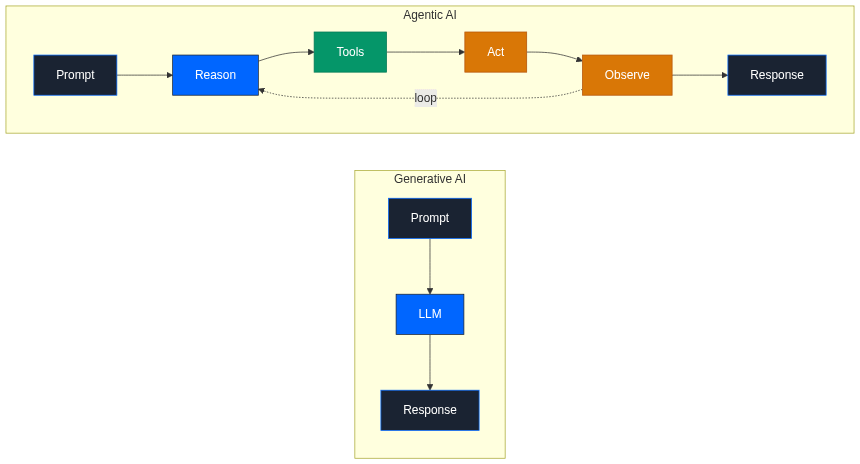
Figure 1: The Agentic Flow
Generative AI (left): prompt → LLM → response. Agentic AI (right): the same LLM reasons and plans, then calls tools (including MCP and APIs), acts, observes results, and may loop until a final response—the transformation from answer-only to systems that act.
From Generative AI to Agentic AI: Research and Practice
The distinction between Generative AI and Agentic AI is more than marketing—it reflects a real shift in architecture, capability, and risk. Recent surveys and industry research clarify what that shift entails and why it matters for operators.
Conceptualizing the transition. Schneider's survey [7] frames Agentic AI as building on Generative AI: GenAI generates outputs directly from inputs (text, code, images) with little or no use of external tools or environments; Agentic AI adds reasoning (decomposition, reflection, planning), memory (persistent and retrieved context), tools (selection, invocation, integration), and interaction (with users, environments, and other agents). The same LLM may sit at the core, but the system's behavior changes when it can perceive, act, and reflect over time. For operators, the implication is clear: the boundary is not "which model" but what the system is allowed to do and how it is evaluated.
Tool use and integration. A central differentiator of agentic systems is sophisticated tool use. Research on dynamic tool selection [8] shows that agents can leverage large, evolving toolsets (databases, APIs, code execution, search) rather than fixed inventories—with measurable gains on complex reasoning tasks when tool use is well scoped. In practice, that means your governance must answer: Which tools can this agent call, under what conditions, and with what logging and approval? Tool registries and use-case boundaries (covered in the playbook) are the operational answer.
Autonomy and reasoning–action loops. Agentic systems often implement reasoning–action–reflection loops: the system reasons, acts, observes the result, and may revise its plan. The next section spells out the main patterns—CoT, ReAct, RAG—that make this concrete.
Why this matters for you. Understanding the Gen AI → Agentic AI transition in terms of research and practice helps you (1) set expectations with stakeholders, (2) scope governance so you govern tools and actions, not only prompts, and (3) invest in the right capabilities: playbooks, tool registries, and evaluation of behavior, not only output quality.
Reasoning and Execution Patterns: CoT, ReAct, RAG
Agentic systems don’t just “call a tool”—they reason, act, and often ground answers in external data. Three research-backed patterns show up again and again; knowing them helps you understand what you’re governing when AI acts.
Chain-of-thought (CoT). CoT [10] asks the model to produce intermediate reasoning steps before an answer. That improves accuracy on complex tasks and makes behavior easier to audit: you can inspect why the system reached a conclusion. When agents use step-by-step reasoning, those steps can be logged and reviewed—so governance and trust are supported.
ReAct (reasoning + acting). ReAct [1] interleaves reasoning and action: the model alternates between generating a "thought" (reasoning step), taking an "action" (e.g., calling a tool), and observing the result. This loop—Thought → Action → Observation—grounds the agent in real-world feedback and reduces hallucination. It also produces interpretable trajectories (thought–action–observation sequences), which you can use for auditing and for defining approval gates (e.g., review before certain actions). Newer work extends this with reinforcement learning and environment feedback [9].
RAG (retrieval-augmented generation). RAG [11] grounds model outputs in retrieved documents or data—reducing reliance on the model’s internal knowledge and cutting hallucination. In agentic setups, "agentic RAG" extends this with dynamic retrieval, multi-step queries, and tool use. For operators, the governance question is: Which data sources can the agent retrieve from, and under what access controls? Document this in tool registries and use-case boundaries so retrieval is scoped and auditable.
Why this matters for the shift to agency. These patterns are part of what changes when you move from Generative AI to agentic AI: the system can reason step-by-step (CoT), interleave thought and action (ReAct), and pull in external data (RAG). Auditability depends on capturing these trajectories—what the system thought, what it did, and what it observed—so you can govern and debug. Part 3 (the playbook) builds on this: once you know which patterns your agents use, you can design approval workflows and playbooks that require the right level of transparency.
Key Challenges on the Path to Agentic AI
Moving from Generative AI to agentic systems introduces challenges that operators and leaders should anticipate.
Defining and bounding autonomy. Agentic systems are "autonomous" in the sense that they decide when and how to use tools and take steps—but that autonomy must be bounded. Research and practice [7, 9] stress the need for clear definitions of what agents are allowed to do, what requires human approval, and what is out of scope. Without those boundaries, technical debt and governance gaps compound quickly.
Safety, alignment, and misuse. Systems that act on your behalf can cause harm if misaligned or misused. Safety and alignment research emphasizes verifiable planning, human-in-the-loop checkpoints, and misuse resistance. Aligning with intelligent choice architecture [12]—designing so agents present choices and options to humans where it matters—reinforces human-centric control and accountability. Operators should treat approval workflows and use-case registries not as bureaucracy but as the mechanism that keeps agentic systems safe and aligned with organizational values.
Scalability and sustainability. Scaling agentic AI—more use cases, more tools, more users—requires structured approaches: curated tool sets, agent playbooks, and consistent evaluation. Ad-hoc rollout leads to fragmented guardrails and higher long-term cost. The cost-curve idea (when to patch vs. rebuild) applies directly here.
Governance and trust. Trust in AI erodes when systems act without transparency [4, 5]. Governance—clear ownership, decision gates, and accountability—is what keeps agentic systems auditable and trusted. The playbook in Part 3 (governance and scaling for a system of agents) is the natural next step.
What Operators Need to Think About
Before deploying agentic systems, operators and leaders should clarify:
Scope of action. What is the system allowed to do? Which tools, data sources, and external systems can it touch? Defining this is the first step toward clear governance.
Boundaries and guardrails. Just as effective prompting relies on constraints in what you ask, agentic systems need constraints on actions: what they must not do, what requires confirmation, and what is out of scope.
From prompt quality to action quality. You'll still evaluate whether the system "understood" the request. You'll also evaluate whether it acted appropriately: Did it use the right tools? Stay within boundaries? Escalate when it should?
Governance and scaling. Once systems act, the organization needs clear ownership, approval workflows, and accountability. A structured playbook for running a system of agents—use-case registries, decision gates, human-in-the-loop rules—is the natural next step. Designing for intelligent choice architecture [12] (presenting choices to humans rather than automating them away) keeps the system human-centric and supports trust at scale.
Cost of ad-hoc rollout. Deploying agentic capabilities without clear boundaries can create technical and governance debt. A related idea is the cost-curve: when quick patches become more expensive than a structured rebuild (clear tool set, approval workflows, playbooks). Investing in governance before the cost compounds pays off; a dedicated playbook expands on when to patch versus rebuild.
Conclusion: From Generative AI to Agentic AI
This article clarified the shift: when AI doesn't only answer—it acts—you're in agentic territory. Same interface (language), new layer (autonomy over actions). Operators must think about scope of action, boundaries, action quality, and the cost of ad-hoc rollout.
Taken together with a foundation in prompting (intent, context, constraints, evaluation) and a playbook for governance and scaling, the trilogy answers one question: How do we get value from AI and run it responsibly—from the first prompt to systems that act? Human-centric design—intelligent choice architecture [12], where systems present choices and empower human decision makers—should run through that arc. Reading the three in sequence builds a fuller picture; each can also stand alone.
One question to take away: For the systems we're building or buying, do we know where Generative AI ends and agentic AI begins—and have we defined what they're allowed to do? If that question lands, you're ready to design governance and scaling for what acts.
Key Takeaways
Generative AI → Agentic AI: The shift is from systems that only return text to systems that perceive, reason, use tools, and take actions [1–3, 7]. The same prompting discipline applies; constraints now shape actions as well as answers.
Same interface, new layer. You still use language to specify intent; the system can now execute within boundaries. Operators must define scope of action, guardrails, and where human review is required.
Research and practice align. Surveys and frameworks [7–9] clarify tool use, reasoning–action loops, and the need for bounded autonomy. Operators should govern tools and trajectories, not only prompts.
Trust and governance matter. Trust in AI erodes when systems act without transparency [4, 5]. Running agentic systems so they stay auditable and aligned requires governance—approval workflows, use-case boundaries, and accountability.
Governance and scaling follow. Understanding the Gen AI → Agentic AI transition—and the cost of ad-hoc rollout—sets up the need for a structured playbook: approval workflows, tool registries, and scaling within clear boundaries. Design for intelligent choice architecture [12] so agents present choices to humans where it matters.
References
Sources cited or drawn on in this article. Numbers in the text (e.g., [1], [2–6], [12]) refer to these entries.
Yao, S., Zhao, J., Yu, D., Du, N., Shafran, I., Narasimhan, K., & Cao, Y. (2022). ReAct: Synergizing reasoning and acting in language models. arXiv:2210.03629. https://arxiv.org/abs/2210.03629
IBM. (2024). What is agentic AI? IBM Think Topics. https://www.ibm.com/think/topics/agentic-ai
Google Cloud. (2024). What is agentic AI? Google Cloud Discover. https://cloud.google.com/discover/what-is-agentic-ai
Harvard Business Review. (2025, November). Workers don't trust AI. Here's how companies can change that. Harvard Business Review. https://hbr.org/2025/11/workers-dont-trust-ai-heres-how-companies-can-change-that
MIT Sloan Management Review. (2024). What leaders must do to build trusted AI. MIT SMR Connections. https://sloanreview.mit.edu/mitsmr-connections/infographic-what-leaders-must-do-to-build-trusted-ai/
Boston Consulting Group. (2025). GenAI doesn't just increase productivity. It expands capabilities. BCG Publications.
Schneider, J. (2025). Generative to Agentic AI: Survey, conceptualization, and challenges. arXiv:2504.18875. https://arxiv.org/abs/2504.18875
AutoTool and related work on dynamic tool selection and integration for agentic reasoning (e.g., arXiv:2512.13278). LLM agents can leverage large, evolving toolsets with measurable gains on reasoning tasks; for operators, tool registries and use-case boundaries are the operational answer to "which tools, under what conditions."
Microsoft ARTIST and related frameworks: agentic reasoning and tool integration for LLMs via reinforcement learning (e.g., arXiv:2505.01441). Outcome-based RL teaches when, how, and which tools to invoke; for operators, auditability depends on capturing thought–action–observation trajectories so governance and debugging are possible.
Wei, J., Wang, X., Schuurmans, D., Bosma, M., Ichter, B., Xia, F., et al. (2022). Chain-of-thought prompting elicits reasoning in large language models. Advances in Neural Information Processing Systems, 35. https://arxiv.org/abs/2201.11903
Lewis, P., Perez, E., Piktus, A., Petroni, F., Karpukhin, V., Goyal, N., et al. (2020). Retrieval-augmented generation for knowledge-intensive NLP. Advances in Neural Information Processing Systems, 33. https://arxiv.org/abs/2005.11401 (RAG foundation; agentic RAG extends this with dynamic retrieval and tool use.)
Kiron, D., & Schrage, M. (MIT Sloan Management Review / TCS). Intelligent choices reshape decision-making and productivity. TCS Global Studies. https://www.tcs.com/insights/global-studies/intelligent-choice-architectures-reshape-decision-making
Editorial transparency. Essays at The AI Operator may use AI-assisted research, drafting, and editing tools under staff editorial review. Facts, figures, and recommendations are checked before publication; we correct the record when evidence changes. Questions: hello@theaioperator.net.
Published on [Substack](https://theaioperator2.substack.com/p/when-ai-acts).