


Executive Summary
Governance for the agentic horizon: from scarce reserves to a floor system—how organizations administer guardrails when autonomy scales.
The Argument
Generative AI is crossing a structural threshold. Corporations are moving from experimental models embedded in isolated workflows to agentic systems that can plan, use tools, and act across the business. Capital expenditure is following: in 2025 alone, hyperscale firms committed nearly $400 billion to AI data centers and hardware. Yet most enterprises report no measurable productivity uplift from their AI programs.
This is the new productivity paradox. The core problem is not the quality of models, but the governance logic around them. Most organizations still treat AI as a set of discrete tools to be supervised one task at a time—a “Limited Reserves” mindset inherited from traditional IT. Every automatic action is treated as a unit of work that must be watched, approved, or manually routed. At small scale this works; at agentic scale it becomes a systemic bottleneck.
The right mental model comes from an unexpected place: central banking. After the 2008 crisis, the U.S. Federal Reserve shifted from a world of scarce reserves—fine-tuning the quantity of money day by day—to a “Floor System” operating in an environment of ample reserves. Instead of micromanaging every transaction, the Fed began administering a set of rates and backstops that shape behavior system‑wide.
Enterprises now face an analogous transition. AI “reserves” in the form of compute, model access, and agent capabilities are moving from scarce to abundant. Leadership can no longer oversee every decision an agent makes. To scale safely and effectively, organizations must adopt an Ample Reserves framework for AI governance:
Administered rates, not manual knobs: define “reservation values” for autonomous agents, hard floors for compliance, and explicit costs for human intervention.
Guardrails over micro-approvals: design floor‑like constraints that allow thousands of agents to act within bounded autonomy.
Causal, not just predictive, intelligence: move beyond commodity prediction to decision architectures grounded in causal inference and domain modeling.
Human EPOCH capabilities as the scarce asset: Experience, Perspective, Ownership, Context, and History become the core differentiators in an agentic economy.
AI is no longer a tool to be managed; it is a system to be administered. The operators who make this mental shift—from “running models” to running an ample‑reserves regime of administered intelligence—will be the ones who convert capex into real productivity.
The Context
From Scarce to Ample Reserves in Central Banking
For most of its modern history, the Federal Reserve operated under a “Limited Reserves” or corridor system. Banks held only the minimum reserves required by regulation. The Fed managed interest rates by adjusting the quantity of reserves through daily open market operations (buying and selling government bonds). In this regime:
A small change in reserve supply could move the overnight federal funds rate.
The central bank’s influence depended on continuous, precise intervention.
Liquidity shocks required large, disruptive interventions to restore stability.
This model worked as long as reserves were scarce and balance sheets were small. But the 2008 Great Financial Crisis forced a structural break. Through large‑scale asset purchases—Quantitative Easing (QE)—the Fed flooded the system with liquidity. Reserves were no longer scarce; they became abundant and eventually ample.
In this new environment, the old corridor logic broke down. Adjusting the quantity of reserves no longer reliably moved interest rates. Instead, the Fed pivoted to a Floor System:
It sets administered rates, such as the Interest on Reserve Balances (IORB).
It uses facilities like the Overnight Reverse Repurchase Agreement (ON RRP) facility to provide a hard floor for a broader set of institutions.
It maintains standing backstops (like the discount window and standing repo facilities) to manage stress without daily micro‑interventions.
The Fed stopped trying to micromanage the quantity of money. It now administers the price of liquidity and the architecture of backstops, allowing the market to self‑organize within clear bounds.
From Scarce AI to Ample Agentic Capacity
Enterprise AI is undergoing a similar structural shift:
Scarce phase: a few data scientists, a few high‑value models, tightly curated datasets, and every output scrutinized by humans before action. AI projects look like classic IT implementations: long cycles, heavy approvals, and limited autonomy.
Ample phase: cheap access to foundation models, composable tools, and agent frameworks that can perceive, reason, and act across workflows. Compute and model access become base utilities, not rare privileges.
In the scarce phase, managing AI like a traditional IT portfolio—project by project, workflow by workflow—was viable. In the ample phase, this “Limited Reserves” logic collapses:
You cannot feasibly approve or inspect every agent decision.
Micro‑governance turns into a productivity choke point.
Fragmented data and legacy systems create an “Integration Wall” that forces humans back into the loop whenever agents cannot reach ground truth.
At the same time, the cognitive demands on leadership are increasing. As AI systems generate more options, scenarios, and signals, operators experience “Brain Fry”—cognitive exhaustion from evaluating endless AI‑generated possibilities. Decision cycles compress, but the number of decisions explodes.
The result is a Productivity Paradox: massive investments in AI infrastructure with little or no impact on bottom‑line output. Like the Fed in 2008, enterprises need to rethink their control system—from quantity‑based micromanagement to floor‑style administration.
The Analysis
1. Parallel Evolutions of Complexity
The common pattern between modern central banking and enterprise AI is an evolution of complexity that breaks legacy control regimes.
In the pre‑2008 corridor system, the Fed:
Managed a world of scarce reserves.
Used quantity management to steer rates.
Required frequent, precise interventions in the open market.
In the post‑2008 Floor System, the Fed:
Operates in a world of ample reserves.
Relies on administered rates to set a floor under the market.
Uses standing facilities and guardrails instead of daily tactical moves.
Enterprises are facing their own Agentic Crisis:
Data volumes have exploded.
Decision cycles are compressed from months to hours or minutes.
Agentic AI systems can chain tools, maintain memory, and act autonomously in complex environments.
Old “corridor” management practices—review every output, route every request, sign off on every automation—cannot scale. The governance unit of work can no longer be the individual task. It must shift to the system level: the rates, guardrails, and backstops under which many agents operate.
Table 1: Limited vs Ample Reserves for Enterprise AI
Feature: Operational State · Limited Reserves (Legacy IT / Pre‑Agentic): Resource scarcity; manual oversight of each automated task · Ample Reserves (Agentic / Floor System Governance): Resource abundance; autonomous scaling across workflows
Feature: Primary Control Tool · Limited Reserves (Legacy IT / Pre‑Agentic): Quantity management (managing tasks and approvals) · Ample Reserves (Agentic / Floor System Governance): Price/policy management (managing guardrails and reservation values)
Feature: Incentive Structure · Limited Reserves (Legacy IT / Pre‑Agentic): Minimization – do only what is assigned · Ample Reserves (Agentic / Floor System Governance): Optimization – maximize value within defined bounds
Feature: Failure Mode · Limited Reserves (Legacy IT / Pre‑Agentic): Liquidity crunch – human bottlenecks and approval queues · Ample Reserves (Agentic / Floor System Governance): Volatility/herding – synchronized algorithmic behavior and cascading risk
Feature: Scaling Logic · Limited Reserves (Legacy IT / Pre‑Agentic): Linear (1 Manager : 10 Tools) · Ample Reserves (Agentic / Floor System Governance): Exponential (1 Strategist : 1,000 Agents)
The question for operators is no longer, “How do I review this particular agent action?” but rather, “What system of administered constraints will keep thousands of actions within safe and valuable bounds?”
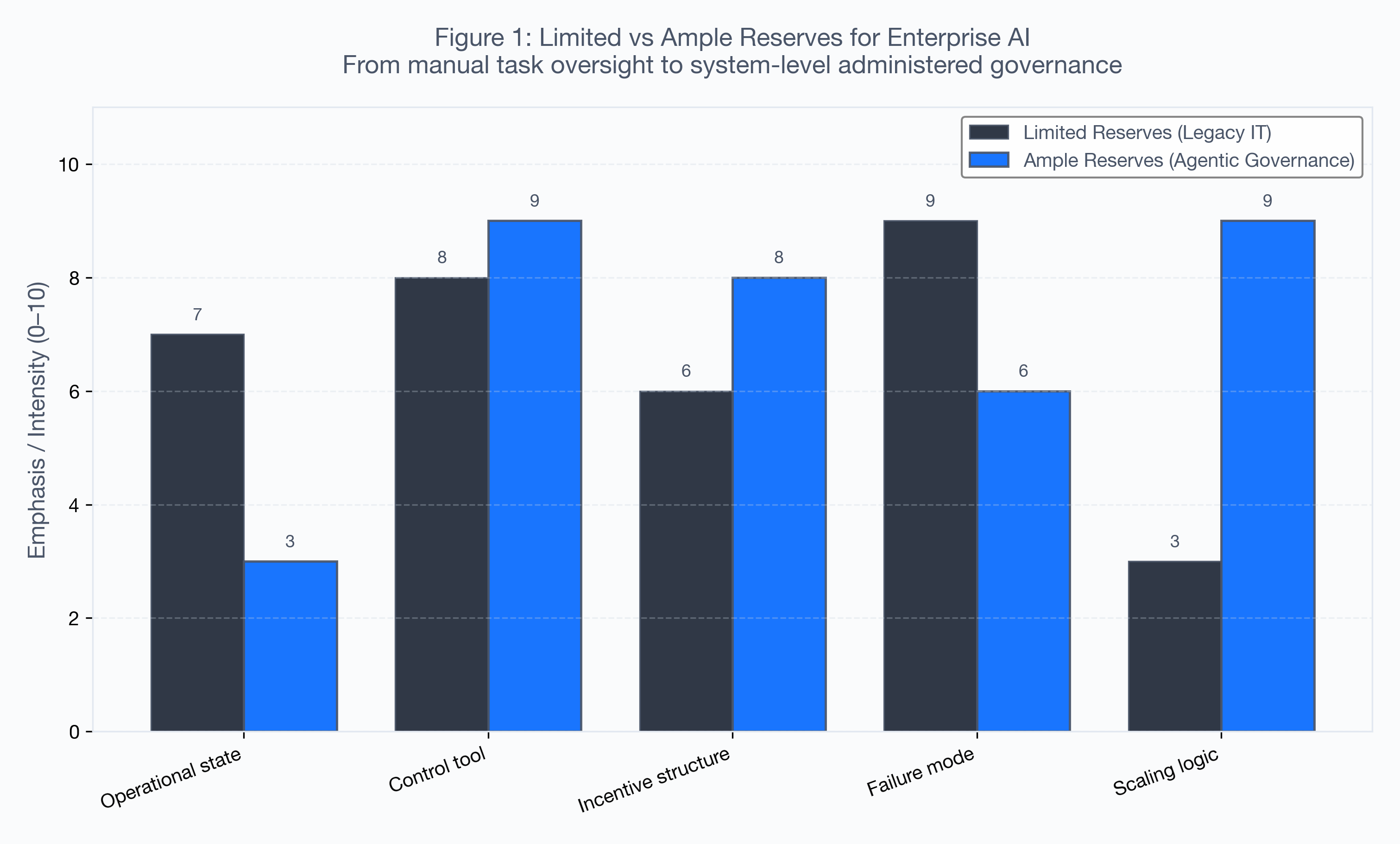
Figure 1: Limited vs Ample Reserves for Enterprise AI
Limited Reserves regimes lean heavily on quantity management and manual task oversight, while Ample Reserves regimes emphasize price/policy guardrails and system‑level scaling. The visual shows how moving to an administered floor system for AI governance shifts emphasis toward optimization, resilience, and exponential scaling logic.
2. The Floor System as a Blueprint for AI Governance
To appreciate what an Ample Reserves regime for AI looks like, we can map the Fed’s tools into enterprise governance levers.
Interest on Reserve Balances (IORB) → Reservation Quality
In the Floor System, the Interest on Reserve Balances (IORB) is the reservation rate—the minimum rate a bank is willing to accept when lending its funds. If it can earn 5% risk‑free by leaving reserves at the Fed, it has no incentive to lend at 4%. IORB thus creates a floor for the federal funds rate.
In AI governance, the analogue is a Standard of Autonomous Value:
Define a Reservation Quality threshold: the minimum accuracy, reliability, and ethical performance an agent must demonstrate to operate without a human‑in‑the‑loop.
If an agent’s reservation value falls below this standard, it is “pulled from the market”—downgraded from fully autonomous to human‑led or collaborative execution.
ON RRP → Compliance Floor
The Overnight Reverse Repurchase Agreement (ON RRP) facility extends the floor to a broader set of financial institutions, including those without direct access to IORB. It ensures that short‑term rates do not fall below the Fed’s target range, even under extreme liquidity.
For enterprises, the ON RRP plays the role of Compliance Floor:
It is the hard minimum standard every agent must meet, whether built in‑house or sourced from a vendor.
It covers data privacy, bias mitigation, and transparency requirements that cannot be traded away for speed or convenience.
Agents that cannot meet this floor are disqualified from production, regardless of their capabilities.
Discount Rate → Intervention Cost
The Discount Rate is the rate the Fed charges for borrowing through the discount window—a ceiling for the federal funds rate and a backstop during stress. In normal times, banks rarely use it, but it defines the cost of emergency liquidity.
In AI orchestration, this corresponds to the Resource Cost of Human Intervention:
The time, attention, and capital required when a human must step in to resolve ambiguity or remediate an agent failure.
In a healthy Ample Reserves regime, this intervention is rare but clearly priced: executives know when to step in and what it costs to do so.
Open Market Operations & Standing Repo → Compute/Data Fabric & Templates
Open Market Operations (OMO) and standing repo facilities maintain the overall level and usability of reserves. They are not about specific loans; they are about the infrastructure of liquidity.
In AI, the equivalents are:
A Workflow Data Fabric that provides zero‑copy, real‑time access to authoritative data sources across the business.
Standardized agent templates—pre‑vetted patterns for specific workflows (e.g., “collections agent,” “supply chain monitor,” “campaign optimizer”) that can be deployed quickly with known governance characteristics.
Table 2: From Federal Reserve Tools to AI Governance Levers
Fed Tool: IORB · Economic Function: Sets reservation rate for lending · AI Governance Lever: Reservation Quality · Operator Action: Define baseline performance required for autonomy; demote agents below it
Fed Tool: ON RRP · Economic Function: Provides a hard floor for broader money markets · AI Governance Lever: Compliance Floor · Operator Action: Set non‑negotiable ethical, privacy, and safety standards for all agents
Fed Tool: Discount Rate · Economic Function: Sets ceiling for emergency borrowing costs · AI Governance Lever: Intervention Cost · Operator Action: Make human overrides explicit, rare, and visibly costly
Fed Tool: Open Market Ops · Economic Function: Maintains ample level of reserves · AI Governance Lever: Compute/Data Fabric · Operator Action: Invest in reliable, low‑friction infrastructure powering all agents
Fed Tool: Standing Repo · Economic Function: Backstop for collateral and liquidity stress · AI Governance Lever: Standardized Templates · Operator Action: Maintain pre‑approved agent blueprints for rapid, safe scaling
The design principle is clear: stop governing at the transaction level and start governing at the rate and facility level.
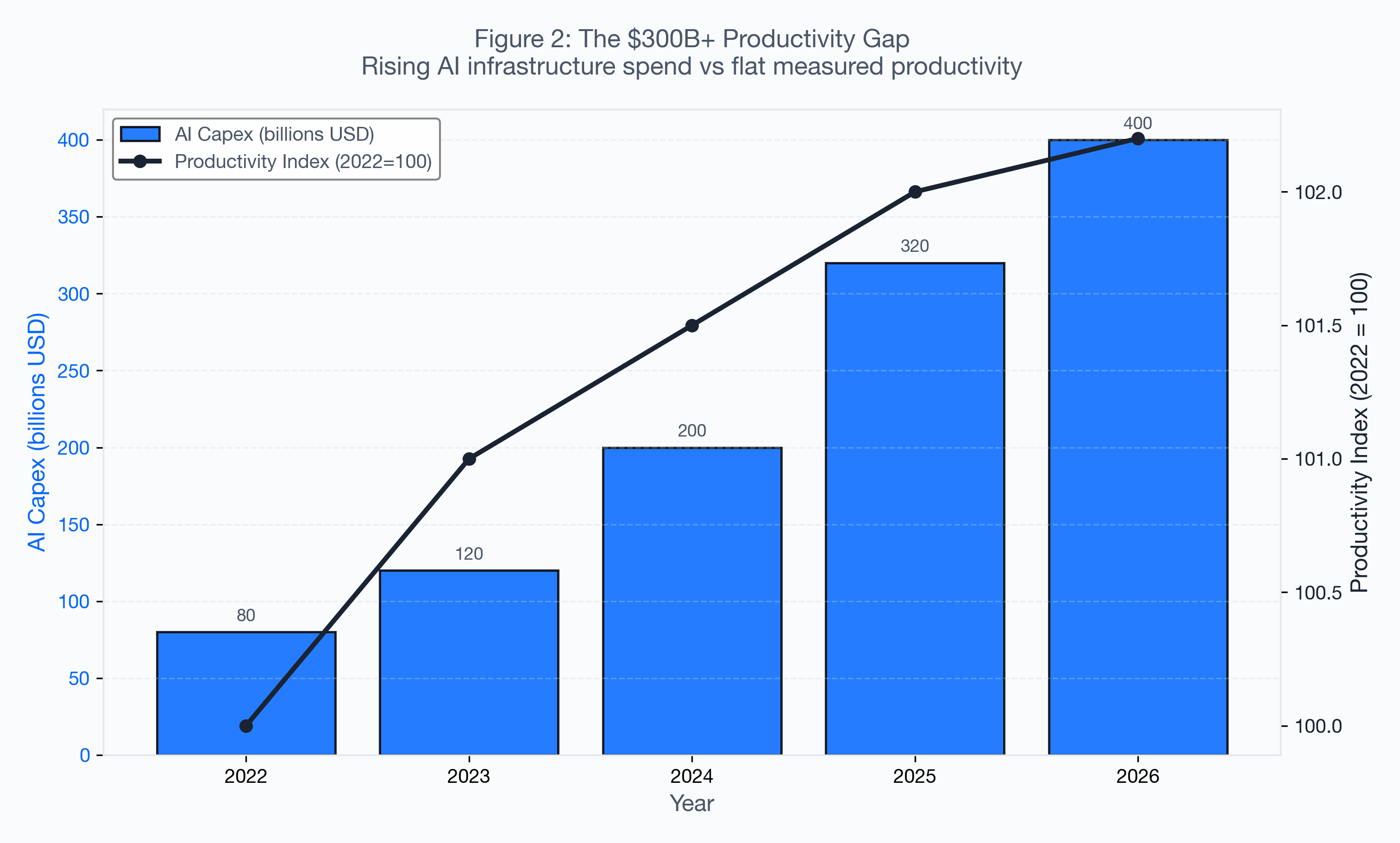
Figure 2: The $300B+ Productivity Gap
AI capital expenditure has grown sharply over the past several years, while measured productivity has barely moved. The divergence between the electric‑blue capex bars and the nearly flat deep‑navy productivity line illustrates the core paradox motivating an Ample Reserves governance shift: prediction capacity is abundant, but administered, causal decision architectures are still scarce.
3. The $300 Billion Productivity Gap: Prediction vs Causality
The move to Ample Reserves is not academic. It is driven by a stark economic fact: the current AI capex boom is not yielding proportional returns.
Recent analyses suggest:
Hyperscalers and large enterprises are committing $300–400B+ to AI infrastructure.
An NBER paper (2026) finds that around 90% of firms report no measurable productivity improvement from AI implementations.
This is a modern iteration of the Solow Paradox: we see AI everywhere except in the productivity statistics. The root cause: organizations are over‑invested in prediction and under‑invested in causality and orchestration.
The Commoditization of Prediction
Traditional AI models are prediction engines:
Next‑token prediction for language.
Churn likelihood for customers.
Failure probability for equipment.
As models, tooling, and infrastructure commoditize, access to high‑quality prediction becomes table stakes. Competitive advantage migrates from “Who has the best predictor?” to “Who can turn prediction into reliable prescription?”
The Data Science Escape Hatch: Causal Inference, Bayesian Reasoning, Domain Modeling
To escape the productivity gap, organizations need a Data Science Escape Hatch—a set of second‑order capabilities:
Causal Inference: Determine whether X actually causes Y, rather than merely correlating with it. Prediction without causality is often just an expensive way to watch things happen.
Bayesian Reasoning: Treat uncertainty honestly by updating beliefs as new evidence arrives. This avoids the Expertise Trap, where highly educated users become more confident in AI outputs without corresponding gains in accuracy.
Domain Modeling: Build explicit representations of the business’s latent structure—how products, customers, constraints, and incentives really interact—so agents do not misinterpret noise as signal.
Bayes’ rule is a useful mental model for updating beliefs under uncertainty [3][8]:
P(A | B) = P(B | A) · P(A) / P(B)
Applied well, it forces operators to:
Start from prior beliefs about the business (P(A)).
Ask how likely the evidence is if the hypothesis is true (P(B|A)).
Normalize against all the ways the evidence could arise (P(B)).
In an Ample Reserves regime [1][2], this logic is embedded in how agents are evaluated and allowed to act [3][4], not just in how models are trained.
4. Case Studies in Value‑Driven Orchestration
Michelin: The Disciplined Pursuit of ROI
The Michelin Group is often cited as an example of value‑driven orchestration at scale—public communications describe large portfolios of AI use cases and material ROI claims [9]. Treat vendor-reported ROI as illustrative unless you can reconcile it to audited figures; the operator lesson is the gatekeeping CoE pattern, not the headline euro amount.
Key practices:
A strong AI Center of Excellence (CoE) evaluates projects for ROI, scalability, and strategic relevance before they progress beyond proof‑of‑concept.
The CoE blocks “injected” projects driven purely by vendor hype or senior‑leader enthusiasm without clear value.
Michelin runs formal post‑deployment reviews to verify that promised value actually materializes and adjusts systems accordingly.
This is an Ample Reserves mindset: projects advance only if they justify their place in the administered system of agents, not just because they are technically interesting.
Vanguard: Scaling Small Efforts into Big Value
The Vanguard Group shows how small‑scale automations can be orchestrated into large aggregate gains—estimated at $500M in AI ROI:
Individual Productivity: tools for meeting transcription and briefing prep create a low‑risk sandbox where employees can safely experiment with AI.
Role‑Specific Integration: developers use AI coding assistants (driving 25% productivity gains), while call‑center agents get real‑time answer retrieval and suggested next actions.
Process Automation: marketing teams use AI to orchestrate multi‑channel campaigns; supply chain managers use conversational interfaces to identify inventory gaps and constraints.
Vanguard’s mantra is that “decentralization is not abdication”. Front‑line leaders can author local rules and workflows, but the executive team owns the global guardrails for security, intellectual property, and ethics—another form of administered rates.
MD Anderson: The Danger of the Moon Shot
By contrast, the MD Anderson “moon shot” project—a high‑profile effort to use cognitive technologies for cancer treatment—illustrates the risk of unanchored ambition. Despite years of work and significant spending, the program failed to deliver as promised.
The core issue was not only the technology; it was a misalignment between aspiration and administered capacity:
Governance frameworks, data infrastructure, and clinical integration were under‑specified relative to the ambition of the system.
The organization lacked an Ample Reserves–style foundation: clear reservation values, compliance floors, and backstops for failure.
The lesson is stark: even world‑class technology fails when deployed into a governance vacuum.
5. The Integration Wall and Workflow Data Fabric
Most agentic AI pilots do not fail because the models are weak. They fail because they slam into the Integration Wall:
Decades of technical debt: fragmented systems, brittle integrations, and undocumented workflows.
Inconsistent data taxonomies: customer, product, and asset definitions that differ across systems.
Legacy platforms that resist programmatic access or cannot expose real‑time data.
When agents cannot reliably access trusted ground truth, they require constant human intervention:
Humans become the “API glue” between systems, manually copying, reconciling, and interpreting data.
The supposed Ample Reserves regime collapses back into a Limited Reserves reality of approval queues and manual reconciliations.
The structural antidote is a Workflow Data Fabric:
Zero‑copy connectivity: agents operate on live data where it resides, rather than proliferating inconsistent copies.
Unified identity and entity models: shared definitions for customers, assets, and processes across the enterprise.
Context‑rich access: agents receive not just data, but metadata and policy context (e.g., who owns this record, what constraints apply, when human sign‑off is mandatory).
In an Ample Reserves regime, building this fabric is not an IT hygiene task; it is a core strategic investment, analogous to building out the pipes and plumbing of a modern financial system.
6. Macro Ripples of AI Abundance
The shift to an Ample Reserves framework for AI is part of a broader macro transition that central banks are already watching.
Structural Deflation and the Maintenance Economy
Some economists argue that advanced economies are bifurcating into:
A Maintenance Economy (healthcare, government services, compliance‑heavy sectors) that is relatively insensitive to interest rates and slow to adopt automation.
A Growth Economy (technology, high‑growth services) that is highly sensitive to rates and can adopt AI and automation quickly.
Agentic AI exerts a structural deflationary force in the Growth Economy:
It reduces the marginal labor required for many services.
It compresses coordination costs and transaction frictions.
It creates value that traditional GDP metrics, focused on measured exchange, often undercount.
Central banks like the Bundesbank and Bank of Japan are beginning to consider how AI affects the natural rate of interest, inflation dynamics, and the interpretation of productivity data.
The Risk of Model Monoculture
Another emerging risk is Model Monoculture:
Large institutions converge on similar AI models and strategies for credit risk, trading, portfolio management, or operational optimization.
In a stress scenario, synchronized model behavior can amplify volatility—for example, by triggering simultaneous asset sell‑offs or identical hedging behaviors.
This is analogous to herding in traditional finance but with algorithmic speed and scale. For enterprise operators, it implies:
A need for model diversification and scenario testing.
Governance that considers system‑level behavior, not just individual agent performance.
The Counterargument
The central banking analogy is powerful, but it has limits.
First, experimentation still matters. Many organizations are in learning mode; small, prediction‑oriented pilots can surface opportunities, teach teams how to work with AI, and build internal champions. Not every use case requires a full Ample Reserves regime from day one.
Second, over‑governance is its own risk. If the reservation value is set too high or the compliance floor too rigid, organizations may:
Stall experimentation.
Drive shadow AI usage outside official channels.
Miss emergent opportunities where “good enough” autonomy would have been acceptable.
Third, central banks operate in a domain where objectives (inflation, employment, financial stability) are relatively well specified. Enterprises face messier, multi‑objective landscapes:
Short‑term profit vs long‑term resilience.
Efficiency vs learning.
Automation vs talent development.
The analogy should thus be used as a design pattern, not a doctrine. The goal is not to reproduce the Fed inside your org, but to borrow the idea of administered floors and backstops for a domain where intelligence—not liquidity—is the abundant resource.
The Implications
1. Redefining Human Value: The EPOCH Capabilities
As agents increasingly handle the Maintenance Economy of work—data entry, basic analysis, routine coordination—the center of human value shifts. MIT Sloan researchers describe a cluster of capabilities under the acronym EPOCH:
Experience: the intuitive sense built from years inside specific industry dynamics.
Perspective: the ability to view problems through ethical, social, and long‑term strategic lenses.
Ownership: true accountability for outcomes, which still resides with human actors.
Context: awareness of the unwritten rules, power structures, and culture that shape how decisions actually land.
History: institutional memory that relates today’s challenges to prior crises, bets, and recoveries.
Jobs that are rich in EPOCH content have seen higher growth and resilience than roles built primarily around tasks vulnerable to automation. In an Ample Reserves regime, these capabilities become the scarce, high‑leverage resource that operators must cultivate.
2. Managing Brain Fry and Knowledge Loss
An agentic enterprise faces two intertwined risks:
Brain Fry: cognitive overload from the Explosion of Options—every simple decision now arrives with ten AI‑generated variants that need triage.
Knowledge Loss: early‑career employees over‑rely on AI to draft, analyze, or decide, and never build the “critical thinking muscles” required for future leadership.
Operators should design workflows that:
Constrain option sets: ask agents to return fewer, better options with clear trade‑offs, not sprawling menus.
Stage autonomy by seniority: junior employees may get AI support for drafting but must also complete manual reps that build core skills.
Log reasoning: capture both agent and human rationale for key decisions to build an institutional library of “how we think.”
3. Governing Autonomous AI: The Hierarchy of Backstops
Just as the Floor System relies on a hierarchy of rates and facilities, an Ample Reserves regime for AI relies on a hierarchy of Backstops.
Table 3: Hierarchy of AI Backstops in an Ample Reserves Regime
Tier: 1 · Backstop: Administered Rates · Function: Set reservation values for agents · Operator Responsibility: Define standard metrics and thresholds for autonomous behavior
Tier: 2 · Backstop: Standing Facilities · Function: Maintain pre‑vetted agent templates and workflows · Operator Responsibility: Curate an inventory of secure, approved “agentic templates”
Tier: 3 · Backstop: Control Tower · Function: Provide real‑time observability of agent behavior · Operator Responsibility: Implement monitoring, alerts, and dashboards for drift/bias
Tier: 4 · Backstop: Human Override · Function: Offer final accountability and intervention paths · Operator Responsibility: Define red lines where human approval is mandatory
Practical implications:
Tier 1: decide where you allow full autonomy vs assisted or human‑led modes.
Tier 2: standardize patterns (e.g., for customer service, collections, monitoring) so each new deployment does not reinvent governance from scratch.
Tier 3: build “control tower” views that show where agents are acting, what tools they are using, and where they are near policy boundaries.
Tier 4: make human override pathways explicit and auditable, not ad hoc.
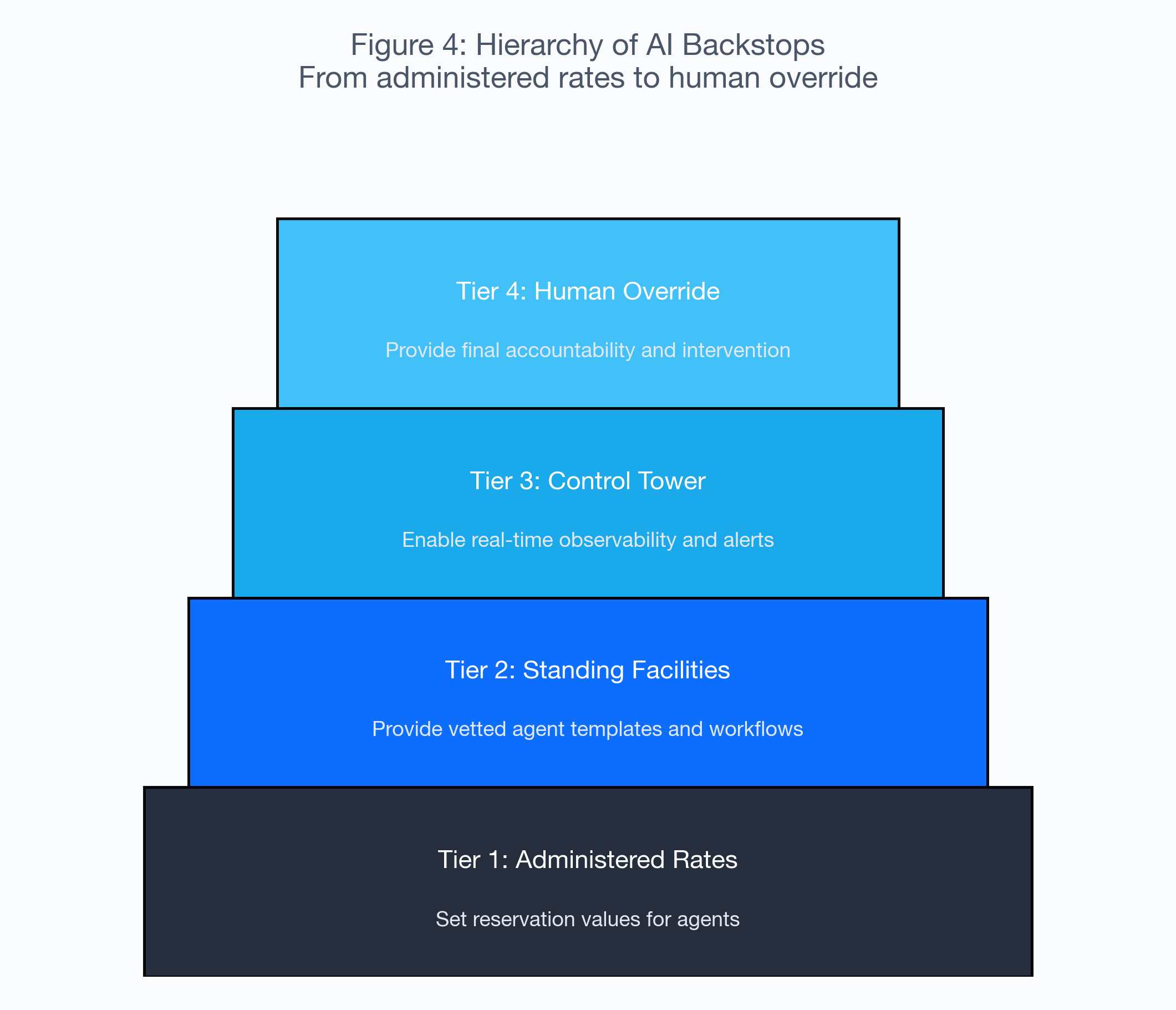
Figure 4: Hierarchy of AI Backstops
A four‑layer stack shows how administered rates at the base support standing facilities, a real‑time control tower, and finally human override at the top. As you move up the stack, the number of interventions shrinks but their consequence grows, reinforcing why clear thresholds and responsibilities at each tier are essential to a resilient Ample Reserves regime.
4. Building the Scaffolding: Data, Architecture, and Guardrails
An Ample Reserves regime depends on scaffolding:
Data quality over model novelty: proprietary, well‑governed data and trusted context will differentiate outcomes more than marginal model improvements.
Architectural readiness: APIs, event streams, and permission models that make it easy for agents to act safely.
Policy‑as‑code: express reservation values, compliance floors, and red lines in machine‑readable form so they can be enforced automatically.
This is where many AI programs stumble. They treat architecture and data as background IT concerns rather than the primary levers of administered intelligence.
5. Actionable Recommendations for Enterprise Leaders
To transition from a Limited to an Ample Reserves regime for AI, leaders can follow a staged roadmap:
Stop Tinkering, Start Orchestrating
Move beyond a portfolio of disconnected pilots. Select a single, well‑defined, overarching objective (e.g., “days‑sales‑outstanding reduction,” “first‑contact resolution,” “supply chain uptime”) and make it the guiding principle for AI adoption.
Establish Your Administered Rates
Define a Reservation Value for each autonomous process. If an agent cannot meet this threshold, it operates in a collaborative or manual mode. Make the Compliance Floor explicit and non‑negotiable.
Build the Scaffolding First
Invest in the Workflow Data Fabric, identity models, and policy‑as‑code infrastructure. Differentiation in an age of abundant AI comes from trusted context, not just clever prompts.
Invest in EPOCH Capabilities
Re‑orient learning and development around Experience, Perspective, Ownership, Context, and History. Design roles where humans are responsible for setting rules, curating intent, and adjudicating trade‑offs, not just pressing “run.”
Democratize through “Vibe Analytics”
Provide conversational interfaces that let non‑technical leaders interrogate data, test hypotheses, and see causal narratives—not just dashboards. This reduces translation lag and accelerates decision cycles.
Monitor for Brain Fry
Avoid mandating AI usage everywhere by default. Design workloads that absorb complexity on behalf of humans rather than exporting it as cognitive overhead.
Table 4: AI Ample Reserves Transformation Roadmap
Phase: Phase I · Maturity Level: Envision · Key Milestone: Data audit & ethics framework · Governance Focus: Align AI with core business needs and risk appetite
Phase: Phase II · Maturity Level: Pilot · Key Milestone: ROI‑positive, scoped pilots · Governance Focus: Avoid “moon shots”; prove value with clear guardrails
Phase: Phase III · Maturity Level: Engineer · Key Milestone: Zero‑copy workflow data fabric · Governance Focus: Build the scaffolding for safe, repeatable autonomy
Phase: Phase IV · Maturity Level: Expand · Key Milestone: Autonomous “decision factory” at scale · Governance Focus: Run a Floor System–style regime of administered AI
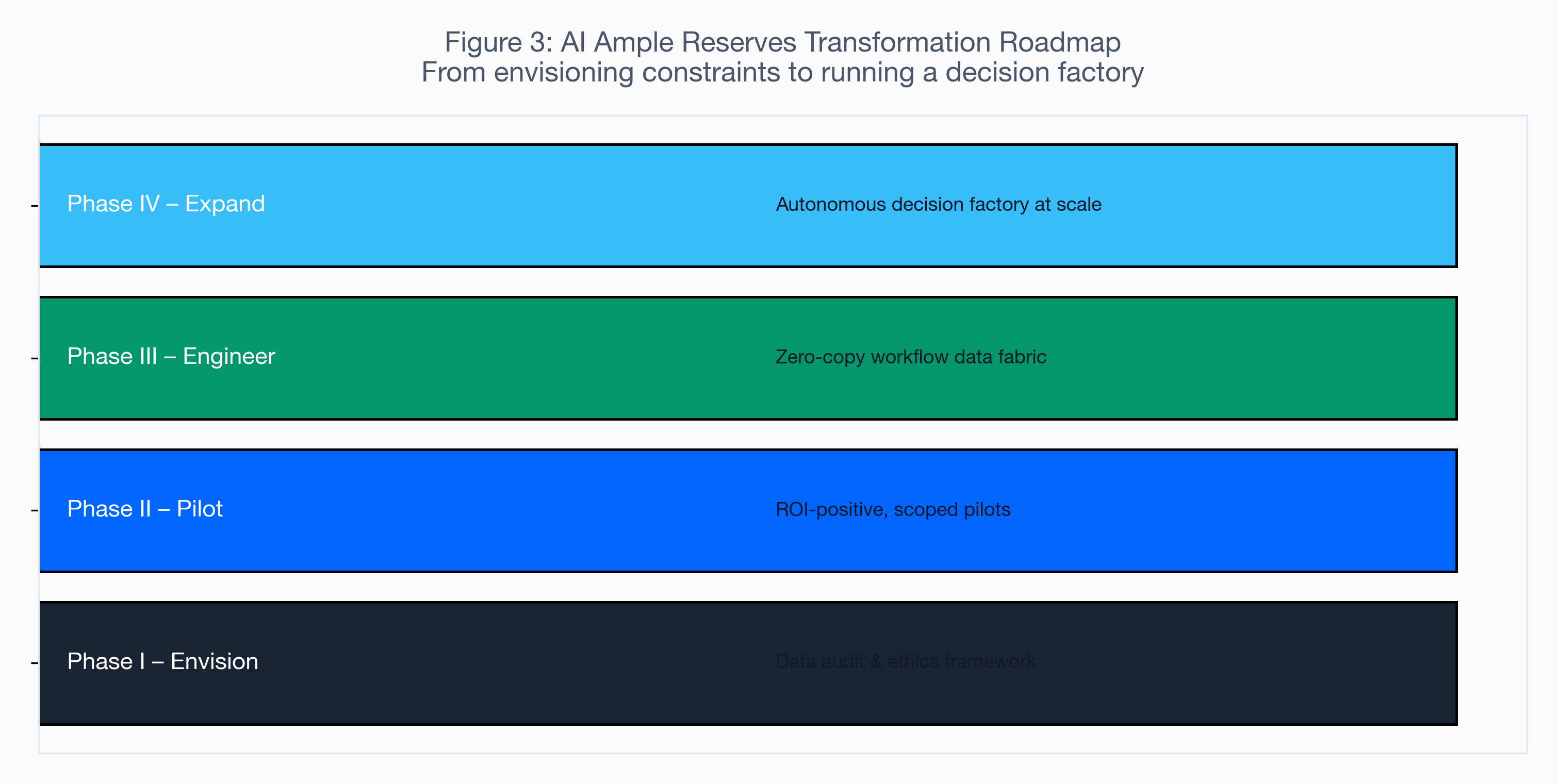
Figure 3: AI Ample Reserves Transformation Roadmap
The roadmap moves from Phase I (Envision) through Phase IV (Expand), showing how organizations progress from ethics‑anchored audits to a full decision factory. Each bar encodes the phase label and key milestone, emphasizing that administered governance capacity—not just model sophistication—determines how far along the curve an enterprise can safely move.
Conclusion
The shift from Limited Reserves to Ample Reserves is the defining management challenge of the agentic era. For over a century, management has meant manual oversight: controlling labor and resources one decision, one project, one tool at a time. That model cannot survive in a world where intelligence is effectively environmental—embedded in our tools, workflows, and infrastructure like electricity.
By learning from the Federal Reserve’s Floor System, leaders can design organizations that are both autonomous and stable:
Agents operate with real freedom inside clearly administered bounds.
Guardrails, not micro‑approvals, keep the system aligned with strategy and ethics.
Human judgment is elevated from task supervision to rule‑setting and intent curation.
The resilience of the modern enterprise will not be measured by the raw power of its models but by the strength of its guardrails and the clarity of its administered rates. In an age of agentic abundance, trust becomes the ultimate differentiator: trust that agents will act within bounds, trust that backstops will engage when needed, and trust that the system as a whole will deliver more than the sum of its parts.
This is the promise of Administered Intelligence: a world where we do not merely deploy smarter tools, but govern an intelligent system with the same rigor that central banks bring to liquidity. The enterprises that embrace this shift will be the ones that finally reconcile the AI capex boom with real, measurable prosperity.
Key Takeaways
From tools to systems: AI has moved from discrete tools to agentic systems. Governance must move from task supervision to system‑level administration.
Ample Reserves for AI: Just as the Fed shifted to a Floor System in an environment of ample reserves, enterprises must adopt Ample Reserves–style governance for abundant agentic capacity.
Prediction is not enough: Commodity prediction must be coupled with causal inference, Bayesian reasoning, and domain modeling to close the productivity gap.
EPOCH as the scarce asset: Experience, Perspective, Ownership, Context, and History become the defining human differentiators in an agentic economy.
Guardrails over micromanagement: Administered rates, compliance floors, workflow fabrics, and hierarchical backstops enable bounded autonomy at scale.
Trust as differentiator: The strength of your guardrails and the clarity of your administered intelligence—more than your models alone—will determine whether AI capex turns into real productivity.
References
Board of Governors of the Federal Reserve System. Monetary Policy Implementation / reserve balances. https://www.federalreserve.gov/monetarypolicy/reserve-balances.htm
Federal Reserve Bank of New York. Monetary Policy Implementation: Ample Reserves. https://www.newyorkfed.org/markets/domestic-market-operations
National Institute of Standards and Technology. (2023). Artificial Intelligence Risk Management Framework (AI RMF 1.0). https://www.nist.gov/itl/ai-risk-management-framework
Board of Governors of the Federal Reserve System. (2011). SR 11-7: Guidance on Model Risk Management. https://www.federalreserve.gov/supervisionreg/srletters/sr1107.htm
European Union. (2024). Regulation (EU) 2024/1689 (AI Act). https://eur-lex.europa.eu/eli/reg/2024/1689/oj
International Monetary Fund. (2024). Gen-AI: Artificial Intelligence and the Future of Work (Staff Discussion Note). https://www.imf.org/en/Publications/Staff-Discussion-Notes/Issues/2024/01/14/Gen-AI-Artificial-Intelligence-and-the-Future-of-Work-542379
Anthropic. (2024). Building effective agents. https://www.anthropic.com/research/building-effective-agents
Ransbotham, S., et al. (2024). Learning to Manage Uncertainty, With AI. MIT Sloan Management Review. https://sloanreview.mit.edu/projects/learning-to-manage-uncertainty-with-ai/
Michelin Group. Public sustainability / AI deployment reporting. https://www.michelin.com/
National Institute of Standards and Technology. (2023). AI RMF Manage function (ongoing monitoring). https://www.nist.gov/itl/ai-risk-management-framework
Learn Next
The Fed's Floor System — ample-reserves operators framing
Human-on-the-Loop Runbook — escalation when agents act
This article synthesizes public information about central banking frameworks, AI adoption, and productivity research. The statistics and comparisons presented are based on publicly available data from central banks, academic research, and industry reports. The frameworks and strategic recommendations are designed to be actionable for operators building production AI systems. Real‑world applications require adjustment for domain‑specific dynamics, regulatory constraints, and organizational context. The concepts here should be treated as a foundation for more detailed governance design tailored to specific agentic AI deployments.
Editorial transparency. Essays at The AI Operator may use AI-assisted research, drafting, and editing tools under staff editorial review. Facts, figures, and recommendations are checked before publication; we correct the record when evidence changes. Questions: hello@theaioperator.net.
Published on [Substack](https://theaioperator.net/p/governing-agentic-horizon).