

Watch
Also on our YouTube channel.
Executive Summary
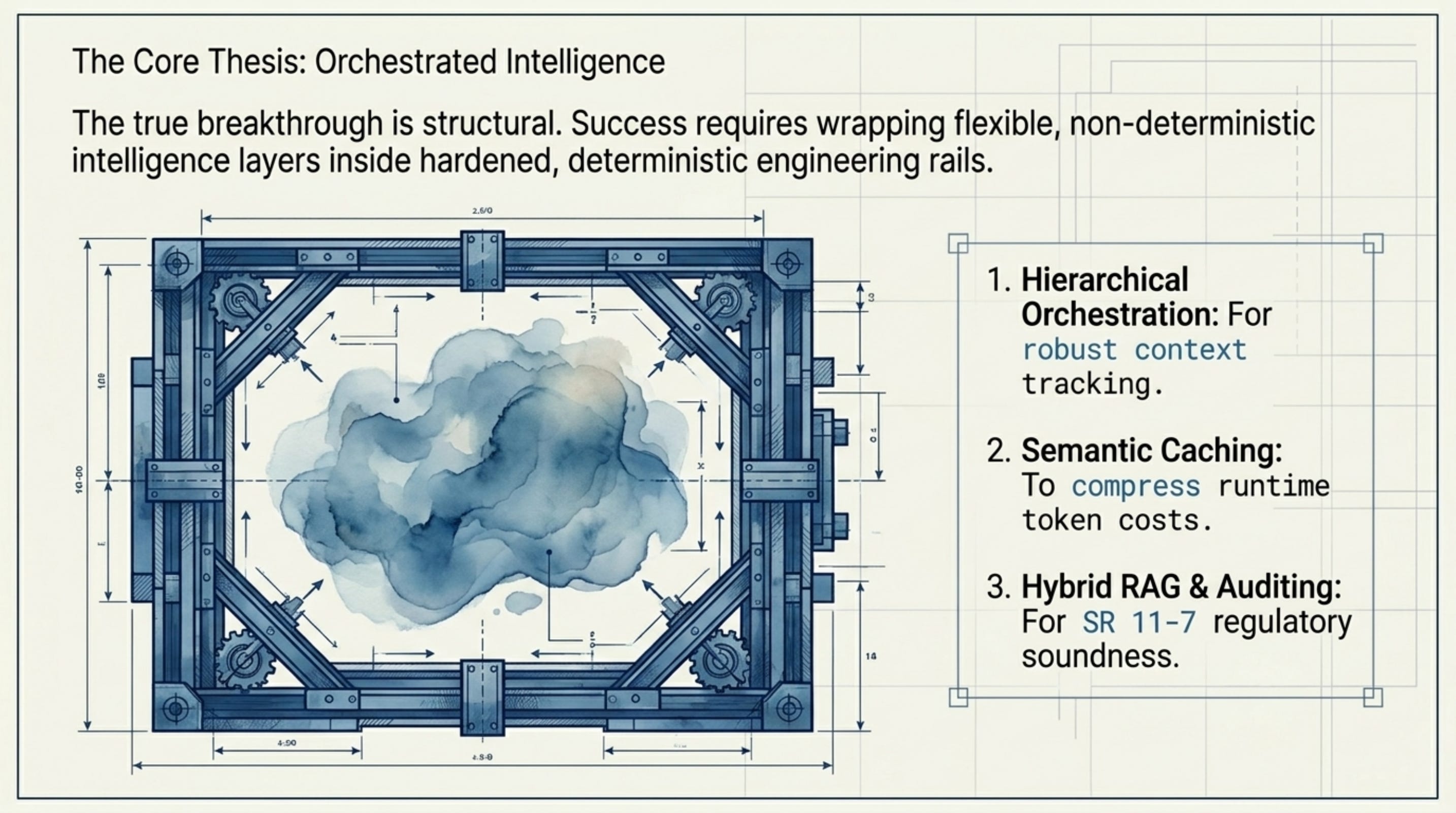
The headline is not headcount. Klarna's customer-AI program is best understood as a deterministic multi-agent stack—intent routing, domain experts, Redis-backed state, and hybrid RAG—wrapped in guardrails that fail closed before a frontier model speaks to a customer [1][2].
Regulated scale requires a cage, not a copilot. Context injection with negative constraints, Agentic Validation Suites in CI/CD, real-time DLP, HITL overrides, and a regulatory mapping matrix (SR 11-7, EU AI Act) form the audit-survivable layer executives should demand [3][4][5].
Cost discipline is architectural. Semantic caching and lightweight routing models for Tier-1 queries cut latency and token spend; autonomy expands only where validation suites and human gates already pass in production [1][6].
At a Glance
Who this is for: Board members, risk committees, and operators evaluating agentic customer service in payments, lending, or BNPL—not engineers comparing LLM benchmarks.
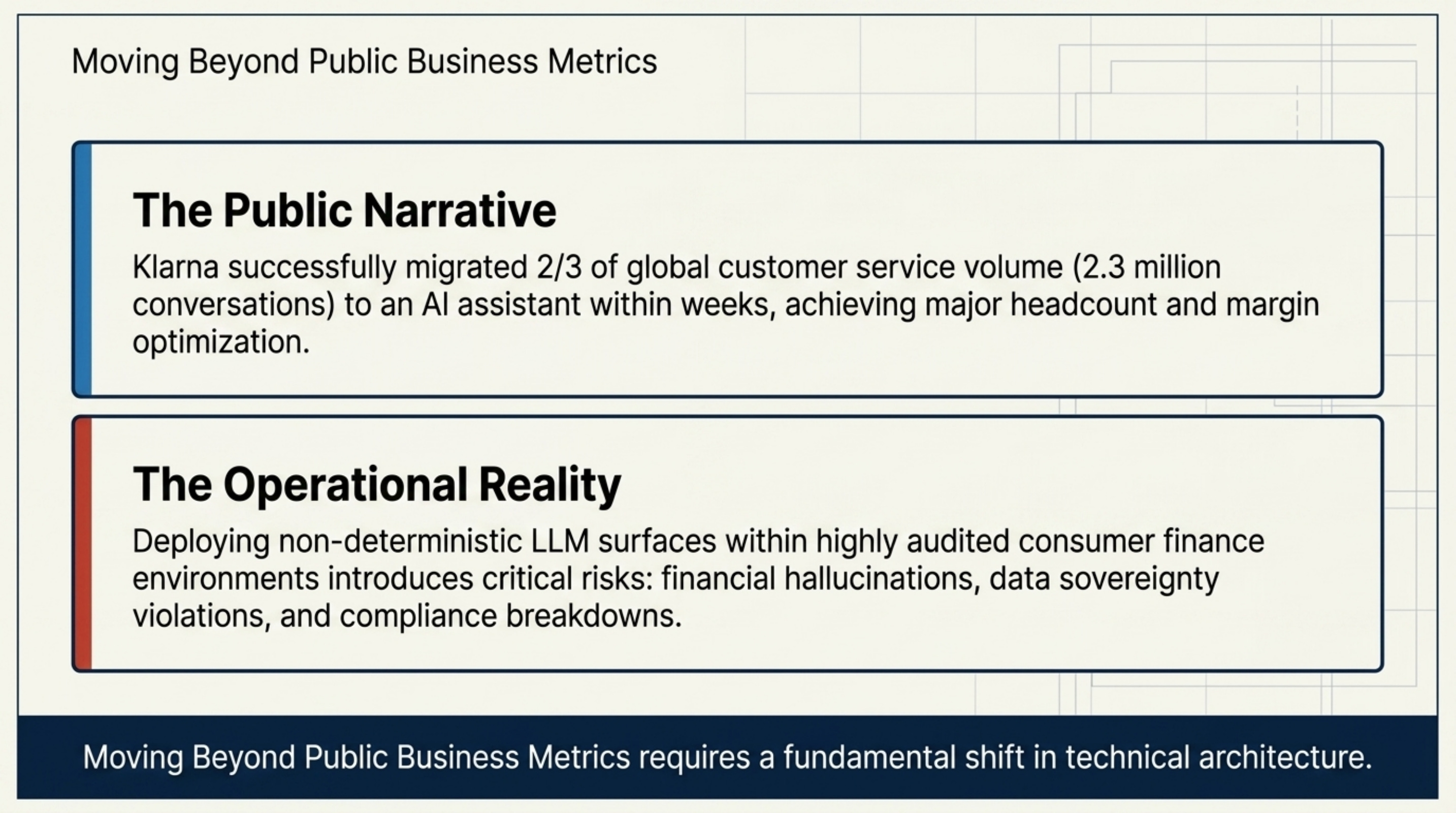
Klarna's public narrative emphasizes volume: an AI assistant handling a large share of customer service chats within months of launch [2]. The operator question is not whether chatbots answer faster—it is whether millions of regulated conversations can run without silent ledger errors, PII leakage, or unowned model drift.
This case log extracts the technical architecture and risk case from our Klarna AI Disruption notebook [1]. It complements The production loop agents and ML share (shared verify loop) and Human-on-the-loop runbook (escalation tiers)—it does not re-teach generic governance metaphors from Governing the agentic horizon.
Dimension: Architecture · Operator takeaway: Hierarchical orchestration: router → domain agents → tools grounded in live ledger data
Dimension: Risk · Operator takeaway: Deterministic cage: schema, validation suites, DLP, HITL, regulatory matrix
Dimension: Economics · Operator takeaway: Semantic cache + model routing before frontier inference
Dimension: Executive mistake · Operator takeaway: Funding autonomy from press releases without control architecture
The Scale Bet—and Why Architecture Matters
In early 2024 Klarna positioned an OpenAI-powered assistant as a step-change in customer service efficiency—two-thirds of chats handled by AI in its first month, with implications for handle time and staffing mix [2][7]. Markets rewarded the narrative; operators should reward the control story underneath.
The notebook deck frames a structural shift: moving from business-metric demos to production-grade orchestration where every customer-facing action passes through typed state, authorized tools, and replayable logs [1]. That shift mirrors what we observe across regulated fintech: the failure mode is not "bad answers" alone—it is ungrounded numbers (balances, due dates, dispute statuses) presented with conversational confidence [8].
Composite vignette: A BNPL operator deploys a single general-purpose agent to "handle Tier-1." Dispute workflows cite stale balance snapshots pulled from parametric memory; complaints spike; model risk asks for an inventory of prompts that never existed as versioned artifacts. Klarna's pattern instead routes intents to domain-specific expert models—disputes, balance checks, payment rescheduling—each with narrower tool schemas and rehydrated session state from Redis [1]. Illustrative composite grounded in deck architecture.
lightweight intent routing to domain expert agents with Redis-backed state—not one monolithic assistant [1][12].
The Deterministic Stack
Notebook synthesis describes a hierarchical multi-agent system rather than one monolithic assistant [1][12]:
Intent routing layer — A lightweight model extracts metadata and routes to the correct worker. The strategic point: use a mini model for classification and handoff, not a frontier model for every turn [1].
Domain expert agents — Disputes, balance checks, and payment rescheduling run as separate workers with procedural prompts aligned to legal and ledger rules [1].
State management — Strongly typed JSON schemas in a Redis cluster; stateless worker prompts rehydrated each turn from verified system state [1].
Hybrid RAG — Dynamic injection of ledger-grounded facts; explicit rejection of parametric memory for account-specific numbers [1][8].
This is the same production loop operators already use elsewhere—gather → act → verify → repeat [6]—with fintech-specific gather (live ledger snapshots) and verify (schema + validation suites before customer-visible replies).
Customer message
 → Intent router (mini model)
 → Domain expert agent (rehydrated state)
 → Tool call (authorized endpoint only)
 → validate_pre (schema + DLP)
 → Customer reply OR human_gate
 → ledger_log (workflow_id, policy_version)
Link technical gates to organizational runbooks: when human_gate fires, Human-on-the-loop T1–T3 ownership should already be named—not invented during the incident [9].
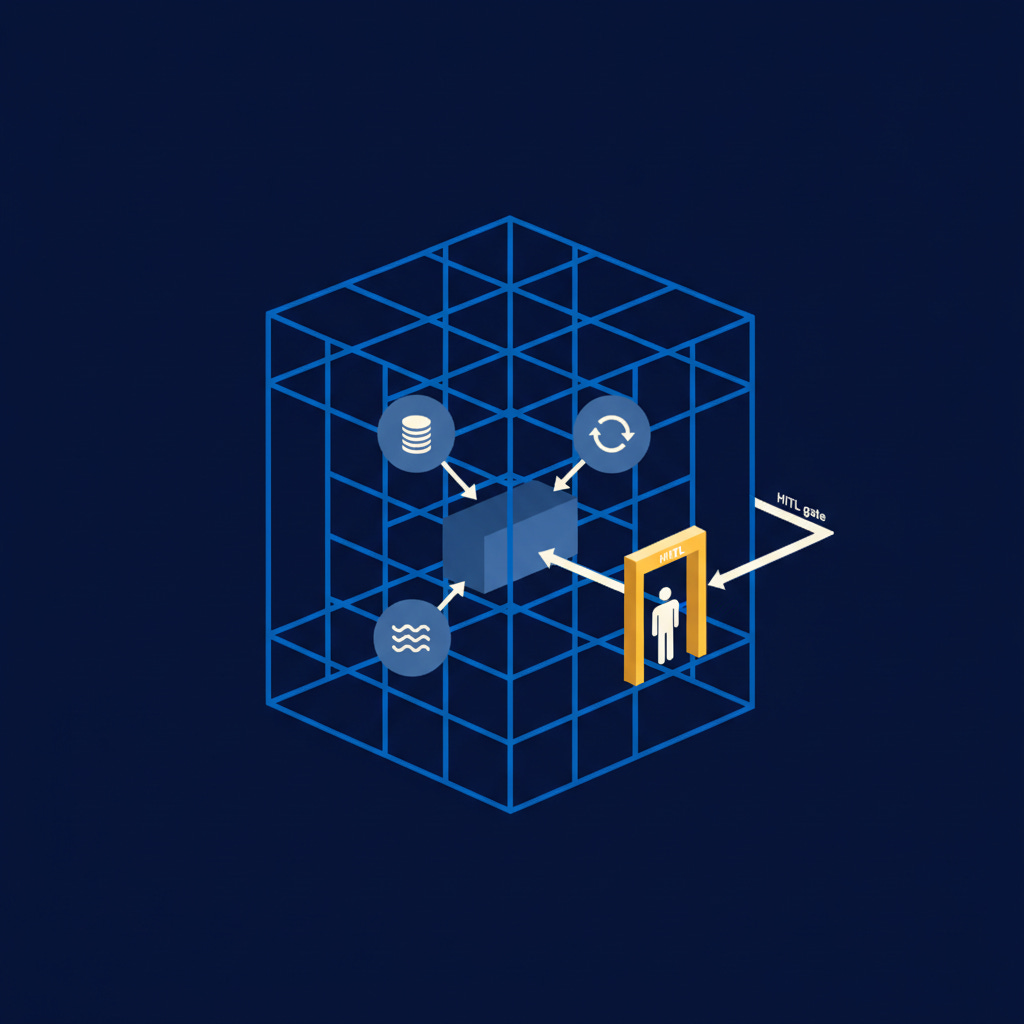
context injection, validation suites, DLP, and HITL gates before customer-visible replies [1][12].
What the headlines miss
Press cycles oscillate between automation triumph and quality retreat—Klarna itself later emphasized re-hiring human expertise for complex cases even as AI volume remained high [2][7]. Operators should treat that oscillation as predictable: unconstrained autonomy creates brand and conduct risk; deterministic cages let you dial human share without rewiring the stack.
Three questions for your next AI steering committee:
Can we replay a session? Redis-backed typed state plus
workflow_idlogging is the difference between root-cause analysis and anecdote [1][6].Can we prove grounding? Hybrid RAG with dynamic ledger injection beats parametric recall for balances and dates [1][8].
Can we fail closed? If validation suites or DLP fail, the customer should see a queue handoff—not a confident wrong answer [1][12].
Guardrails That Survive Audit
NotebookLM chat synthesis and the Architectural Design Blueprint report align on five guardrail classes executives can map to audit committee questions [1][12]:
Guardrail: Context injection + negative constraints · What it does: Schema-enforced prompts; explicit "must not" rules in system context · Audit question: Show prompt/version registry and change control
Guardrail: Agentic Validation Suites · What it does: CI/CD tests for tool correctness and argument correctness · Audit question: Which releases shipped without suite pass?
Guardrail: Real-time DLP · What it does: Regex + NER scrub of Tax IDs, card numbers, account numbers before vendor APIs · Audit question: Prove PII never leaves boundary in sample sessions
Guardrail: HITL override · What it does: Hard stop + session dump on adversarial prompts or vulnerability signals · Audit question: Who is paged, SLA, and rollback path?
Guardrail: Regulatory mapping matrix · What it does: SR 11-7 conceptual soundness; EU AI Act high-risk documentation [4][5] · Audit question: Where is the model inventory and owner map?
Operator rule: Treat LLM fluency as untrusted output until rules pass. This is the same verify hierarchy we document for coding harnesses—rules first, human judgment at the boundary [10].
The EU AI Act and SR 11-7 do not replace engineering controls—they require traceable ownership of who validated conceptual soundness and ongoing performance [4][5]. Pair this case with Board-ready AI metrics when translating guardrails into monthly board tiles [11].
Cost vs Autonomy
Financial engineering in the deck is not FinOps theater—it is routing policy [1]:
Semantic caching serves repeated Tier-1 queries from memory—sub-50ms responses and zero tokens on cache hits in the notebook's production pattern [1].
Dynamic model routing sends classification and routing to smaller models; frontier inference reserved for ambiguous or high-stakes paths [1].
Autonomy tiers should expand only when validation correlation and incident rates justify them—see eval-to-incident patterns in board metrics [11].
Before approving the next headcount reduction target tied to AI, ask finance and model risk to joint-sign a $/meaningful-decision trajectory and a rollback drill tied to policy_version [6][11]. The MCP Tax applies when tool sprawl outruns integration governance—Klarna's pattern constrains tools per domain agent instead [10].
Semantic cache as board language
Directors understand cache hit rate and cost per resolved conversation better than parameter counts. The notebook's production pattern claims sub-50ms responses and zero frontier tokens on cached Tier-1 intents [1]. Even if your baseline differs, the governance move is the same: treat cache and router policies as approved model-risk artifacts, not engineering trivia—SR 11-7 expects conceptual soundness documentation for material models and, increasingly, for the systems that route among them [3][4].
When cache misses spike—new product launch, regulatory FAQ changes, attack traffic—your incident response should adjust routing thresholds before you retrain prompts. That is the same production loop discipline as ML drift: detect, gate, rollback, then improve [6][11].
Board framing: Pair cache and router metrics with Board-ready AI metrics tile #2 ($/meaningful decision) so finance and model risk review the same chart [11].
What Executives Should Ask Monday
Draw the router. Where is intent classification separated from customer-facing generation?
Inventory ground truth. Which fields are ever read from parametric memory vs ledger/API injection?
Show validation in CI. Paste the latest Agentic Validation Suite run blocking a release.
Run a HITL fire drill. Trigger an adversarial prompt; measure time-to-human and log completeness.
Map regulations. One-page matrix: SR 11-7 owner, EU AI Act classification, DLP evidence.
Price the cache. What percentage of Tier-1 volume is served without frontier tokens?
Learn Next
For implementation patterns: Operator production loop · Fintech model risk interface · Eval pays rent.
Key Takeaways
Deterministic cage beats autonomy hype in regulated customer AI—architecture is the product.
Multi-agent is an org design choice: routers, domain experts, typed state, and narrow tools—not one chat window.
Guardrails are programmable: validation suites and DLP belong in CI/CD, not slide footnotes.
Executives fund controls first, headcount narratives second—audit committees will ask for evidence anyway.
References
The AI Operator / NotebookLM. (2026). Klarna AI disruption deck — Klarna AI Disruption notebook (
658aeb9b-7554-49ac-a107-3b66c8ea4b9a). https://notebooklm.google.com/notebook/658aeb9b-7554-49ac-a107-3b66c8ea4b9aKlarna. (2024). Klarna AI assistant handles two-thirds of customer service chats. https://www.klarna.com/international/press/klarna-ai-assistant-handles-two-thirds-of-customer-service-chats/
Board of Governors of the Federal Reserve System. (2011). SR 11-7: Guidance on Model Risk Management. https://www.federalreserve.gov/supervisionreg/srletters/sr1107.htm
European Union. (2024). Artificial Intelligence Act. https://artificialintelligenceact.eu/
National Institute of Standards and Technology. (2023). AI Risk Management Framework. https://www.nist.gov/itl/ai-risk-management-framework
The AI Operator. The production loop agents and ML share. https://www.theaioperator.net/articles/operator-production-loop-agents-ml
OpenAI. Klarna. https://openai.com/index/klarna/
The AI Operator. Fintech model risk interface. https://www.theaioperator.net/articles/fintech-model-risk-interface
The AI Operator. Human-on-the-loop runbook. https://www.theaioperator.net/articles/human-on-the-loop-runbook
The AI Operator. The MCP Tax. https://www.theaioperator.net/articles/mcp-integration-tax
The AI Operator. Board-ready AI metrics. https://www.theaioperator.net/articles/board-ready-ai-metrics
Google NotebookLM Studio. (2026). Architectural Design Blueprint: Deterministic Multi-Agent Orchestration for Regulated Environments — artifact in Klarna notebook.
Monday Morning Checklist
[ ] Name the intent router owner and domain agent owners on one slide.
[ ] Block any production prompt change without
policy_versionbump and validation suite pass.[ ] Sample 20 sessions: confirm ledger fields were injected, not recalled from parametric memory.
[ ] Schedule quarterly HITL override drill with CISO and customer ops present.
[ ] Add Klarna-pattern guardrail matrix as appendix to next AI risk committee pack.
[ ] Watch the learning-package video for board pre-read (email unlock on site).
Editorial transparency. Essays at The AI Operator may use AI-assisted research, drafting, and editing tools under staff editorial review. Facts, figures, and recommendations are checked before publication; we correct the record when evidence changes. Questions: hello@theaioperator.net.
Published on [Substack](https://theaioperator2.substack.com/p/klarna-deterministic-ai-case-log).