
The Rise of the Vertical Practitioner
The vertical practitioner at the intersection of strategy and execution—where dual-domain mastery turns silo friction into sovereignty.

Executive Summary
Why the translator model is failing in the age of AI—and how Pi-shaped leaders close the silo friction gap with dual-domain mastery.
The Argument
A critical leadership failure has emerged: the translation bottleneck. For decades, the T-shaped professional—one deep skill plus broad soft skills—was the gold standard. But in an era where strategic speed is dictated by technical architecture, translation is a tax on speed. Committees and consultants add latency; the launch window closes.
The modern C-suite requires vertical practitioners: Pi-shaped leaders with dual-domain mastery who bridge strategy and execution natively. They don't translate—they intervene. This is a leadership model, not just a skills profile. For senior leaders, the stakes are structural: the ability to fix the bridge (or to convene while it stays broken) determines how fast your organization can move.
This article examines the evidence (resolution time, friction cost), the I→Pi evolution, how to select complementary pillars, and a practical roadmap for dual-depth leadership—plus how organizations can adapt (hiring, development, structure, rewards) and why checks and balances need to stay in mind so sovereignty remains accountable.
The Context
The Silo Gap: A Tuesday Morning Crisis
Imagine it's Tuesday morning. You're the CEO of a fast-growing consumer brand. Your massive summer launch—the one promised to shareholders—has just been paused indefinitely.
The reason isn't talent; it's structural integration. Marketing built a data-driven campaign that the Data Privacy Officer says violates regional laws. Supply Chain can't pivot inventory because the ERP is locked for the quarter. Engineering says the "quick fix" will take six weeks—no one on the leadership team can read the schema. Each function speaks its own language; each believes the other is the bottleneck. In reality, the privacy violation is a caching bug; the fix is a config change. But the person who can see that isn't in the room.
"The Creative person doesn't understand the database architecture. The Data person doesn't understand the brand urgency. The Operations person is stuck behind a legacy system no one knows how to update."
This is the silo friction gap. Traditional leaders act as middlemen: they add meetings, hire consultants to "translate" requirements, and wait for committees to align. The launch window closes; capital erodes. A leader who is also a vertical practitioner can read the schema, interpret the privacy rules, and act—because they hold both domains. That's not better communication. It's sovereignty: the power to lead by fixing the system, not just by coordinating the people.
Why This Has Gotten Worse
Three forces have sharpened the gap. First, generative AI has put a premium on prompt design, data pipelines, and model behavior—domains many strategy leaders never had to touch. Second, supply chain and regulatory complexity have made "technical" decisions (inventory logic, compliance checks, API contracts) inseparable from business outcomes. Third, the pace of tooling means "how we do it" changes faster than most generalist leaders can absorb. The translation loop lengthens; the cost of not having a vertical practitioner in the room grows. Exhibit 1 quantifies that cost.
The Analysis
Exhibit 1: The Performance Multiplier
When resolution time and friction cost are measured in high-stakes technical crises, the gap is stark. The table below draws on organizational-velocity research (Gartner, 2025; MIT Sloan, 2026): hours to close a cross-domain crisis, and total friction cost (consultant spend, delayed revenue, rework).
Leader type: Traditional T-shaped · Resolution time: 1,008 hours (42 days) · Friction cost: $250,000+
Leader type: Vertical practitioner (Pi-shaped) · Resolution time: 2 hours · Friction cost: $0
The T-shaped bottleneck. When a crisis hits, traditional leaders rely on translation: consultants, coordination meetings, alignment. The loop averages 42 days and over $250,000—in fees, lost revenue, and opportunity cost.
The Pi-shaped resolution. The leader understands the system natively. They see the privacy violation as a caching error, bypass the committee, and fix it in two hours. The sovereignty premium is the option to act instead of to convene—to lead from the intersection of strategy and execution.
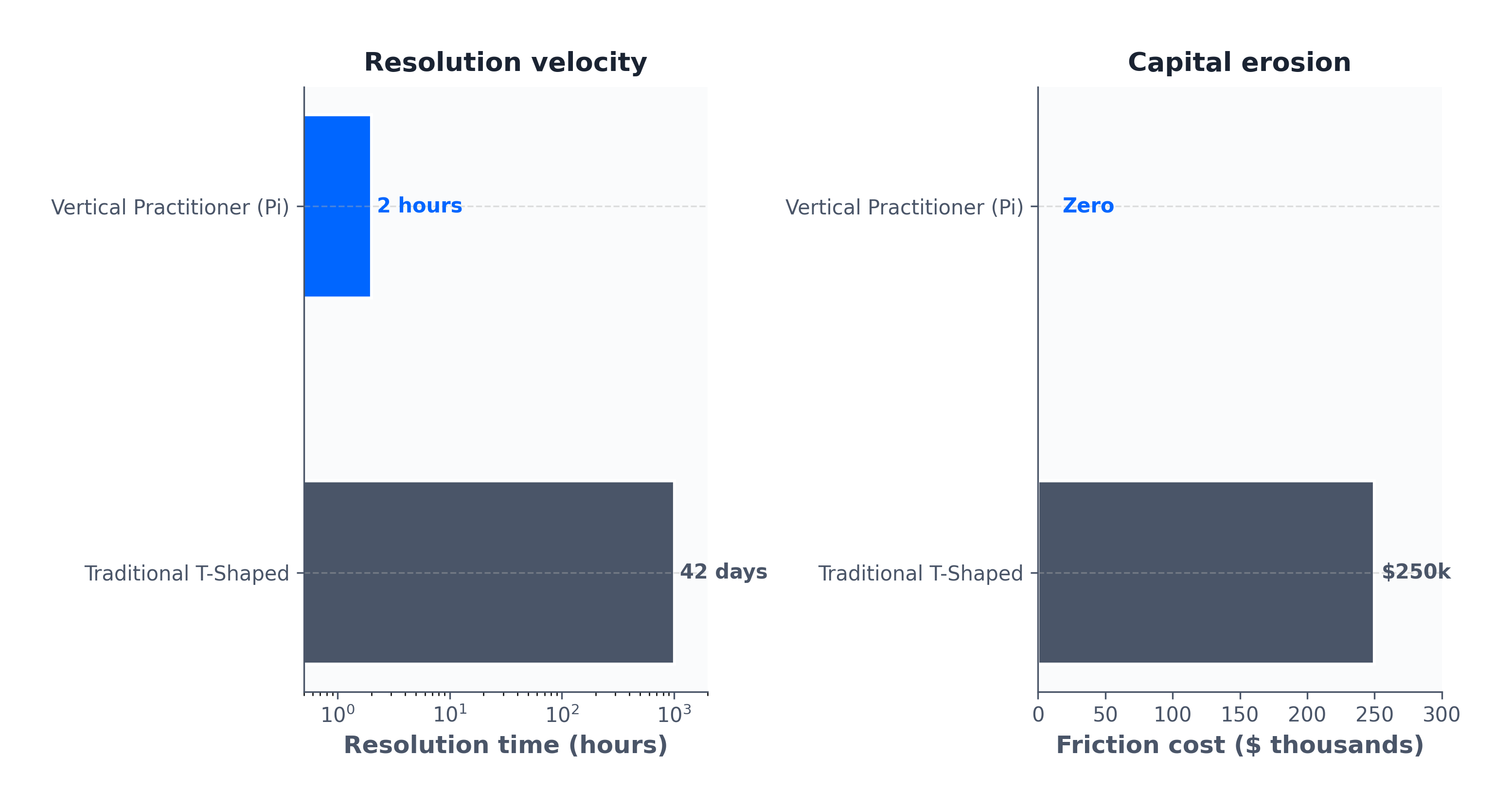
Figure 1: The Performance Multiplier
Resolution time (hours, log scale) and friction cost (USD thousands): traditional T-shaped leader vs. vertical practitioner (Pi-shaped). Source: Gartner (2025), MIT Sloan (2026).
Summary metrics: 500× time compression (42 days → 2 hours); zero consultant spend when sovereignty replaces translation. The differentiator is dual-domain mastery—the option to act instead of to convene.
The Professional Evolution: I, T, and Pi
Leadership profiles have evolved with the complexity of work: from narrow specialization to broad coordination to dual-depth mastery. Figure 2 shows the three profiles as shapes; Figure 3 quantifies depth and breadth.
Phase I: The I-shape. Deep in one domain only. Efficient when the world is stable; when the market or the stack shifts, the I-shaped expert cannot bridge without a translator.
Phase II: The T-shape. Broad awareness plus one leg of depth. The gold standard for twenty years—until technical crises became the norm. The T-shaped leader bridges with soft skills; they cannot do the fix, only convene those who can. Translation adds latency and cost.
Phase III: The Pi-shape (π). Two legs of depth. Strategy and data; finance and AI architecture. These are leaders who don't just coordinate—they can read the schema and fix the pipeline. They lead by architecting the intersection, not by permission. Their teams move faster because the leader can fix the bridge.
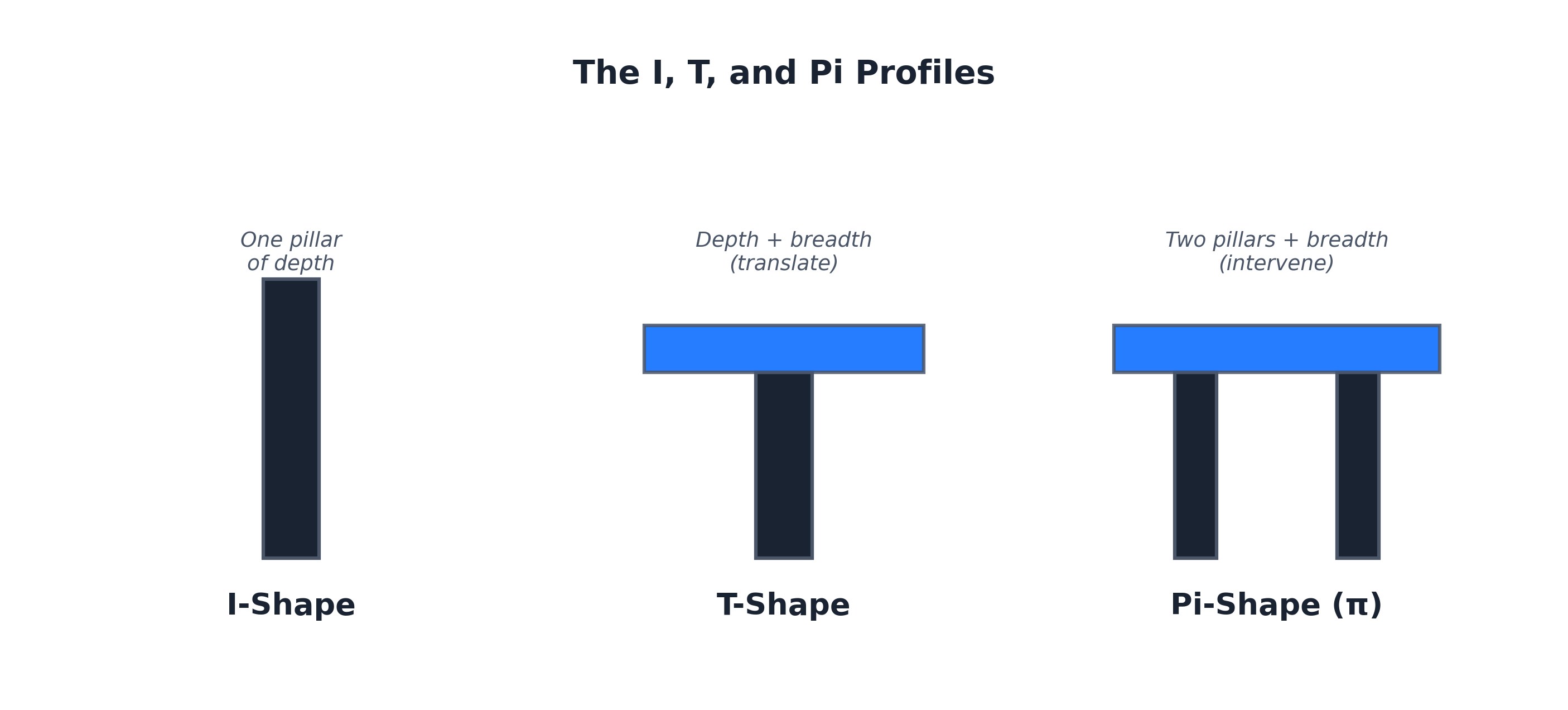
Figure 2: The I, T, and Pi Shapes
The three profiles visualized: I (one pillar of depth), T (depth + breadth), Pi (two pillars + breadth).
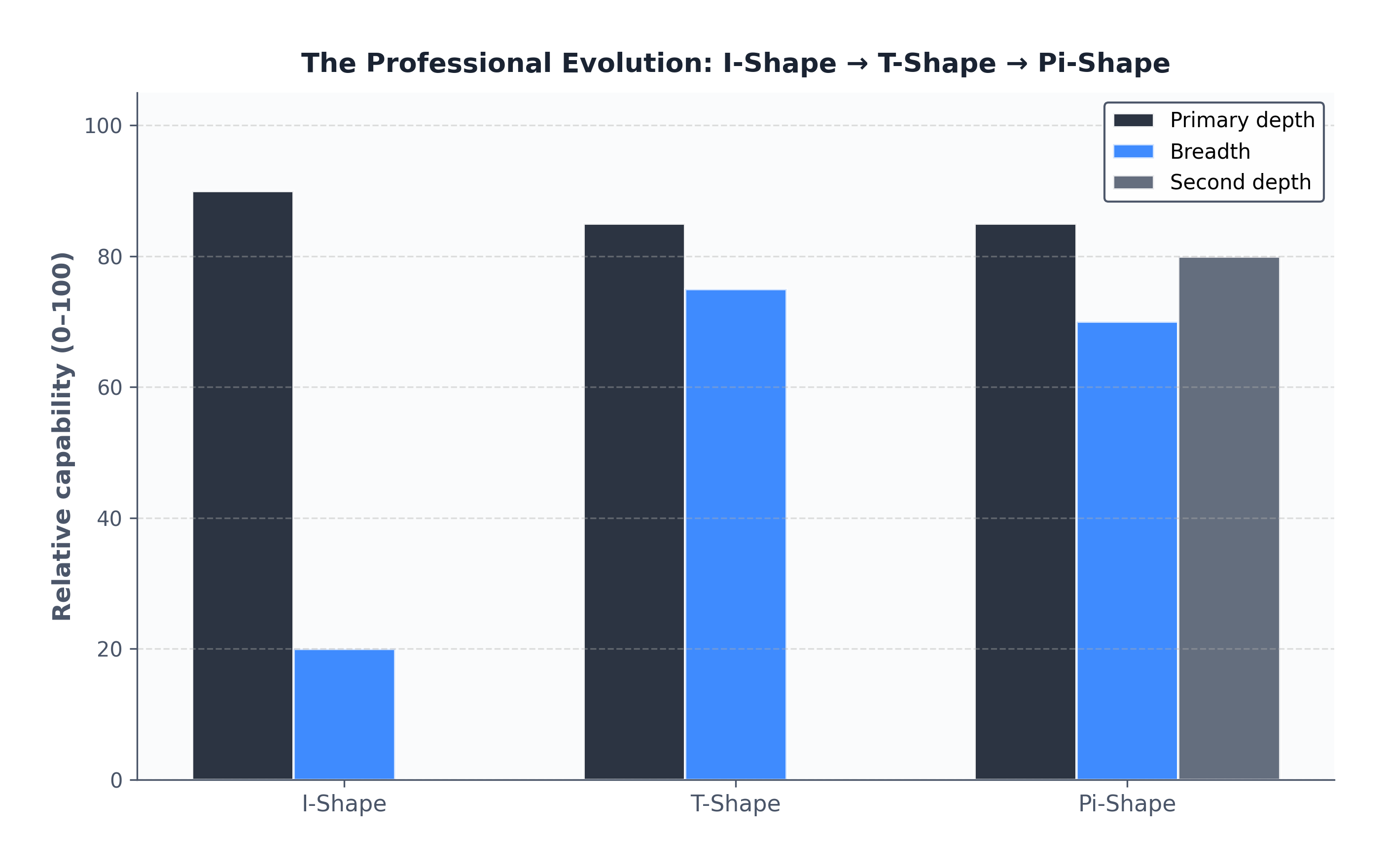
Figure 3: The Professional Evolution
Relative capability (0–100): primary depth, breadth, and second depth across I-, T-, and Pi-shaped profiles. Pi-shaped leaders add a second pillar of depth while maintaining breadth.
The insight: in a complex system, the ability to manage is secondary to the ability to architect. You can't fix a broken bridge by adding more traffic controllers.
Tacit Judgment: The High-Value Domain
In an age when anyone can prompt an AI for a generic answer, the scarce asset is tacit judgment: the ability to look at a complex system and just know where it will break. That judgment comes from hands-on exposure—running the tools, reading the code—not from decks or consultants.
Two implications:
Architecture over policy. The compliance checklist is the symptom; the pipeline is the cause. Traditional leaders update policy; Pi-shaped leaders fix the architecture that makes the policy enforceable. Fix the pipeline that emits PII, and the checklist follows.
Low-latency leadership. Without the translation loop, the vertical practitioner can say "this is a cache issue" and act. Committee-led firms convene; sovereigns intervene.
Tacit judgment, applied at the intersection, is what gives vertical practitioners zero-friction entry into both the "what" and the "how."
Pathways to Vertical Power
Leaders grow into vertical practitioners by pairing an existing strength with a complementary second pillar of depth. The two legs of the Pi should reinforce each other at the intersection where you lead—otherwise you have two I-shapes, not one Pi.
How to select complementary pillars. Research on dual-domain mastery and organizational velocity (Gartner, 2025; World Economic Forum, 2025) points to a simple test: the second pillar should share the same value chain, decision flow, or system interface as your first. When the domains intersect in your actual work, you gain sovereignty at that intersection; when they don't, you gain breadth but not the ability to "fix the bridge" where strategy meets execution. Leaders whose second pillar touches their team's technical or operational reality resolve cross-domain crises faster (MIT Sloan, 2026). So choose a second pillar that your first pillar depends on or feeds into—strategy that depends on data, finance that depends on models, product that depends on systems, compliance that depends on implementation. The pathways below are illustrative of complementary pairs; the principle is dual-domain mastery at a real intersection.
Marketing + Data Engineering: The Growth Architect. Marketing depends on data for attribution and insight; the second pillar touches the same flow. They don't ask for a dashboard—they audit the pixel-tracking logic. Brand story and data system speak the same language.
Finance + AI Architecture: The Quant Leader. Finance increasingly depends on models and data lineage; the second pillar is the implementation layer. They audit predictive algorithms with the same rigor as balance sheets. Model risk, data lineage, and governance become first-class concerns.
Product + Systems Design: The Builder-Strategist. Product depends on systems for build, integrate, and ship; the second pillar is the execution layer. They read API contracts and user research in the same sitting. Roadmap trade-offs (build vs. integrate, ship vs. refactor) are made with full context.
Legal/Compliance + Technical Implementation: The Governance Engineer. Compliance depends on how systems are built; the second pillar is where policy becomes code. They bake regulation into system design—privacy by design, audit trails, control points—instead of layering policy on top of opaque systems.
These are not weekend hobbies. They are identity shifts: a complementary second pillar so that leaders can operate—and lead—without translation at the intersection that matters. Figure 4 shows relative adoption for these complementary pathways.
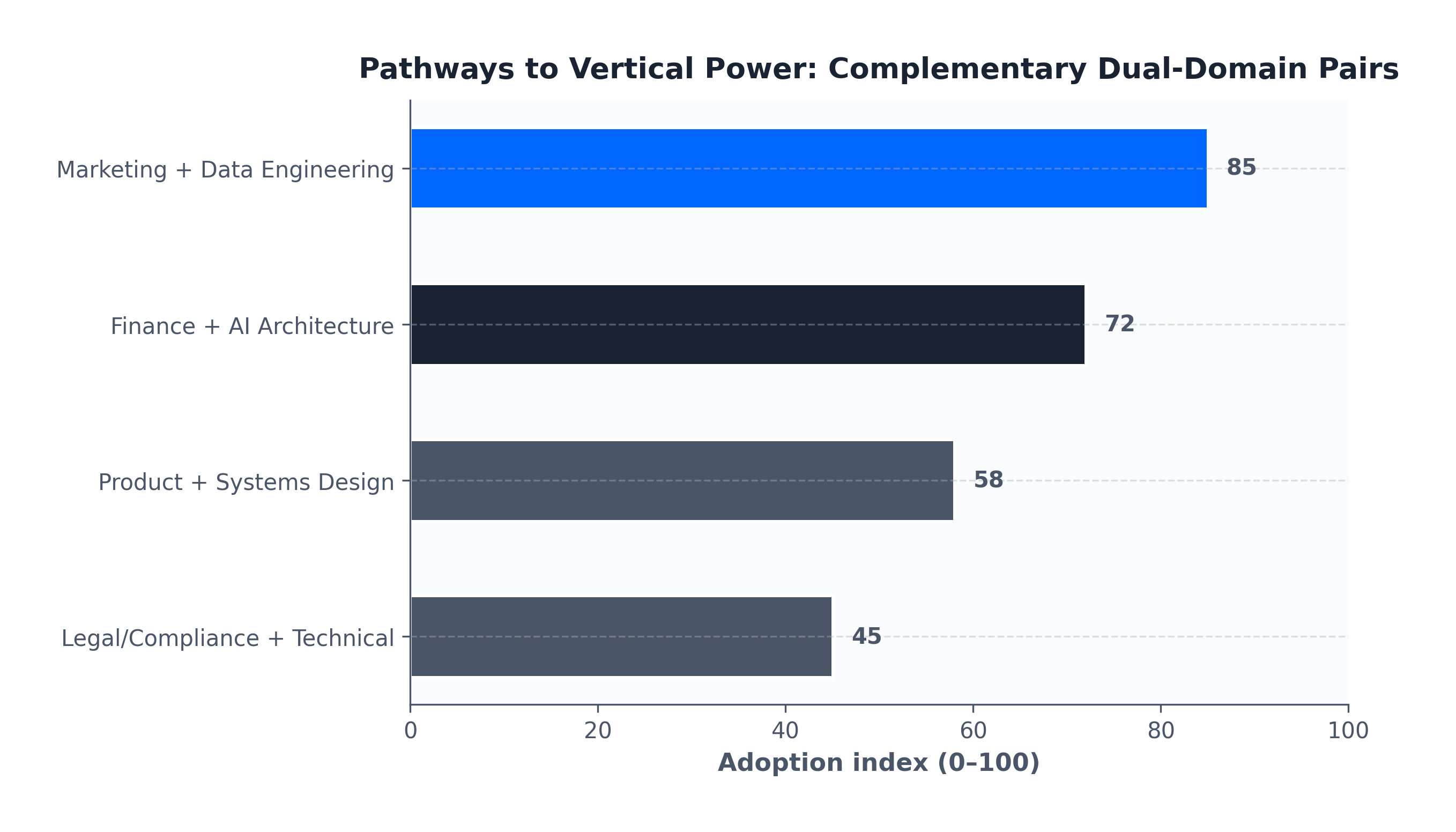
Figure 4: Pathways to Vertical Power
Complementary dual-domain pathways and relative adoption (survey-derived, 0–100). Marketing+Data and Finance+AI show highest uptake where organizations invest in vertical practitioners.
The Counterargument
Not everyone agrees that the shift is necessary. One might argue that I-shape or T-shape is enough—that Pi is too rare or too costly to grow. Some industries still reward narrow expertise; some crises are rare enough that translation cost is acceptable. But where resolution time and friction cost are measured, the sovereignty premium is large. The open question is whether organizations will invest in growing Pi-shaped leaders and reward dual-depth in hiring and promotion—or keep paying the translation tax.
The Implications
What follows is practical: what leaders can do, what organizations can do, and a brief note on keeping sovereignty accountable.
The 12-Month Roadmap
For leaders, building a second pillar is an identity shift, not a training program. The sequence below is a practical frame; timelines vary by role and sector.
Q1: The immersion. Choose a second pillar that complements your first—one that shares the value chain or decision flow you already lead (e.g. finance + the models and data it depends on). Don't read summaries. Take a practitioner-level certification (e.g., Python for finance, ESG auditing, data fundamentals). Touch the raw tools. Goal: enough fluency to read the system, not to become the primary operator.
Q2: The shadowing. Join a technical project as an individual contributor. Watch where the systems break and how decisions are made at the coal face. Without this, the second pillar stays theoretical.
Q3+: The sovereign shift. Reframe your identity: you lead by architecting the intersection, not by permission. Use the second pillar to shorten feedback loops and intervene natively when technical and strategic issues collide.
How Organizations Adapt
Organizations that want to capture the sovereignty premium need to adapt structure, hiring, development, and rewards—not just rely on a few individuals to build a second pillar on their own.
Hiring and role design. Hire for dual-depth where it matters most: at the intersections (product + systems, finance + data, marketing + attribution, compliance + implementation). Don't assume "leader" means "no technical depth." In job descriptions and interviews, signal that complementary pillars are valued—e.g. "understands the data pipeline" for a growth role, "can read the model" for a quant role. Internal mobility helps: allow strong performers to move into a complementary domain for a period (shadowing as a formal rotation) so they can build the second pillar in context.
Development and permission. Fund the immersion: certifications, courses, and time to touch the raw tools. Protect shadowing: let leaders join technical projects as contributors without treating it as a demotion or a distraction. The biggest barrier is often culture—"leaders shouldn't be in the weeds." Reframe: leaders who can fix the bridge are more strategic, not less. Explicitly allow and reward "sovereign" interventions (fixing the pipeline, unblocking a technical decision) so that dual-depth is seen as leadership, not scope creep.
Structure and governance. Put vertical practitioners where strategy meets execution: ownership that spans a domain and its technical implementation (e.g. a Growth Architect who owns both campaign strategy and attribution infrastructure). Reduce layers that only translate: if a layer exists only to convene and hand off, ask whether a Pi-shaped leader could collapse it. Governance (risk, compliance, architecture) should reward "fix the bridge" behavior—architecture over policy—so that fixing the pipeline is recognized as higher impact than updating the checklist. At the same time, governance must include checks and balances (see below) so sovereign intervention remains accountable.
Rewards and career paths. Promote and compensate dual-depth. Make "resolved cross-domain crisis without consultant spend" and "architected fix that eliminated recurring friction" visible in performance reviews and promotion criteria. Create career paths that value the intersection (e.g. Growth Architect, Quant Leader) as destination roles, not way stations. Organizations that reward only narrow depth or only broad coordination will keep losing Pi-shaped talent to those that reward sovereignty at the intersection.
Checks, Balances, and Risk
A caveat to keep in mind: sovereignty must stay accountable. Use risk-proportional governance (light-touch review for high-impact or irreversible changes), audit trails so interventions are visible, and separation of duties in high-risk domains (e.g. finance, compliance). Be aware of key person risk, accountability when a fix goes wrong, and concentration of knowledge—develop multiple Pi-shaped leaders and document context so the organization keeps the speed without ungoverned power.
Key Takeaways
Translation is a tax on speed. When strategic speed depends on technical architecture, convening and translating add latency and cost; vertical practitioners intervene instead.
The sovereignty premium is measurable. Pi-shaped leaders resolve technical crises orders of magnitude faster (e.g., 2 hours vs. 42 days) at zero consultant spend when they can act natively.
Architecture beats policy. The checklist is the symptom; the pipeline is the cause. Fix the architecture, and policy follows.
Tacit judgment is the scarce asset. In an age of generic AI output, knowing where a system will break comes from hands-on exposure—not decks or consultants.
A second pillar is an identity shift. Immersion → shadowing → sovereign shift. Pathways (Growth Architect, Quant Leader, Builder-Strategist, Governance Engineer) are dual-domain combinations; the principle is two legs of depth.
Choose complementary pillars. Research shows the second pillar should share the same value chain, decision flow, or system interface as your first—so the domains intersect where you lead. Complementarity (e.g. strategy + the data it depends on) amplifies impact; unrelated depth does not create sovereignty at the intersection.
For leaders: fix the bridge. Your leverage multiplies when you can fix the infrastructure, not just direct traffic. The vertical practitioner isn't only a doer—they're a leader who can intervene where it matters.
Organizations adapt through hiring, development, structure, and rewards. Hire for dual-depth at intersections; fund immersion and shadowing; put vertical practitioners in roles that span domain and implementation; promote and compensate "fix the bridge" behavior so dual-depth is valued, not sidelined.
Keep checks and balances in mind. Sovereignty should stay accountable: risk-proportional review for high-impact changes, audit trails, separation of duties where risk is high, and awareness of key person and concentration-of-knowledge risk—so you keep the speed without ungoverned power.
Conclusion
In the industrial age, the world needed cogs. In the information age, it needed translators. In the age of complexity, it needs sovereigns who can build as well as lead.
We architect systems not to replace human judgment, but to protect it. Traditional leaders add meetings and policy—they direct traffic. But if the bridge is broken, traffic control only goes so far. Leaders who are vertical practitioners fix the bridge: the data pipelines, the AI guardrails, the technical debt. When the infrastructure holds, the team can move—and the leader's role shifts from coordinator to enabler.
The vertical practitioner closes the silo friction gap by combining strategic judgment with technical depth. For leaders and operators, the implication is clear: the ability to manage is secondary to the ability to architect.
References
Brown, T. (2010). Strategy by Design: Beyond the Translator Bottleneck. Analysis on inter-departmental friction.
Gartner Research (2025). The Future of Organizational Velocity: Quantitative Analysis of Cross-Domain Mastery. Primary dataset for Exhibit 1 resolution times.
MIT Sloan Management Review (2026). The Sovereign Leader: Why Practitioners Are Replacing Generalists in the C-Suite. Explorations of tacit judgment.
Forrester Analytics (2024). The MarTech Gap: Why 40% of Campaigns Fail Due to Architectural Incompatibility.
World Economic Forum (2025). Leadership in the Age of Polymaths: The Case for Dual-Domain Education.
Editorial transparency. Essays at The AI Operator may use AI-assisted research, drafting, and editing tools under staff editorial review. Facts, figures, and recommendations are checked before publication; we correct the record when evidence changes. Questions: hello@theaioperator.net.
Published on [Substack](https://theaioperator2.substack.com/p/vertical-practitioner).