
Support Deflection Economics: When Automation Saves Tickets but Costs Trust
Quality-adjusted deflection vs gross ticket closure—a case on reopen rates, CSAT guardrails, and when automation saves cost without burning trust.

Executive Summary
Deflection rate is the favorite key performance indicator (KPI) of support automation—and the most gamed. A composite consumer financial technology firm drove its gross ticket deflection by artificial intelligence from 12% to 34% in one quarter, but found that quality-adjusted deflection (QAD)—cases with no reopen within seven days and a customer satisfaction (CSAT) score of at least 4—rose from only 9% to 19%. The 15-point gap represented cheap closes that reopened, escalated, or churned customers, creating a hidden cost center in customer lifetime value. Illustrative composite.
Cross-domain lens: Revenue recognition distinguishes gross from net; support operations must distinguish gross deflection from quality-adjusted deflection that survives a week of real-world customer behavior.
The Challenge
The initial mandate from the Chief Operating Officer was simple: reduce support operating expenses by 15% year-over-year by implementing an AI chatbot for Tier-1 inquiries. The Head of Support was bonused on a single metric: the gross deflection rate. Within two months, agents, observing the system's logic, learned to route ambiguous tickets to the bot, knowing it would offer a generic answer and auto-close the case. This met their performance targets but offloaded the problem back to the customer.
The consequences surfaced in other departments first. The marketing team’s social media monitoring tools flagged a 40% increase in negative public comments mentioning "support bot" and "stuck in a loop." The product team saw a rise in one-star app store reviews citing poor customer service. The finance team celebrated the initial cost savings from reduced agent handle time, while the customer success team fought to contain the damage as churn risk spiked among high-value accounts. The core tension was clear: we were optimizing a departmental KPI at the expense of the overall customer experience.
The Context
This scenario is a composite based on a financial technology firm with 4.2 million customers and 180 support full-time equivalents (FTEs). The automation stack included a large language model (LLM)–powered copilot for agents and an auto-close function for specific Tier-1 intents. The fully loaded cost per human-handled ticket was calculated at $2.40. A critical early signal was when the Legal team questioned whether auto-closing billing disputes without explicit human review violated consumer protection regulations. This inquiry revealed a deeper operational flaw: the product team had not created a clear tier map defining which actions were safe for full automation versus which required a human-in-the-loop (see Human-on-the-Loop Runbook).
The Approach
The question shifted from "how do we deflect more tickets?" to "how do we deflect the right tickets durably?" This forced a move away from a volume-based metric to a quality-gated one. The cross-functional team, including leaders from Support, Product, and Data Science, developed and implemented Quality-Adjusted Deflection (QAD) as the new primary success metric.
Defining and Implementing QAD:QAD = (deflected tickets with no reopen in 7d and CSAT ≥ 4) / eligible tickets
Treat automation metrics as governed indicators under an AI RMF Measure lens [1]—not vanity deflection counts.
Metric Definition: The seven-day window for reopen was chosen because analysis showed 95% of reopened tickets occurred within this timeframe. A CSAT score of 4 or 5 (on a 5-point scale) was deemed the minimum threshold for a successful resolution. Anything less was considered a failure, even if the ticket stayed closed.
Instrumentation: The data engineering team built a pipeline to join data from the ticketing platform (like Zendesk) with the CSAT survey tool and the application's backend database. A unique interaction ID was required to track a ticket from initial bot contact through deflection, potential CSAT response, and any new ticket created by the same user within the seven-day window.
Eligibility Governance: A working group with representatives from Legal, Product, and senior Support agents was formed to define "eligible tickets." They started conservatively. High-confidence, low-risk intents like password resets and checking an application status were eligible for auto-close. More sensitive intents, such as billing disputes or fraud flags, were explicitly excluded after a chaotic six-week trial period. These were moved to a "draft-only" mode where the AI suggested a response but an agent had to approve and send it.
This new metric was reported to the operating committee monthly, with gross deflection demoted to a secondary diagnostic. The incentive structure for the Head of Support and team leads was revised to be 70% weighted on QAD and 30% on team-wide CSAT.
Metric: Gross Deflection Rate · Before (Gross Deflection Bonus): 12% · After (QAD Bonus, 2 Qtrs): 34%
Metric: Quality-Adjusted Deflection (QAD) · Before (Gross Deflection Bonus): 9% · After (QAD Bonus, 2 Qtrs): 19%
Metric: Reopen Rate (AI-touched tickets) · Before (Gross Deflection Bonus): 22% · After (QAD Bonus, 2 Qtrs): 11%
Metric: Cost per Quality-Adjusted Ticket · Before (Gross Deflection Bonus): — · After (QAD Bonus, 2 Qtrs): $0.89 vs. $2.40 human
Metric: Escalations to Tier-3 Support · Before (Gross Deflection Bonus): +8% · After (QAD Bonus, 2 Qtrs): −3%
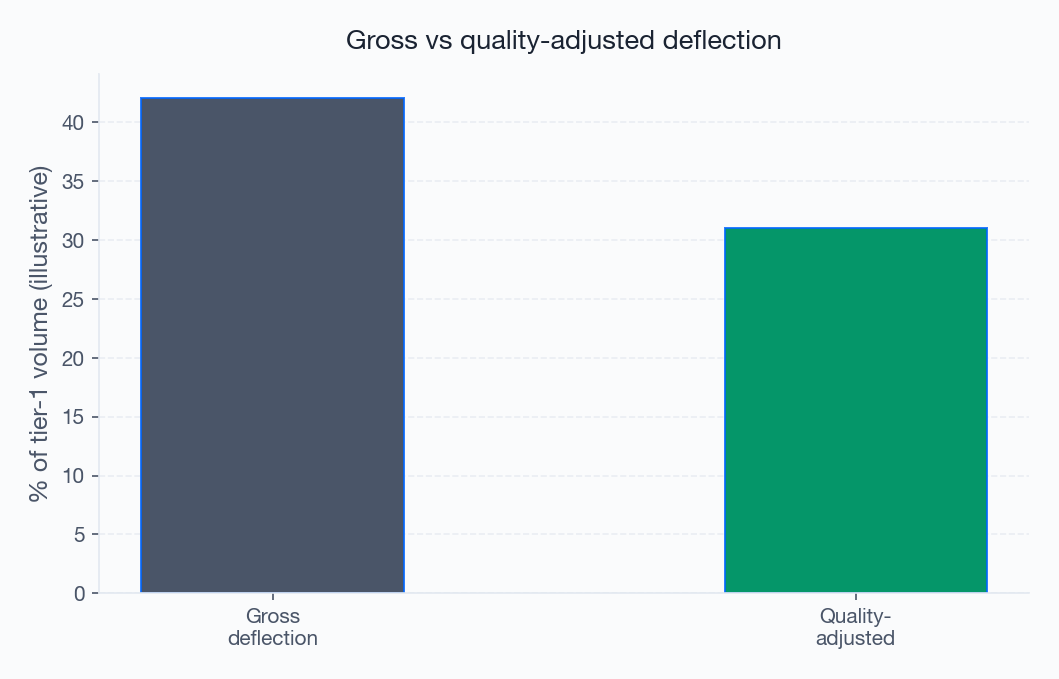
Figure 1: Gross vs QAD deflection
Illustrative spread—raw KPI diverges from durable deflection as the gap between them represents low-quality automated interactions.
The Analysis
Quality-adjusted deflection fundamentally changes incentive design. When bonuses were tied to gross deflection, frontline teams had a clear incentive to let the bot close tickets, knowing the negative consequences—a reopened ticket—would fall into a general queue and not affect their individual performance. The reopen rate of 22% was an artifact of this system. By shifting the bonus to QAD, the entire team became responsible for the durability of the resolution.
The economics only work when quality is factored in. The initial business case was built on a flawed premise. The true cost of a poorly deflected ticket was not zero; it was the cost of the eventual human intervention plus the erosion of customer trust. The composite firm calculated the cost per quality-adjusted ticket at $0.89, which included API calls, tool amortization, and data pipeline maintenance. This provided a real, defensible saving of $1.51 against the $2.40 human-handled ticket. The 8% increase in escalations to Tier-3 support during the initial phase was the loudest warning sign; the bot was frustrating customers on simple issues, causing them to demand senior help for problems that should have been solved at Tier-1. The eventual 3% reduction in these escalations after implementing QAD demonstrated that getting the initial triage right saved expensive senior agent time.
Micro-surveys on reopen paths corrected critical sample bias. The standard CSAT survey often missed the most frustrated users, who would rather open a new ticket or leave the platform than fill out a survey. By triggering a simple, one-question micro-survey ("Did our bot resolve your issue?") specifically when a user created a new ticket within 48 hours of a deflected one, the team captured previously invisible negative sentiment. This data was instrumental in identifying which automated responses were causing the most friction.
What Went Wrong
The primary failure was misaligned metrics creating cross-departmental friction. The Support team was initially rewarded for hitting a 25% gross deflection target. In the Q2 all-hands meeting, the VP of Operations celebrated this as a major efficiency win. Simultaneously, the Head of Marketing was presenting data to the executive team showing a sharp increase in negative social media sentiment and a dip in the Net Promoter Score (NPS) attributed directly to "support issues." Finance saw a cost reduction, Support saw a performance bonus, and Marketing saw a brand crisis. We were organizationally rewarding one team for creating a problem for another. It took a heated operating committee meeting and a joint dashboard showing deflection, reopen rates, and NPS side-by-side to force the realization that we were optimizing a silo, not the business.
Key Takeaways
Report quality-adjusted deflection and reopen rate in the same pack as headcount savings; a partial story invites gaming.
Mandate Legal and Product sign-off on any customer intent eligible for fully automated resolution. Policy and risk assessment must precede automation deployment.
Use the Tier-3 escalation rate as the canary in the coal mine. When it rises, freeze the rollout of new automated intents and diagnose the root cause.
Bonus on the durable outcome (QAD), not the intermediate activity (gross deflection). What you measure is what you get.
References
National Institute of Standards and Technology. (2023). Artificial Intelligence Risk Management Framework (AI RMF 1.0). https://www.nist.gov/itl/ai-risk-management-framework
Zendesk. Customer Experience Trends reports (industry benchmarks; directional). https://www.zendesk.com/blog/
Harvard Business Review. The value of customer experience / satisfaction (directional CSAT framing). https://hbr.org/
Forrester Research. Customer service automation (directional). https://www.forrester.com/
Anthropic. (2024). Building effective agents — evaluate tool/support automation with outcome checks. https://www.anthropic.com/research/building-effective-agents
Board of Governors of the Federal Reserve System. (2011). SR 11-7: Guidance on Model Risk Management. https://www.federalreserve.gov/supervisionreg/srletters/sr1107.htm
Learn Next
Editorial transparency. Essays at The AI Operator may use AI-assisted research, drafting, and editing tools under staff editorial review. Facts, figures, and recommendations are checked before publication; we correct the record when evidence changes. Questions: hello@theaioperator.net.
Published on [Substack](https://theaioperator2.substack.com/p/support-deflection-economics).