
RAG Freshness Debt: When Your Index Is the Bottleneck
Wrong-version answers when RAG indices lag policy—freshness SLOs, corpus versioning, and chargeback rows for re-embed that make stale retrieval visible on the P&L.


Executive Summary
Retrieval-augmented generation (RAG) fails quietly when the index is stale: answers sound confident while policy, pricing, and product truth have moved on. This composite case follows a business-to-business (B2B) software-as-a-service (SaaS) team that treated re-embed and re-index as “infrastructure misc.” until support tickets tagged wrong-version answers at 31 per 1,000 assisted sessions—then cut that to 7 per 1,000 by publishing freshness service level objectives (SLOs), versioned corpora, and separate chargeback rows for batch re-index. The fix was not a better model, but treating data freshness as a first-class product metric with a named owner and a visible budget. Illustrative composite.
Cross-domain lens: Just-in-time inventory systems flag stock age before pick—retrieval-augmented generation needs the same signal on corpus version before retrieve.
The Challenge
For six months, a mid-market compliance software firm celebrated the successful launch of its new AI-powered support assistant. The platform engineering team reported consistent improvements in model latency and token efficiency. Yet, the Director of Customer Support was escalating a troubling trend: customer satisfaction (CSAT) scores for AI-assisted sessions were down 14% quarter-over-quarter. The support team was handling a rising tide of tickets where customers, frustrated after interacting with the AI, cited incorrect information about product features, support policies, and even pricing tiers.
The initial assumption pointed to model regression. The VP of Product, under pressure to show return on the firm's significant AI investment, tasked engineering with evaluating newer, more powerful large language models (LLMs). This was a misdiagnosis. The root cause was not the generative model's reasoning capability but the data it was reasoning from. The retrieval layer, the "R" in RAG, was operating on an index with a median data age of 48 hours.
Nightly batch jobs to re-embed and re-index the knowledge base were simply too slow. Critical intraday updates—a pricing change from marketing, a revised data-residency policy from legal, an urgent feature patch note from product—were invisible to the AI for up to two days. Customers were receiving authoritative, well-written, and confidently delivered wrong answers. The system's fluency masked its ignorance, eroding trust with every confidently incorrect response.
The core challenge was organizational, not technical. There was no single owner for "corpus freshness." The platform team viewed re-indexing as a pure cost center, an operational tax to be minimized. The product team viewed content accuracy as a given, an assumed property of the platform. And the finance team saw a single, opaque line item—$186,000 per quarter for "API & Vector Services"—with no way to connect spend to the quality of a specific customer-facing feature. The system was failing in a blind spot created by diffused responsibility.
The Context
This composite case is modeled on a B2B SaaS provider specializing in enterprise compliance and risk management software. The stakes for data accuracy are high; a wrong answer about regulatory requirements can have direct legal and financial consequences for their clients.
The company operated eight distinct RAG-powered workflows, each with its own knowledge corpus:
Internal: Sales enablement, HR policy lookup.
External: In-product support assistant, developer documentation search, public marketing site chatbot.
A central platform engineering team managed the underlying AI infrastructure, including the vector database and the embedding and indexing pipelines. They were measured on system uptime, latency, and cloud cost efficiency. They were not, however, measured on the accuracy or timeliness of the information served by the RAG systems.
The $186,000 quarterly spend was buried in a miscellaneous cloud services budget, a blend of costs from multiple vendors for model application programming interfaces (APIs), vector database hosting, and the compute resources for batch processing. Without itemization, it was impossible for a business leader to ask a simple question: "What are we paying for freshness, and is it enough?" The product managers responsible for the AI features had no visibility into or control over the cost drivers of the data pipeline that fed their products. This financial abstraction ensured that debates about re-indexing frequency remained technical and qualitative, never reaching the level of a quantitative business trade-off.
The Approach
The breakthrough came when the Director of Support, armed with a dossier of 50 tickets directly attributable to stale data, secured a mandate from the COO to form a cross-functional task force. The group included leads from Product, Platform Engineering, and Finance. Their approach was not to find a new technology, but to install a new operating system for managing data freshness as a core business concern.
The inquiry was reframed. Instead of asking "How can we make the model smarter?", they asked, "How do we ensure our retrieval system operates on a verifiably fresh and accurate representation of our business reality?" This led to four specific, interlocking controls.
Control: Freshness SLO · Policy: P95 corpus age under 4 hours for tier-1 policy
Control: Version ID · Policy: Every answer cites
corpus_versionin logsControl: Re-index row · Policy: Separate Decision Ledger line for embed and batch
Control: Canary query · Policy: 12 golden questions run hourly on live index
1. Establishing Tiered Freshness SLOs
The first step was acknowledging that not all data is created equal. A single, aggressive freshness target for all eight corpora would be prohibitively expensive. The task force, led by the VP of Product, defined three tiers of data based on business impact.
Tier: Tier 1 · Corpus Examples: Pricing pages, Terms of Service, Security policy, critical bug fixes · Business Impact of Staleness: High: Direct financial, legal, or security risk. High customer trust impact. · Freshness SLO (P95 Age): < 4 hours · Indexing Strategy: Event-driven delta indexing + daily full rebuild
Tier: Tier 2 · Corpus Examples: General product documentation, feature guides, integration specs · Business Impact of Staleness: Medium: Customer friction, increased support load. · Freshness SLO (P95 Age): < 24 hours · Indexing Strategy: Nightly delta indexing + weekly full rebuild
Tier: Tier 3 · Corpus Examples: Marketing blog posts, old press releases, community forum content · Business Impact of Staleness: Low: Minor user confusion, low impact on core operations. · Freshness SLO (P95 Age): < 7 days · Indexing Strategy: Weekly full rebuild
P95 corpus age was chosen over an average because it focuses on the worst-case user experience. An SLO of "< 4 hours" meant that 95% of Tier-1 documents in the index must have been checked for updates within the last four hours. This negotiation was critical. The platform team could now calculate the specific compute and API costs required to meet each SLO, turning an abstract desire for "freshness" into a concrete budget line.
2. Implementing and Surfacing Corpus Version IDs
To make freshness auditable, every document chunk ingested into the vector store was stamped with a version identifier. The team opted for a composite ID: doc_id:source_git_hash:ingest_timestamp. This allowed for precise traceability. When a user interacted with the AI assistant, the corpus_version IDs for all retrieved chunks were written to the application log alongside the user query and the final generated answer.
This had an immediate operational impact. When a customer support agent reviewed a complaint about a wrong answer, they no longer had to debate the model's "hallucinations." They could perform a simple check:
Look up the
corpus_versionID in the log for the problematic session.Compare that version hash to the current
HEADof the content repository.If they differed, the root cause was confirmed as stale data.
The resolution time for this class of tickets dropped from hours of confused back-and-forth to minutes of deterministic verification. This simple piece of metadata shifted the conversation from opinion to evidence.
3. Creating an Attributed Re-index Chargeback
This was the most contentious and most impactful change. Working with Finance, the platform team broke down the monolithic "$186K API & Vector Services" line item. They implemented a chargeback model based on The AI Operator's Decision Ledger framework [2].
Before:
Cost Center: Central Platform R&D
Line Item: API & Vector Services - $186,000
After:
Cost Center: Product Team A (In-product support)
Line Item: Inference Tokens (GPT-4) - $45,000
Line Item: Embedding Tokens (Ada-002) - $8,000
Line Item: Re-index Batch Compute (Tier-1 SLO) - $16,000
Cost Center: Product Team B (Developer Docs)
Line Item: Inference Tokens (GPT-4) - $31,000
Line Item: Embedding Tokens (Ada-002) - $6,000
Line Item: Re-index Batch Compute (Tier-2 SLO) - $8,000
Suddenly, the $24,000 per quarter spent on re-indexing the two primary external-facing corpora was visible and attributed to the product owners who benefited from it. When the product manager for the in-product assistant wanted to pilot a 1-hour SLO, they could see the direct trade-off: an estimated $9,000 increase in their quarterly chargeback. Freshness became a feature with a price tag. This financial clarity empowered product owners to make informed decisions and forced platform engineering to optimize their pipelines to offer better SLOs at a lower cost.
4. Building a Canary Monitoring System
An SLO is meaningless without monitoring. The team implemented an automated "canary" system to continuously test the freshness of the live index. The Director of Support designated two senior agents to curate a set of 12 "golden questions." These were not simple keyword searches; they were questions whose correct answers depended on the most recently updated Tier-1 documents.
Example Golden Question: "What is the data retention policy for customers on the new Enterprise Plus plan launched yesterday?"
A scheduled script ran these queries against the production RAG system every hour. It didn't check the full LLM answer for correctness, which is brittle. Instead, it checked that the retrieved source chunks contained the specific, updated policy text. If the correct document version was not retrieved, an alert was automatically fired to the platform team's on-call rotation. This proactive monitoring, aligned with the NIST AI Risk Management Framework's "Measure" function [4], ensured that index staleness was detected within an hour, long before it could impact a critical mass of customers.
The Results
The implementation of this four-part system over 90 days yielded measurable improvements across operations, finance, and customer experience. The changes transformed freshness from an unmanaged liability into a managed operational metric.
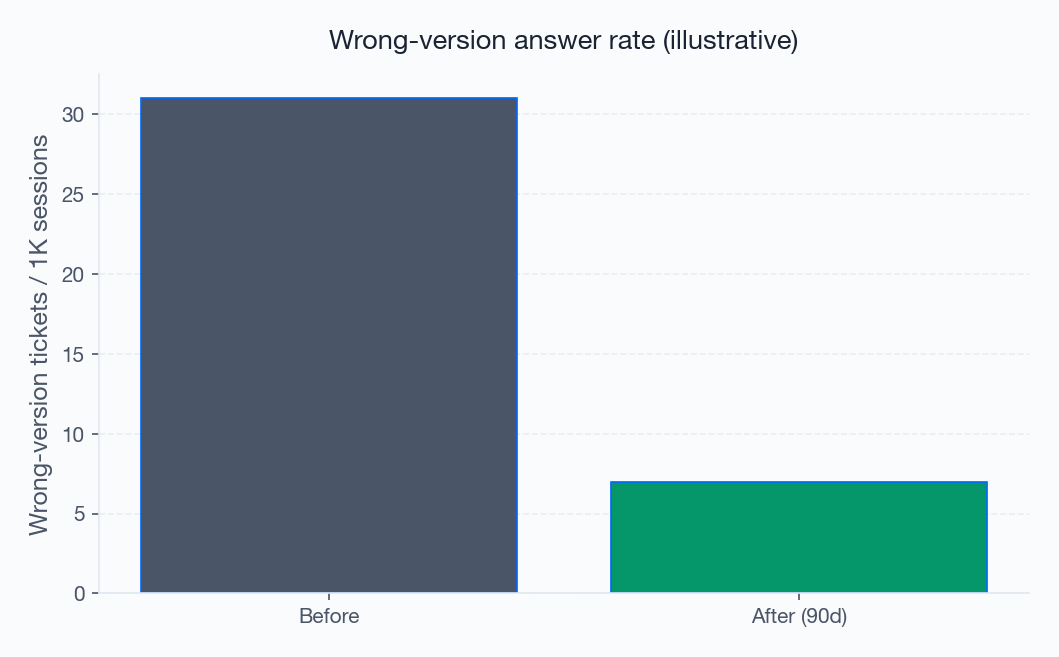
Figure 1: Wrong-version answer rate
Before/after implementation of freshness SLOs, corpus versioning, chargeback, and hourly canary queries. Illustrative data based on composite case.
Metric: Wrong-version tickets / 1K · Before: 31 · After (90 days): 7
Metric: P95 corpus age (Tier-1) · Before: 52h · After (90 days): 3.2h
Metric: Re-index spend (visible) · Before: $0 line · After (90 days): $24K/qtr attributed
Metric: CSAT (assisted) · Before: 3.6 · After (90 days): 4.1
Reduction in Wrong-Version Tickets: The primary success metric, support tickets explicitly citing incorrect information from the AI, fell by 77%. This directly reduced the burden on the support team and, more importantly, repaired customer trust. The remaining 7 tickets per 1,000 sessions were largely attributable to ambiguous phrasing in source documents or genuine model errors, allowing the team to focus on true context engineering [3] and prompt tuning.
Verifiable Freshness SLO Adherence: The P95 age of Tier-1 content dropped from over two days to just 3.2 hours, meeting the 4-hour SLO. This was not an estimate; it was a measured and monitored reality, tracked on the same dashboards as system latency and uptime.
Financial Clarity and Optimization: The $24,000 quarterly spend on re-indexing was not new money. It was previously hidden cost that was now visible and accountable. This visibility drove immediate optimization. The platform team, now servicing an internal customer (the product team) with a clear budget, implemented a more efficient delta-indexing strategy. They could now prove that this new strategy saved the product team $4,000 per quarter while still meeting the SLO, a clear win-win that was impossible to demonstrate when the costs were pooled and invisible.
Improved Customer Satisfaction: The CSAT score for AI-assisted support sessions recovered from its low of 3.6 to 4.1. By providing more reliable and accurate answers, the AI assistant began to fulfill its original promise: resolving customer issues quickly and effectively without human intervention.
What Went Wrong
The single biggest failure mode was organizational inertia rooted in cost obscurity. The initial hypothesis from leadership was that the AI model was the problem, triggering a costly and time-consuming evaluation of new LLMs. This misdirection wasted six weeks. The platform team, measured on infrastructure costs, initially treated the request for granular chargeback and freshness monitoring as unfunded administrative overhead. They argued that their job was to keep the "pipes" running, not to validate the "water" flowing through them.
The resistance was not malicious; it was a rational response to existing incentives. Hiding re-index costs in a shared infrastructure line was the path of least resistance. It protected the platform team's budget and avoided difficult conversations with product managers about the true cost of their feature requests. The turning point was not a technical presentation, but a financial one. When the CFO, prompted by the COO, mandated that no AI feature could exist without an itemized P&L showing its full operational cost—including data pipeline maintenance—the incentives shifted. The platform team's role evolved from a cost center manager to an internal service provider, accountable for delivering specific, measurable service levels to their product counterparts. The failure was in assuming that a technical problem could be solved by technical teams alone, without first realigning the financial and organizational structures that govern their work.
Key Takeaways
Treat corpus age as a first-class metric with its own SLO, a named business owner, and a dedicated budget line. Without explicit targets and accountability, freshness will always be an afterthought, managed by engineers optimizing for infrastructure cost rather than by product owners optimizing for customer trust.
Make re-indexing costs visible on a per-workflow decision ledger. Freshness without financial attribution is an invisible debt that customers pay for through trust erosion. When product managers must justify the cost of a 4-hour SLO versus a 24-hour SLO in their own budget, the trade-offs become concrete and business-aligned.
Version your document corpus and surface that version ID at the point of use, especially in support logs. This simple piece of metadata transforms support escalations from subjective debates about model quality into auditable, evidence-based diagnostics, dramatically reducing resolution time.
Your "golden question" canary set is a product, not a one-off script. It requires ownership from the teams closest to the customer, like Support or Sales Engineering, and must be maintained as your product and policies evolve. This is your first line of defense against the quiet, insidious failure of a stale index.
References
Lewis, P., et al. (2020). Retrieval-augmented generation for knowledge-intensive NLP tasks. NeurIPS.
The AI Operator. (2025). The Chargeback Imperative — attribution for embed and batch rows.
The AI Operator. (2026). Context Engineering for Operators — grounding policy companion.
National Institute of Standards and Technology (NIST). (2023). AI Risk Management Framework: Measure function. https://www.nist.gov/itl/ai-risk-management-framework
Wixom, B., & Watson, H. (2014). Data quality fundamentals (directional)—freshness as quality dimension.
Editorial transparency. Essays at The AI Operator may use AI-assisted research, drafting, and editing tools under staff editorial review. Facts, figures, and recommendations are checked before publication; we correct the record when evidence changes. Questions: hello@theaioperator.net.
Published on [Substack](https://theaioperator2.substack.com/p/rag-freshness-debt).