
The Prediction Trap: Why Industrial-Age Leadership Fails in an AI World
Architect vs gardener metaphors for AI programs—and the prediction trap that mis-allocates capital when leaders confuse forecasts for control.

Executive Summary
Architect vs gardener metaphors for AI programs—and the prediction trap that mis-allocates capital when leaders confuse forecasts for control.
Remember when you could plan your way to success? When a detailed five-year strategy and enough market research could give you confidence about the future? Those days are over.
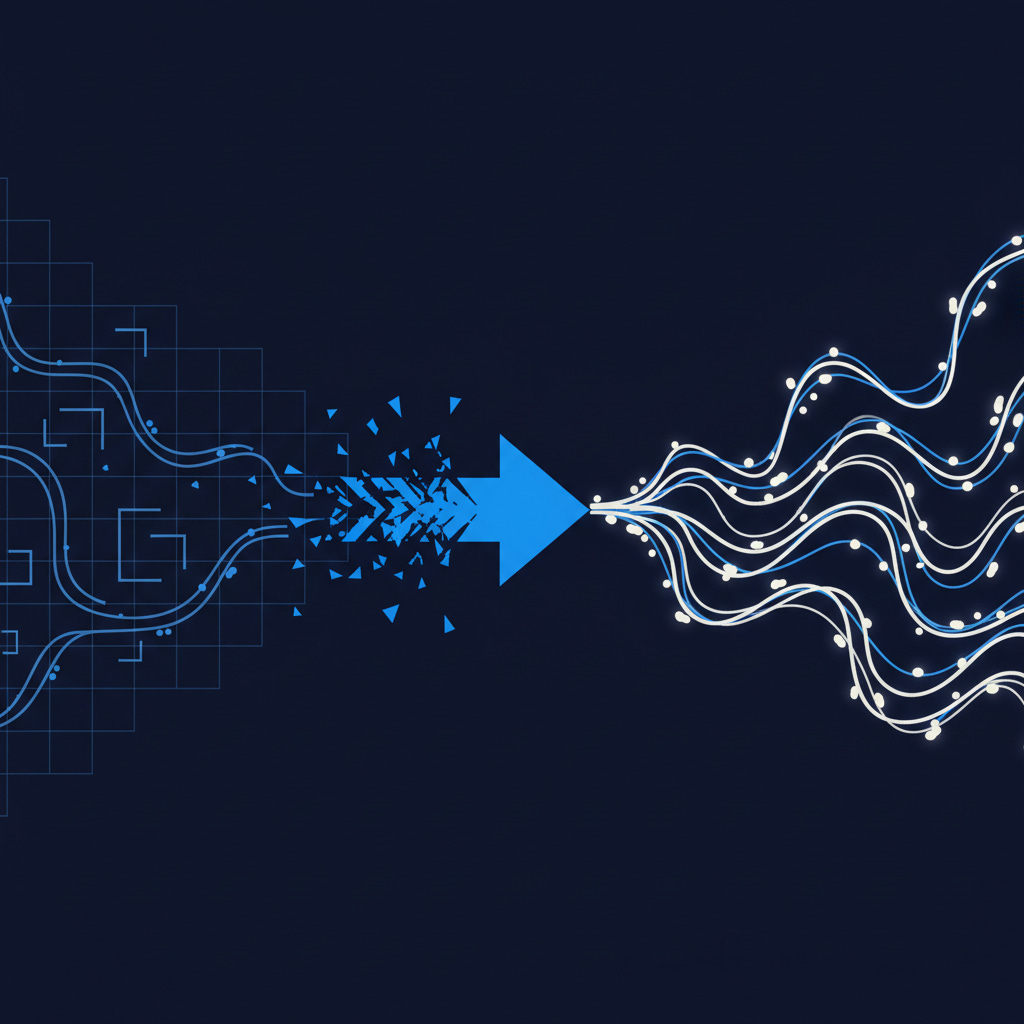
We've been running our organizations like clocks—complicated machines where every gear follows a predictable path. But today's world works like a cloud. Small shifts in one corner create ripples everywhere.
When Silicon Valley Bank collapsed in March 2023, it had a solid plan: invest in long-term bonds, maintain liquidity ratios, follow regulations. But the Fed raised rates faster than predicted, startups withdrew deposits, and a social media-fueled bank run spread in hours. The plan didn't account for that.
When ChatGPT launched in late 2022, Google had been planning its AI strategy for years. Then ChatGPT hit 100 million users in two months [2]. Every company's AI strategy became obsolete overnight. The ones that adapted within weeks won. The ones waiting for quarterly planning cycles are still catching up.
This isn't a problem of not having enough information. It's the friction of trying to use a master plan to navigate a world that refuses to be planned.
The Problem: You Can't Shortcut Reality
Here's a thought experiment: Imagine you're trying to predict what happens at Step 100 of a complex process. The old way of thinking says: "Give me enough data, and I'll calculate the outcome." But in complex systems, there's no cheat code. You can't jump to Step 100. You have to go through Steps 1, 2, 3... all the way to 99, and only then can you see what Step 100 actually looks like.
This concept, called computational irreducibility, isn't academic theory [1]. It's your quarterly plan falling apart by week three. It's markets shifting in ways your models didn't predict. It's competitors launching something that changes everything overnight.
When GameStop squeezed in 2021, hedge funds with decades of market data couldn't predict Reddit coordination or social media amplification. The ones that adapted survived. The ones stuck in their models lost billions.
The trap? We keep trying to plan our way out. Months in strategy sessions, elaborate roadmaps, detailed forecasts. We think we're being thorough. But we're destroying our learning velocity.
Learning velocity is the only thing that matters. It's how fast you can try, see what happens, learn, and adapt. Six months planning instead of six weeks learning? You've lost the only advantage that matters.
The Shift: From Architect to Gardener
The most effective leaders I've seen aren't building blueprints anymore. They're tending gardens.
Think about the difference: An architect designs a building. Every detail is planned. The foundation, the walls, the windows—it's all specified in advance. If something doesn't work, you have to tear it down and start over.
A gardener works differently. They prepare the soil. They plant seeds. They water, they watch, they adapt. Some plants thrive, others don't. The gardener doesn't control every outcome—they create conditions for growth and respond to what emerges.
This is the shift happening in leadership right now. The best leaders are:
Moving from planning to learning. Can't predict Step 10? Stop trying. Get to Step 1 fast. See what Step 2 looks like. Then figure out Step 3. The fastest learners win.
Building systems that learn in real time. Modern trading firms monitor markets, news, and sentiment continuously—adapting immediately when things change. Traditional banks run batch processes overnight. When SVB collapsed, banks with real-time monitoring saw it coming. The ones using yesterday's data found out when it was too late.
Focusing on the soil, not the plants. The "soil" is your culture, data infrastructure, and team's ability to adapt. The "plants" are specific projects. Stop micromanaging plants. Build better soil, and the right things grow.
This isn't about abandoning strategy. It's about recognizing that in a world you can't predict, the best strategy is to get really good at adapting.
The Real Competitive Advantage
Having AI isn't the advantage. Having a learning loop that runs faster than your competitor's? That's the advantage.
Research reported in MIT Sloan Management Review finds that organizations combining human learning with AI-driven insights can be far more effective at managing uncertainty than either alone [3]. Treat that as a directional finding—not a universal constant—and pair it with operator judgment [4]. AI alone is just a calculator. It processes data faster, but it can't replace judgment, intuition, or seeing patterns that don't exist in the data yet.
JPMorgan's trading systems process millions of data points in real-time, but traders make the final decisions. When markets shifted during the 2023 banking crisis, that combination of AI speed and human judgment let them adjust while competitors were still analyzing.
Stripe's fraud detection adapts continuously. Every transaction teaches the system something new. When fraud patterns change, their systems adapt in hours, not months. That's why they process billions while maintaining lower fraud rates than traditional banks.
The magic happens when you combine AI's speed with human adaptability. AI surfaces insights faster; humans decide what they mean. AI handles calculations; humans handle strategy.
The organizations winning right now aren't the ones with the best plans. They're the ones that can learn, adapt, and move faster.
The Bottom Line
In a world you can't predict, the most dangerous thing you can be is certain. The safest thing you can be is adaptable.
Stop perfecting the map. Build a team that navigates terrain as it changes. Stop planning for every scenario. Get really good at responding to whatever actually happens.
The future belongs to the gardeners, not the architects. The question isn't whether you'll adapt—it's how fast.
References
Wolfram, S. (2002). A New Kind of Science (computational irreducibility). Wolfram Media. https://www.wolframscience.com/nks/
Reuters. (2023, February 1). ChatGPT sets record for fastest-growing user base — analyst note. https://www.reuters.com/technology/chatgpt-sets-record-fastest-growing-user-base-analyst-note-2023-02-01/
Ransbotham, S., et al. (2024). Learning to Manage Uncertainty, With AI. MIT Sloan Management Review. https://sloanreview.mit.edu/projects/learning-to-manage-uncertainty-with-ai/
National Institute of Standards and Technology. (2023). Artificial Intelligence Risk Management Framework (AI RMF 1.0). https://www.nist.gov/itl/ai-risk-management-framework
Gift, N., & Deza, A. (2021). Practical MLOps. O'Reilly Media. https://www.oreilly.com/library/view/practical-mlops/9781098103002/
Yokoi, T., & Wade, M. (2025). Rewire Organizational Knowledge With GenAI. MIT Sloan Management Review. https://sloanreview.mit.edu/
Learn Next
Coding with Agents: The Verify-First Harness — learning loops as harness gates
Operator production loop — gather → act → verify velocity
Editorial transparency. Essays at The AI Operator may use AI-assisted research, drafting, and editing tools under staff editorial review. Facts, figures, and recommendations are checked before publication; we correct the record when evidence changes. Questions: hello@theaioperator.net.
Published on [Substack](https://theaioperator2.substack.com/p/prediction-trap).