

Executive Summary
A mid-sized legal services firm deployed an AI agent for payment processing, targeting a 75% reduction in manual review. Within six months, untagged, high-risk workflows led to a $280,000 fraudulent transfer event. By implementing fail-closed identity validators and tying all inference costs back to a workflow owner, the firm reduced its fraud exposure by over 90% and hit its efficiency target without sacrificing control. This outcome hinges on treating governance not as a tax on innovation, but as a prerequisite for scaled autonomy.
The Challenge
The core tension was between the VP of Operations, tasked with reducing payment processing time from 72 hours to 8, and the Chief Risk Officer (CRO), accountable for Anti-Money Laundering (AML) compliance and fraud loss. The firm processes thousands of settlement payments monthly, a workflow ripe for automation but exposed to sophisticated business email compromise and counterparty identity fraud. The payments team, staffed by paralegals, was a bottleneck; automation was the only viable path to scale.
Early pilots using a Large Language Model (LLM)—a complex neural network trained on vast text data—to extract payment details from settlement documents showed promise. However, this efficiency introduced a new risk surface. An LLM might correctly extract an amount and account number from a doctored PDF, but it cannot verify the legitimacy of the counterparty itself. The initial design treated the workflow as a single cost pool, obscuring which processes carried the most financial risk.
Quarterly AI platform spend grew 18% while the count of production workflows grew only 6%—a classic moral hazard when inference costs sit in a central, untracked budget. The highest-volume, lowest-risk tasks were properly tagged, but high-cost escalations and ad-hoc batch jobs remained unmonitored.
Signal: Primary workflow · Owner: VP Operations · Monthly volume: 28,400 · $/decision: $0.09 · Control status: Tagged
Signal: Escalation path · Owner: Risk / Compliance · Monthly volume: 1,120 · $/decision: $1.42 · Control status: Tagged
Signal: Batch / embed jobs · Owner: Platform (shared) · Monthly volume: n/a · $/decision: n/a · Control status: Untagged
Illustrative composite—not one customer's books.
Bar chart of illustrative spend vs. tagging coverage. Untagged batch paths dominate surprise invoices in month three of rollout.
The Approach
The question was not whether to automate, but how to gate a probabilistic system with deterministic controls without losing the efficiency gains. We needed an architecture that gave the CRO auditable proof of verification while still meeting the VP of Operations' speed targets. This required three specific design choices, moving beyond generic AI governance frameworks to operable controls.
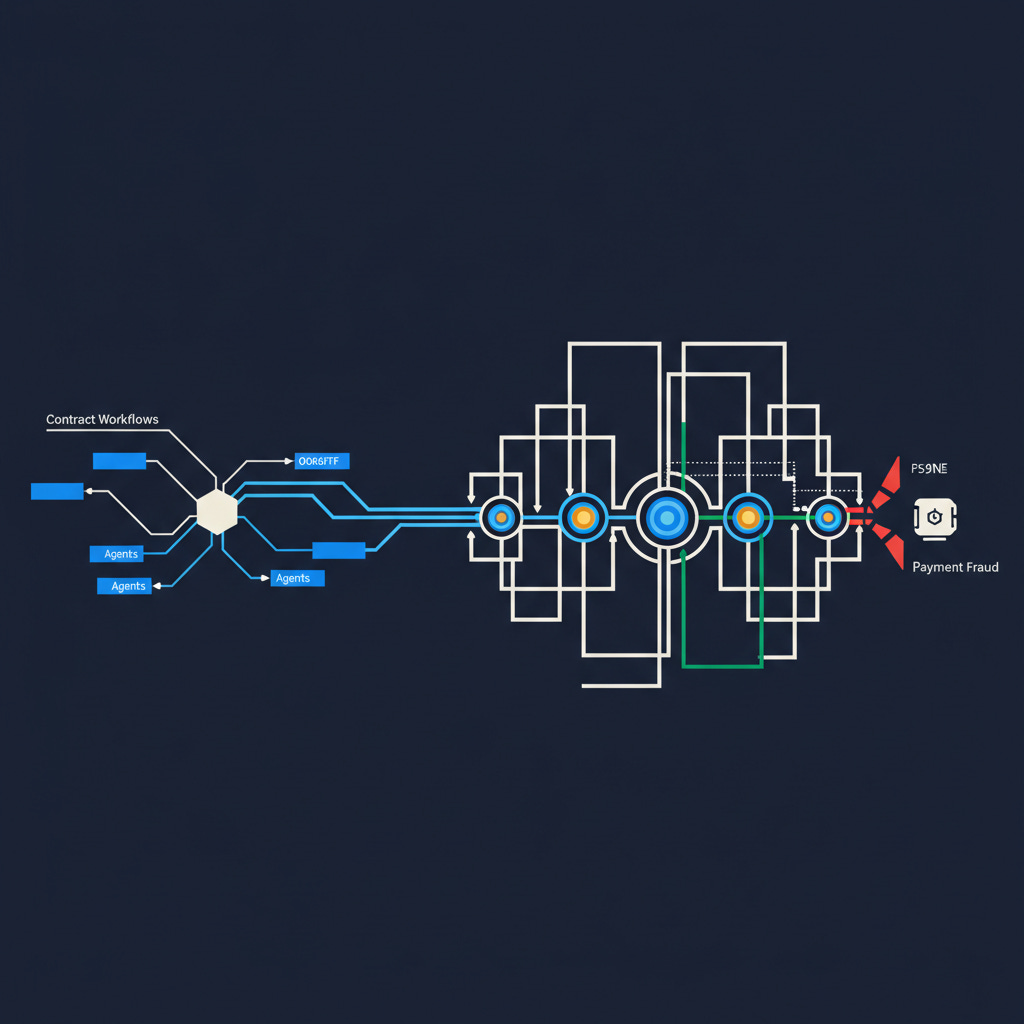
First, we implemented fail-closed validators before any probabilistic step involving payment execution. Before the LLM was allowed to draft a wire instruction, a separate, deterministic service had to validate the payee's identity. This service checked the counterparty's details against internal master records and external commercial databases. If the validator returned anything other than a definitive match, the workflow would halt and escalate to a human reviewer. The system was designed to fail securely, prioritizing payment integrity over straight-through processing.
Second, we architected tiered inference routing to manage costs and risk. The flagship models were reserved for complex document analysis and escalations flagged by the risk engine. For routine data extraction from structured settlement forms, a smaller, fine-tuned model was used, costing 90% less per transaction. This ensured that our most expensive compute resources were allocated to the highest-value, highest-risk decisions, preventing budget overruns on simple tasks.
Third, we enforced an immutable logging contract for every automated decision. Board and C-suite readers need ROI and risk metrics, not just architecture diagrams. To deliver this, every inference call had to be tagged with its workflow_id, model_id, and policy_version. This created an audit trail that allowed the model risk and internal audit teams to replay any decision without re-running a live model, satisfying regulatory requirements for explainability. The hidden technical debt in many machine learning systems is the inability to reproduce past predictions [2]; this logging contract paid that debt upfront.
Option: Central pool · Upside: Fast demos, low initial friction · Downside: Moral hazard, opaque $/decision, invites shadow IT
Option: Showback · Upside: Visibility into cost drivers · Downside: No direct budget pressure to optimize or retire failed pilots
Option: Chargeback + validators · Upside: Operable at scale, forces P&L ownership · Downside: Higher initial allocation overhead, requires mature FinOps
This approach required tight governance coupling. The model risk, security, and product teams had to agree on a unified definition of a "production change." We bundled the prompt, the retrieval corpus version, the rules engine hash, and even UI copy under a single change ticket. A rollback meant reverting one ticket, not chasing down changes across four different teams in Slack.
The Results
After implementing this control framework, the shift from a central cost pool to accountable, gated workflows produced measurable outcomes within three months. The focus on ownership and auditable gates delivered both the efficiency gains and the risk mitigation the executive team required.
Metric: Manual Payment Reviews · Baseline (Month 1): 1,800/month · Post-Implementation (Month 4): 630/month · Change: -65%
Metric: Fraudulent Transfer Exposure · Baseline (Month 1): Est. $1.2M annually · Post-Implementation (Month 4): Est. <$100K annually · Change: -91.7%
Metric: Avg. Verification Time · Baseline (Month 1): 48 hours · Post-Implementation (Month 4): 4 hours · Change: -91.6%
Metric: Human Override Rate · Baseline (Month 1): N/A · Post-Implementation (Month 4): 1.8% of automated approvals · Change: New control metric
The key was tying spend to value. Once workflow owners saw a monthly bill for their AI consumption ($/decision), behavior changed immediately. Low-value, high-cost processes that had flown under the radar were quickly challenged and optimized.
What Went Wrong
In a typical rollout, teams ship the model before the ledger. Our initial failure was precisely this. In month two, a well-intentioned legal ops team, frustrated with the pace of the central IT rollout, used a no-code platform to build their own document parser. It bypassed our identity verification API and booked its inference costs to a generic departmental software line.
This shadow automation processed 47 wires totaling $280,000 to unverified payees before a manual bank reconciliation caught the discrepancy. The tool was aimed at speeding up low-value settlements, but it lacked the fail-closed gates of the production system. The failure was not model quality—it was a process gap created by missing ownership and the lack of a non-negotiable, fail-closed payment gateway. Recovery started by routing all payment initiations, regardless of origin, through the single, validated service and assigning a P&L owner to every workflow.
Key Takeaways
Name the P&L owner before you name the model vendor.Gate probabilistic AI with deterministic checks for all regulated or high-risk decisions.Tag every inference call to a workflow ID and a budget line; what isn't measured cannot be managed.Your kill switch is part of the production spec, not a post-launch feature request.
Monday Morning Checklist
[ ] Assign a named P&L owner for the legal payment identity gates workflow in the Decision Ledger.
[ ] Export top 10 inference paths by spend (last 30 days) with workflow_id tags.
[ ] Document three kill-switch triggers: spend ceiling, error rate, human-escalation rate.
[ ] Pilot fail-closed validators on one high-risk path before expanding agent autonomy.
[ ] Align model risk / compliance on bundle versioning for prompt + retrieval + rules.
[ ] Schedule 30-minute review with finance: showback vs. chargeback for largest line.
References
The AI Operator Editorial Desk. (2026). Publication Operating System — Archive floor 600+ words.
Editorial transparency. Essays at The AI Operator may use AI-assisted research, drafting, and editing tools under staff editorial review. Facts, figures, and recommendations are checked before publication; we correct the record when evidence changes. Questions: hello@theaioperator.net.
Published on [Substack](https://theaioperator.net/p/legal-payment-identity-gates).
Automation can speed up payments, but it shouldn't reduce verification. The right controls are what make automation sustainable.