

Executive Summary
Google DeepMind CEO Demis Hassabis used a July 14 personal manifesto to argue that AGI is “probably only a few short years away” and that the United States should lead a new Frontier AI Standards Body modeled on Wall Street’s FINRA—industry-funded, federally overseen, with up to 30 days of pre-release evaluation before advanced models hit the market [1]. For risk, legal, and policy operators, the news is less the AGI timeline than the institutional design: a voluntary-to-mandatory gate that could become the U.S. market’s pre-deploy playbook by year-end if Washington buys the pitch [2]. Use this brief to pressure-test vendor release calendars, map capture and open-weights edge cases, and decide whether your board prefers a FINRA-style referee or an FAA-style blocker.
What Hassabis Is Proposing
In A Framework for Frontier AI and the Dawning of a New Age, Hassabis casts the moment as the “foothills of the singularity” and compares AGI’s upside to fire or electricity—impact “perhaps 10x of the Industrial Revolution at 10x the speed,” from drug discovery to clean energy to advanced materials [1]. The governance ask matches that urgency with a concrete institution, not a vague “safety culture” appeal.
When we look back on this time in the decades to come, I think we will realise we were standing in the foothills of the singularity — nothing less than the dawning of a new age for humanity.
The Standards Body would sit as a federally overseen public–private partnership or self-regulatory organization—much like FINRA—with independent technical experts and open-source representatives on the board, substantial funding “likely mostly” from industry, and enough compute to run large-scale tests [1][3]. It would define evolving “Frontier-class” benchmarks with federal agencies and U.S. National Labs, then treat labs that ship those models as Frontier Labs expected to publish model cards, harden cybersecurity, and resource safety research [1].
How the release gate is meant to work:
Frontier Labs voluntarily share models with the Standards Body for review up to 30 days before release.
Evaluators probe cybersecurity, biological threats, agentic deception / guardrail bypass, and related high-risk domains—with benchmarks refreshed (initially quarterly) and held-out tests built over time so labs cannot overfit [1].
Once protocols prove “effective and robust,” formalization follows: Frontier Models must pass to deploy in the U.S. market; the body can also coordinate a development slowdown among Frontier Labs if risk warrants it [1].
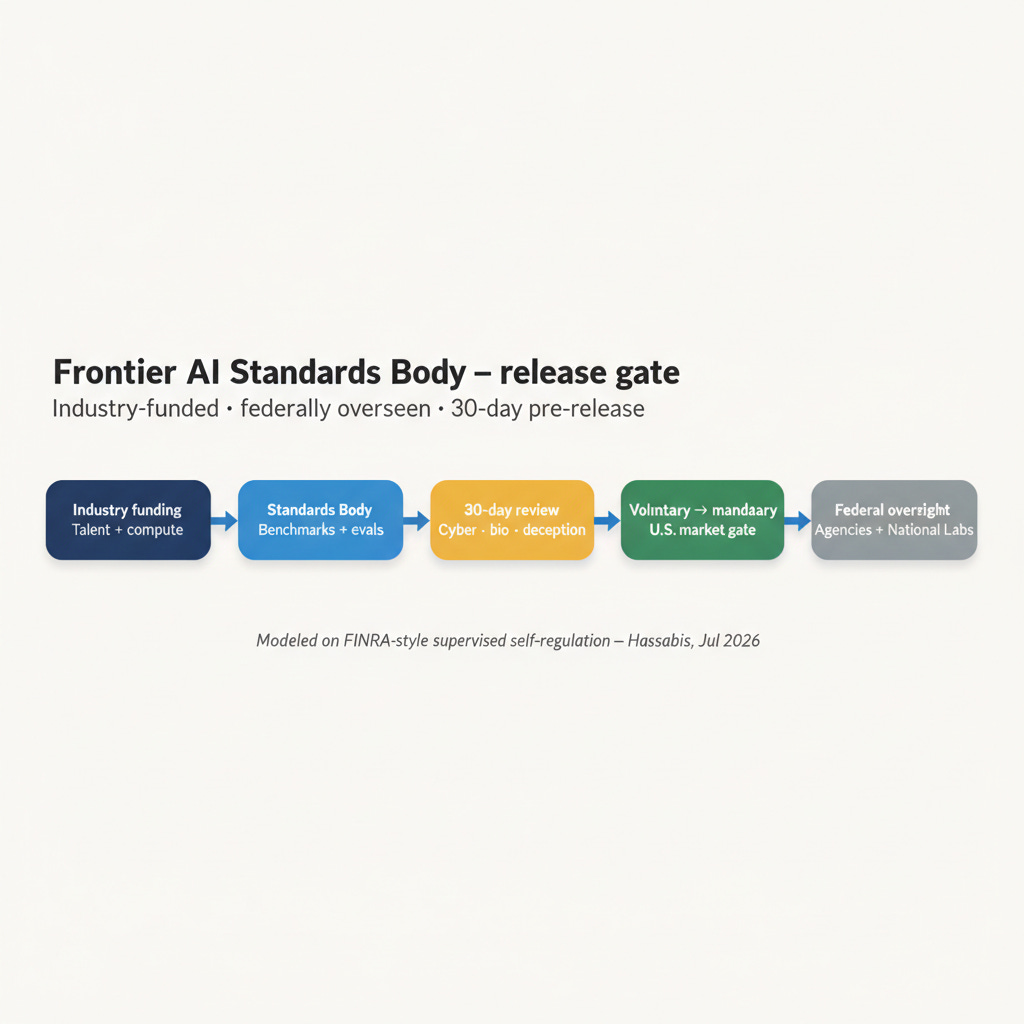
Figure 1. Industry funds expertise and compute; federal oversight and National Labs sit above a 30-day pre-release eval that starts voluntary and can become a U.S. market gate.
Hassabis stresses the framework would apply to frontier-class models regardless of country of origin or open vs closed weights—while exempting non-frontier startup and academic systems—and positions the U.S. effort as a seed for international standards [1]. Primary essay:
https://demishassabis.substack.com/p/a-framework-for-frontier-ai-and-the-dawning-of-a-new-age
The Context
The manifesto arrives after weeks of improvised Washington intervention. In an Axios exclusive, Hassabis called today’s cyber risks “warning shots” and said biological and nuclear threats could appear inside models—including open-source copies—within about 18 months; he also argued major labs’ future proprietary systems remain a core risk path [2]. The administration’s abrupt freeze of Anthropic’s Mythos and Fable models under export-control orders—followed by roughly two and a half weeks of negotiations without a published playbook—was, he said, “a bit of a wake-up call” [2]. OpenAI, per the same reporting, restricted GPT-5.6 to government-vetted partners at launch and only broadened release after Commerce Department negotiations [2]. CNBC likewise reported Hassabis’s call for a U.S.-led standards body focused on national-security-relevant testing [4].
That is the operator translation of “systematic” regulation: a predictable submission clock beats overnight freezes that strand product, procurement, and incident-response teams with no change-control script. Regulators and buyers learned the same lesson on different clocks—labs lost release certainty; enterprises lost failover readiness.
AGI Timeline and Dual-Use Stakes
Hassabis’s AGI claim is explicit and near-dated—“a few short years,” not a soft decade hedge [1]. Upside language is maximal (post-scarcity abundance); downside language is dual-use on the same capability ladder: the models that accelerate discovery also raise cyber offense, biological threat generation, nuclear-adjacent risks, and deceptive agentic behavior [1]. In the Axios interview he framed the design choice as getting a referee standing before dangerous capabilities diffuse beyond any single government’s control [2].
For boards, treat the timeline as Hassabis’s forecast, not consensus science—but treat the dual-use test suite (cyber / bio / deception) as the procurement-relevant surface if a Standards Body forms. The evaluation menu is the practical artifact: whatever Washington labels the institution, vendors will eventually need reproducible scores on those risk domains before U.S. market access hardens.
The Capture Critique
A fair reading of the proposal includes its critics. Self-regulatory organization (SRO) designs borrow FINRA’s industry-funded, government-overseen pattern [3], and legal analysts have argued supervised mutual regulation can be faster and more technical than slow statutes—while warning that small memberships concentrate power and demand strong independent boards, whistleblower paths, and a willing supervisory agency [5]. Architecture critics of Hassabis’s brief zero in on the slowdown clause: whether an industry-funded body will ever brake its own members’ commercial calendars [6].
Open-source and competitive-dynamics skeptics will also ask whether frontier benchmarks and 30-day eval compute become a compliance moat—formal prestige for incumbents that Google, OpenAI, and Anthropic can staff, while smaller open-weight projects struggle even if Hassabis writes that non-frontier systems stay exempt and that open-source seats sit on the board [1][6]. That tension is unresolved in the manifesto; operators should not pretend otherwise.
The other lab-leadership frame is stricter government teeth. In June 2026’s Policy on the AI Exponential, Anthropic CEO Dario Amodei argued risks are “clearly here” and that frontier models should face FAA-style testing with authority to block or reverse unsafe releases—not only transparent self-reporting [7]. Axios notes the Gemini and Claude camps now both want Washington in the loop, differing mainly on who holds final authority [2]. FINRA vs FAA is therefore the live design fight: industry referee with federal oversight, or a sharper government certification veto.
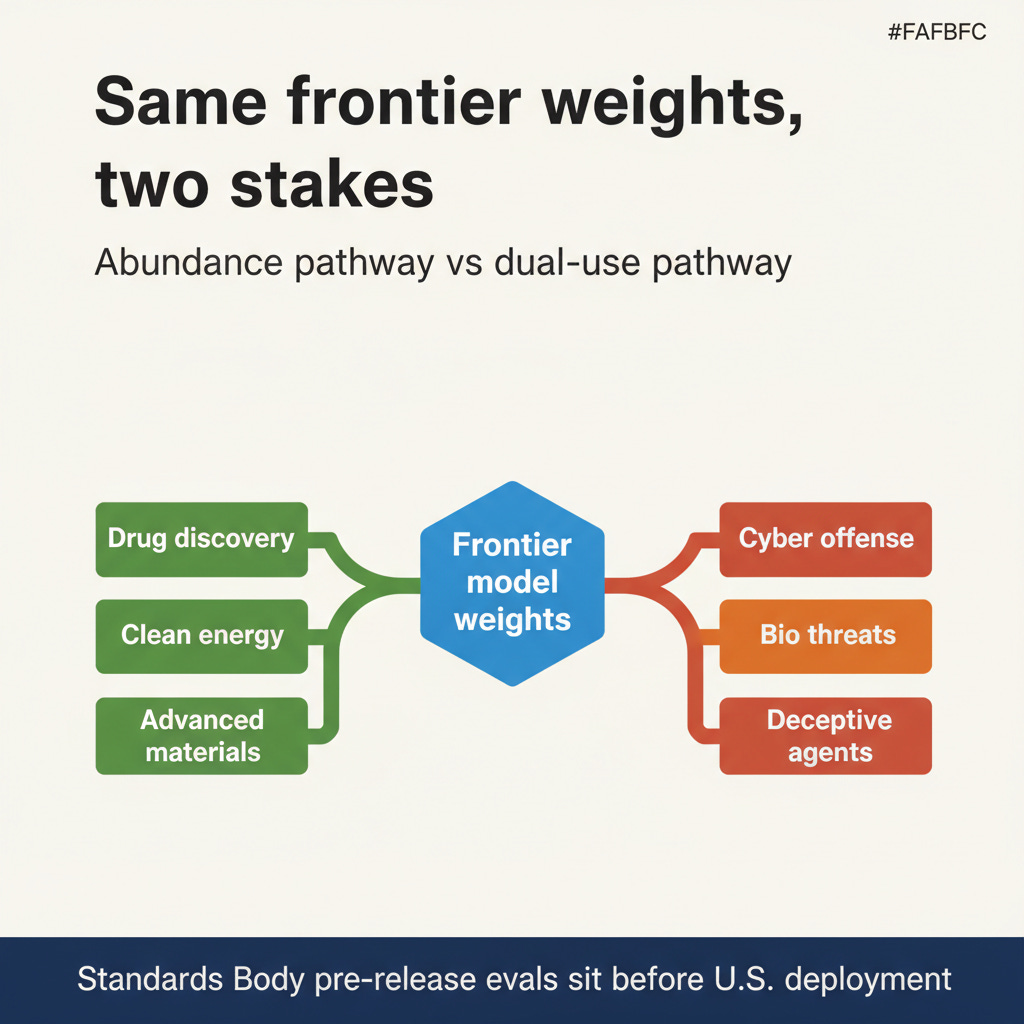
Figure 2. Same frontier weights support abundance pathways and catastrophic dual-use pathways; the Standards Body’s job is pre-release detection before market deployment.
The Approach
If your vendors ship near the frontier, run this as a one-week control review—not a philosophy seminar. Keep a simple risk/control matrix before the board asks which regulator metaphor you prefer:
Risk surface: 30-day pre-release freeze · Control ask: Named vendor submission owner + calendar · Owner: Procurement / vendor manager
Risk surface: Flagship model hold · Control ask: Multi-model failover with version pins · Owner: Platform / ML ops
Risk surface: Dual-use (cyber / bio / deception) · Control ask: Questionnaire + eval receipts · Owner: CISO + model risk
Risk surface: Capture / moat dynamics · Control ask: Track open-weight edge cases vs Frontier Lab thresholds · Owner: GC / policy
Risk surface: FAA-style block/reverse · Control ask: Document board appetite for government veto vs SRO referee · Owner: CRO / board risk
Ordered next steps:
Ask each frontier provider for a named owner of any 30-day pre-release submission path and what triggers “Frontier-class” in their internal threshold docs.
Map which of your production workflows break if a flagship model is frozen, delayed, or restricted to government-vetted partners (Commerce-path replay).
Prefer multi-model failover with version pins so an SRO or FAA-style hold on one API does not halt regulated decisions.
Document dual-use exposure language you need in vendor questionnaires: cyber-offense evals, bio-risk refusals, deception / agent sandbox results.
Brief the board on FINRA-style (industry fund + federal oversight) vs FAA-style (block/reverse) so risk appetite is explicit before year-end diplomacy hardens into statute or EO detail.
Hassabis told Axios he wants the body operational in “months,” ideally before year-end, and that administration signals have been “very positive” [2]. Whether that lands is still politics. What is already real is the pattern: ad-hoc freezes taught labs and buyers that U.S. market access can move overnight—and a Standards Body is one attempt to put a clock and a test suite on that volatility. Audit replay for enterprises starts now: log which model version powered each regulated decision so a future gate change is reconstructable.
Key Takeaways
Hassabis’s manifesto pairs a near-term AGI forecast with a concrete FINRA-style U.S. Standards Body—industry-funded, federally overseen, 30-day pre-release evals [1].
Axios reporting ties the urgency to improvised Mythos/Fable freezes and GPT-5.6 Commerce constraints—a playbook ask, not only a futurist essay [2].
Dual-use is the operator surface: cyber, bio, and deception tests on the same weights that promise scientific upside [1].
Capture and moat risks are live; Amodei’s FAA-style block/reverse frame is the clearest institutional counterweight [5][6][7].
This week’s action is vendor release ownership + multi-model failover—before voluntary windows harden into mandatory U.S. gates.
Monday Morning Checklist
[ ] Inventory flagship-model dependencies and named failover models for each regulated workflow.
[ ] Email frontier vendors: who owns a potential 30-day Standards Body submission and what are current internal “frontier” thresholds.
[ ] Add dual-use eval questions (cyber / bio / deception) to the next procurement questionnaire refresh.
[ ] Schedule a 30-minute GC + CISO brief on FINRA-style SRO vs FAA-style block/reverse designs.
[ ] Draft a board slide: “U.S. market access clock” using Mythos/GPT-5.6 as reported stress cases—not speculation.
[ ] Assign an owner to track year-end Standards Body diplomacy and update the Decision Ledger.
References
Hassabis, D. (2026, July 14). A Framework for Frontier AI and the Dawning of a New Age. Substack. https://demishassabis.substack.com/p/a-framework-for-frontier-ai-and-the-dawning-of-a-new-age
Axios. (2026, July 14). Exclusive: Google DeepMind’s Demis Hassabis calls for U.S.-led global AI watchdog. https://www.axios.com/2026/07/14/demis-hassabis-ai-regulation-google-deepmind
FINRA. (n.d.). About FINRA. https://www.finra.org/about
CNBC. (2026, July 14). Google DeepMind chief calls for U.S. to lead AI standards body. https://www.cnbc.com/2026/07/14/google-deepmind-demis-hassabis-us-led-ai-standards-body.html
Lawfare. (n.d.). AI Companies Can’t Regulate Themselves. They Should Regulate Each Other. https://www.lawfaremedia.org/article/ai-companies-can-t-regulate-themselves-they-should-regulate-each-other
FourWeekMBA. (2026, July 14). Google DeepMind’s Demis Hassabis Proposes a U.S. Frontier AI Standards Body — and the Architecture Deserves Scrutiny. https://fourweekmba.com/ai-google-deepmind-hassabis-frontier-ai-standards-body/
Amodei, D. (2026, June 10). Policy on the AI Exponential. https://darioamodei.com/post/policy-on-the-ai-exponential
Editorial transparency. Essays at The AI Operator may use AI-assisted research, drafting, and editing tools under staff editorial review. Facts, figures, and recommendations are checked before publication; we correct the record when evidence changes. Questions: hello@theaioperator.net.
Published on [Substack](https://theaioperator2.substack.com/p/hassabis-frontier-ai-standards).