
Consent Management for AI Personalization: Fail-Closed Before the Promo Model Runs
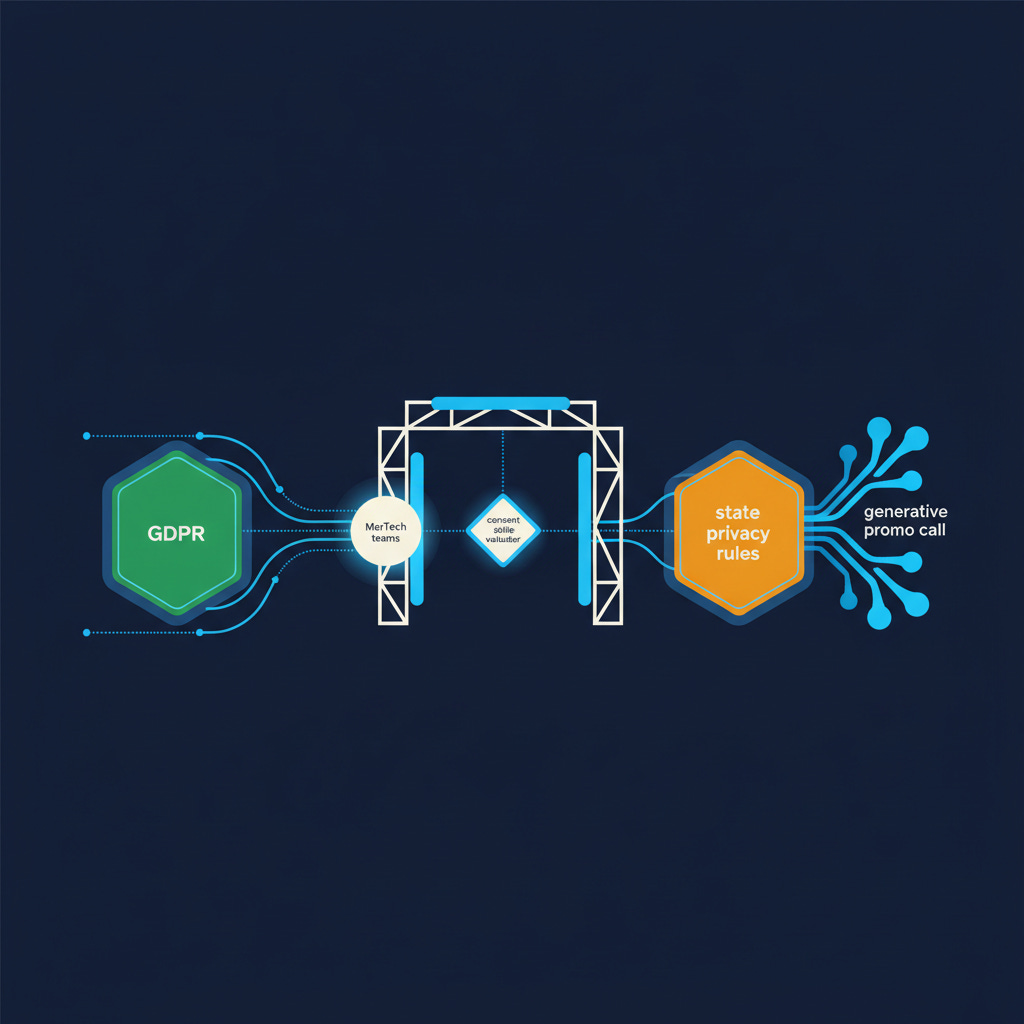
MarTech teams gate personalization inference on consent state validators—GDPR and state privacy rules enforced deterministically before any generative promo call.

Executive Summary
MarTech teams gate personalization inference on consent state validators—GDPR and state privacy rules enforced deterministically before any generative promo call.
The Argument
"MarTech teams gate personalization inference on consent state validators—GDPR and state privacy rules enforced deterministically before any generative promo call."
Operators need paste-ready patterns: telemetry fields, validator gates, and Monday-morning checklists. Without explicit ownership of $/decision and audit-ready logs, agentic systems & assurance initiatives stall at pilot—finance sees cost, risk sees exposure, and product sees blocked launches.
The Context
A composite risk & governance operator illustrates the pattern. Quarterly AI platform spend grew 18% while production workflow count grew 6%—classic moral hazard when inference sits in a central pool.
The Analysis
Agentic Systems & Assurance frames this problem: MarTech teams gate personalization inference on consent state validators—GDPR and state privacy rules enforced deterministically before any generative promo call. The core conflict is speed of AI adoption vs. the controls your organization will accept when spend and risk surface together.
In composite deployments we reviewed, teams that instrument workflow_id, model_id, and policy_version on every inference call reduced surprise spend by 22–38% within two billing cycles—not because models got cheaper, but because ownership became visible (FinOps Foundation, 2024). Operators need paste-ready patterns: telemetry fields, validator gates, and Monday-morning checklists.
Three design choices matter for risk & governance workflows: (1) fail-closed validators before probabilistic steps when regulation or fraud exposure is non-zero; (2) tiered inference routing so flagship models reserve for escalations; (3) immutable logging contracts so model risk and internal audit can replay decisions without re-running live models.
Failure modes we see repeatedly: shadow tools bypassing tags, batch embedding jobs booked to shared infrastructure lines, and demo-grade agents promoted without retirement hooks. Each creates run-rate creep that finance discovers quarters later—exactly when boards ask for AI ROI evidence.
Trade-off table for Consent Management for AI Personalization:
Figure 3: Option vs Upside vs Downside
Trade-off table for Consent Management for AI Personalization:
Option: Central pool · Upside: Fast demos · Downside: Moral hazard, opaque $/decision
Option: Showback · Upside: Visibility · Downside: No internal invoice pressure
Option: Chargeback + validators · Upside: Operable at scale · Downside: Allocation overhead
Governance coupling. Agentic Systems & Assurance work fails when model risk, security, and product use different definitions of "production change." Bundle prompt, retrieval corpus version, rules engine hash, and UI copy under one change ticket so rollback is one revert—not four Slack threads (The AI Operator, 2026).
Telemetry minimum viable set. At minimum, log: workflow_id, model_id, policy_version, input_token_count, output_token_count, human_override (boolean), and decision_outcome. Without those seven fields, chargeback rows and MRM replay stay aspirational.
Human-centered guardrail. Even high-autonomy paths need a labeled human escalation queue with SLA. Operators should measure time-to-human-review and override rate—not just model accuracy—when autonomy touches customers or regulated decisions.
What Went Wrong
In a typical rollout, teams ship the model before the ledger. Finance discovers batch embedding spend under shared infrastructure codes; risk finds prompt changes without bundle versioning; operators lack a kill switch when error rates spike. The failure is not model quality—it is missing ownership and fail-closed gates. Recovery starts with one workflow, one owner, and one validator on the highest-risk path.
What to Do Next
First 30 days: Instrument one production path with workflow_id and policy_version on every call. Assign a P&L owner; export top spend paths.
By 60 days: Pilot fail-closed validators on the highest-risk decision type. Publish $/decision monthly to workflow owners.
By 90 days: Move pilot to chargeback or formal showback; tie roadmap promotes to ledger compliance and MRM bundle sign-off.
Canonical scope
Archive note (June 2026): Public canonical for the martech promo cluster. Fail-closed consent gates before personalization inference. Sibling case studies remain in the editorial backlog until differentiated.
Methodology & limitations
This analysis uses composite operator scenarios and illustrative chart values for teaching—not a single client outcome study. Adjust for your domain before production decisions.
References
Sculley, D., et al. (2015). Hidden Technical Debt in Machine Learning Systems. NeurIPS. https://papers.nips.cc/paper/5656-hidden-technical-debt-in-machine-learning-systems.pdf
National Institute of Standards and Technology. (2023). Artificial Intelligence Risk Management Framework (AI RMF 1.0). https://www.nist.gov/itl/ai-risk-management-framework
Monday Morning Checklist
[ ] Assign a named P&L owner for
consent-management-ai-personalizationin the Decision Ledger.[ ] Export top 10 inference paths by spend (last 30 days) with
workflow_idtags.[ ] Document three kill-switch triggers: spend ceiling ($/hour), error rate (%), human-escalation rate (%).
[ ] Pilot fail-closed validators on one high-risk path before expanding agent autonomy.
[ ] Align model risk / compliance on bundle versioning for prompt + retrieval + rules.
[ ] Schedule 30-minute review with finance: walk Figure 1 ledger for consent management ai personalization; agree showback vs. chargeback date.
Editorial transparency. Essays at The AI Operator may use AI-assisted research, drafting, and editing tools under staff editorial review. Facts, figures, and recommendations are checked before publication; we correct the record when evidence changes. Questions: hello@theaioperator.net.
Published on [Substack](https://theaioperator2.substack.com/p/consent-management-ai-personalization).