


Executive Summary
Defining AI engineering for the agentic era: production constraints, governance, measurement, and the discipline that survives the demo.
What AI engineering is (and why it’s different)
Most AI projects do not fail in the demo. They fail when the demo meets real operations: owners are unclear, costs rise, quality drifts, and rollback is slow. Field evidence has shown this pattern for years in machine-learning systems (Sculley et al., 2015). AI engineering is the discipline that closes that gap by turning model capability into a service that can be run, measured, governed, and improved over time.
Working definition
To keep this clear and consistent, we use the Software Engineering Institute (SEI) definition as our base: AI engineering combines systems engineering, software engineering, computer science, and human-centered design to create AI systems for real mission outcomes. In practical terms, this paper uses AI engineering to mean running AI in production with clear reliability, safety, and accountability expectations. This framing aligns with the NIST AI Risk Management Framework and systems life-cycle engineering practice, and it is broader than only training or benchmarking a model.
AI engineering as a systems engineering domain
When the question is production, AI engineering is systems engineering with a stochastic subsystem. International life-cycle standards for systems (ISO/IEC/IEEE 15288) codify the same rhythm—requirements, architecture, integration, verification/validation, and operation—for engineered systems regardless of whether the risky component is mechanical, electronic, or learned (ISO/IEC/IEEE, 2023). None of that disappears because part of the stack is non-deterministic—it intensifies interface control, hazard thinking, and verification load. What changes is the physics: models drift, prompts and tools change daily, and outcomes are distributions, so classic verification and validation expands into evaluation suites, shadow traffic, canaries, and human gates—but those are still systems instruments, not a different profession.
AI engineering does not replace “systems engineer” as a job title trained on defense, aerospace, or capital-projects methods. It names the slice of systems work where the capability story is LLMs, retrieval, tools, and agents—and where failure modes span data, policy, cost, and authority, not only application bugs.
Everything after this section—history, production practice, agent mechanics, boundaries—is there to support that definition: why it emerged, what it looks like in stack diagrams and loops, and when declining AI is still a disciplined AI engineering outcome.
Here is the tension in one line. The business wants deterministic promises—reproducibility, audit trails, service-level objectives. Modern AI is probabilistic. Good AI engineering does not pretend that tension away. It manages it with control planes, evaluation, and governance.
Key idea — the reliability envelope. Picture layers. Data and lineage sit at the bottom. Policy and access sit above. Evaluation and observability run through the middle. Human gates cap the stack when stakes are high. “Agentic” does not mean “no humans.” It means you decided where judgment must live.
Moving from copilots to agents (planning, tools, persistent state) makes the problem harder, not easier. The edge is less often “which foundation model” and more often “can we ship, observe, test, and govern this like any other critical system?”
Who this is for. We wrote this for operators: engineering managers, tech leads, product leaders, architects. The central decision is not only model choice; it is whether you are building a repeatable capability—data, evaluation, policy, accountability—or renting demos forever. Build vs buy and platform vs one-off are AI engineering decisions too.
Day to day, three jobs run in parallel: product (latency, UX, integration), model stack (data, prompts or training, evaluation), and defensibility (security, ethics, audit). Fund only one lane and you get a model in search of a system. Everything that follows—history, production mechanics, boundaries—threads back to that trio.
Evidence posture. Operational claims here lean on institutional guidance (SEI, NIST), international standards (e.g., ISO/IEC/IEEE 15288; SWEBOK-style software quality), peer-reviewed ML-systems and software-engineering studies, and foundations reports where the citation is part of the argument—not ornament. Market forecasts and vendor roadmaps are treated as directional unless you reproduce them on your telemetry; composite case studies are illustrative, not data.
How to read this. The line of argument runs definition → why the discipline was inevitable → how to implement it → where it should stop. The production section introduces the reliability envelope first, then unpacks core vs shell, operations loops, orchestration, and multi-agent topologies in order of appearance. Tables in the body are there when a team needs a shared snapshot. A short quick reference before References lists key terms for handoffs—not a second document to memorize. The Conclusion synthesizes the evidence for the same definition.
Where the discipline came from
The discipline showed up when models left the notebook and entered operations—real money, regulated data, and real accountability. This history matters because it explains why AI engineering exists: every capability leap widened the gap between what a model can do and what an organization can safely promise. The clearest way to feel that shift is in rough calendar order: early logic and hard questions; a workshop that named the field; long winters and patient field work; public matches that rewired expectations; then data, scale, and generative stacks that made continuous engineering unavoidable.
1943–1956: Logic, a famous question, and a named field
McCulloch and Pitts (1943) wired idealized “neurons” to logic—ideas you could analyze, not only argue about. Alan Turing (1950) posed the imitation-game frame we still use when we ask how to judge machine intelligence.
There is no single “inventor” of AI. There is a launch historians agree on. In 1955, John McCarthy, Marvin Minsky, Nathaniel Rochester, and Claude Shannon proposed the summer workshop at Dartmouth College—McCarthy coined the label Artificial Intelligence. The invitation promised language, concepts, hard problems, even self-improvement; the 1956 gathering did not finish those goals in a single season. It named a cohort, drew funders and students to the same bet, and replaced lone folklore with a research program you could criticize, fund, and extend.
1970s–1990s: Winters, expert shells, and statistical realism
By the 1970s, headlines outran measured progress. James Lighthill’s general survey (1973), commissioned for a UK science symposium, became a focal point for critics who argued AI had under-delivered on its claims; UK funding tightened, and similar skepticism hit pockets of U.S. research too—the familiar AI winter pattern: hype without evidence punishes teams that measure honestly. The durable lesson is operational: traceability, scoped claims, and eval discipline are how trust—and funding—come back.
Work did not stop. Expert systems kept logic explicit inside bounded domains—honest engineering with narrow shoulders. In parallel, statistical ML traded some whiteboard clarity for benchmarks that moved—and tied behavior to data and time. Drift and retraining turned “ship once” into operate forever. DARPA-era statistical speech exemplified fielded ML: error rates tied to deployment constraints, not lab bravado.
1996–1997: Kasparov, Deep Blue, and chess under stadium lights
In February 1996, in Philadelphia, Garry Kasparov—then world chess champion—defeated IBM Deep Blue 4–2 over six games. A year later, in May 1997, the rematch in New York City went to Deep Blue 3½–2½—often described as the first time a reigning world champion lost a regulation match to a computer under classical rules—and computer chess stepped into prime time. Deep Blue was custom silicon, massive search, grandmaster opening knowledge, and evaluation tuned for classical time controls—not a clever script on a laptop.
Game 2 in 1997 became lore: a deep plan by the machine rattled Kasparov enough that commentators still argue psychology versus tree search. For operators, the point is not mysticism. Stage-ready capability is a systems outcome—hardware, software, curated corpora, crews, and match-day discipline—under lights hot enough to melt a narrative. The board was never separable from the backstage work.
2009–2012: ImageNet and AlexNet reboot the compute-and-data race
The ImageNet dataset (2009) and AlexNet (2012) relit the contest for data, compute, and leaderboard discipline—deep learning stopped being a curiosity and became an engineering sport.
2016: Lee Sedol, AlphaGo, and Move 37
Go had been framed as sanctuary—branching so wide that brute force would lag for years. March 2016, Seoul: AlphaGo faced Lee Sedol in a match streamed live to millions who did not need the rules memorized to feel the stakes.
Game 1 went to the machine. Game 2 produced Move 37—eccentric at first sight, beautiful in hindsight. Sedol left the hall for air and a reset because the board quit matching his story. This was not Hollywood AGI. It was a lesson that engineered systems can outrun intuition—and that evaluation, incident practice, and humility belong in the same budget as model depth.
2017–2020: Transformers and the foundation-model turn
In 2017—a little over a year after the Sedol match—the transformer architecture reframed sequence modeling for the whole field. GPT‑3 (2020) dragged prompts, guardrails, and cost-per-token into ordinary product conversations. Few powerful bases and many adapters mean failure modes can travel; systemic risk discussions now treat foundation-model supply chains as shared infrastructure.
Pull the camera wide: it is still a relay. Every handoff grows the engineering surface—interfaces, metrics, named owners. References carries the footnotes.
One widely cited observation explains why this transition accelerated:
“The biggest lesson that can be read from 70 years of AI research is that general methods that leverage computation are ultimately the most effective, and by a large margin.” — Rich Sutton, The Bitter Lesson (2019)
Scale brings capability. Systems engineering brings what operators need: contracts, safety, evidence, recovery. LLM ops extends MLOps patterns to prompts, tools, retrieval, and agent graphs. CMU SEI frames the enduring truth: AI-heavy systems are software-heavy, with more uncertainty, coupling, verification load, and exposure (Horneman et al., 2019, *11 Foundational Practices*). When many products lean on the same few bases, controls, evaluation, and governance belong in the architecture.
In schematic form, three eras describe how the engineering burden expanded—each era inherits the last and adds new surfaces to own:
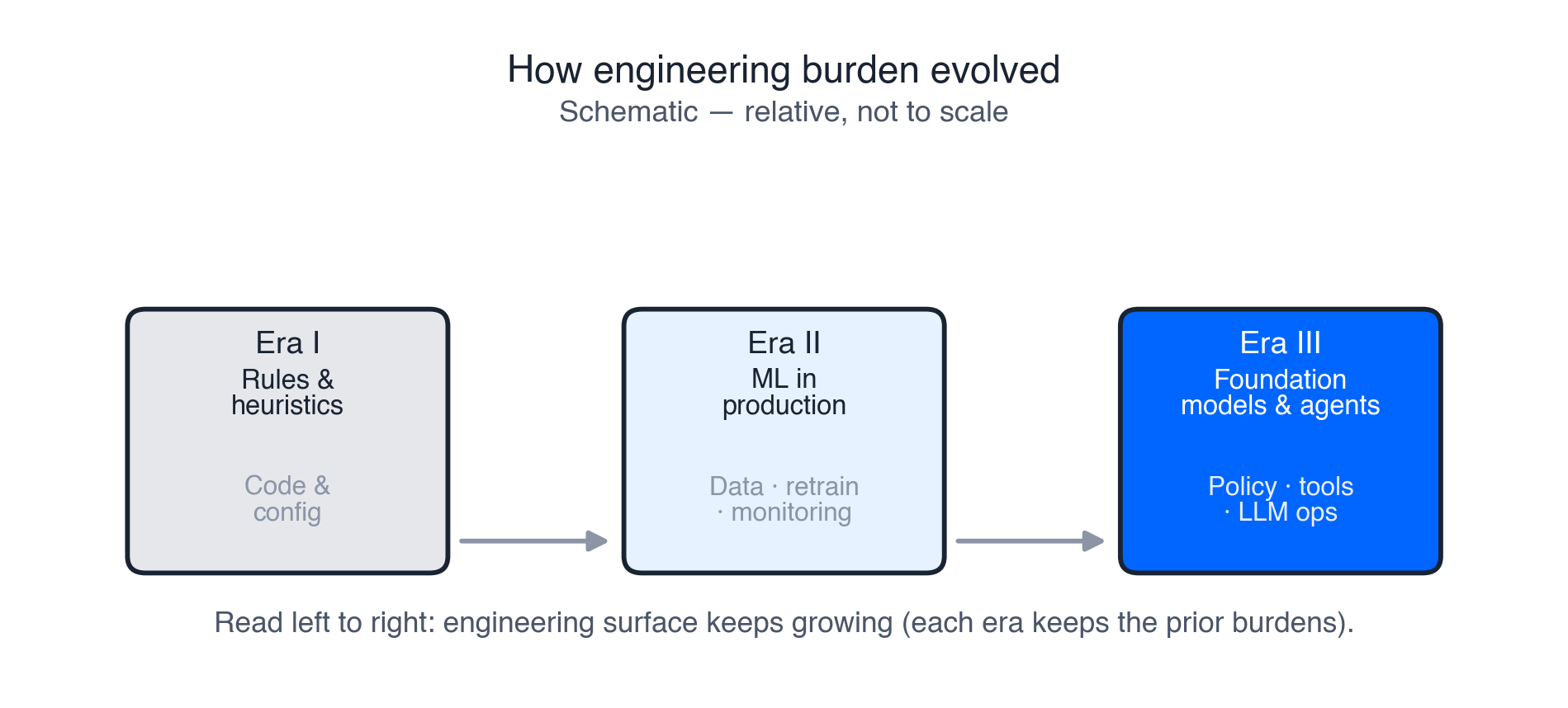
Figure 1: From rules to agents—engineering surface area
A timeline of engineering scope: rules live mostly in code; operated ML adds data + retraining + monitoring; agents add policy, tools, and eval. Each era inherits the last—so reliability work grows unless you invest in shared platforms.
Why “demo culture” is ending
That older winter was largely about funding; today’s flavor of the same trap is often attention—the over-promise cycle can run inside a single fiscal year. Execution beats slide decks when cost to serve, incidents, tool governance, and reproducibility become non-negotiable—and when prompts stay unversioned folklore.
Andrew Ng’s early framing still captures the breadth of adoption pressure:
“Just as electricity transformed almost everything 100 years ago, today I actually have a hard time thinking of an industry that I don’t think AI will transform in the next several years.” — Andrew Ng, Stanford GSB (2017)
The teams that pull ahead share a boring trait: they manage AI like inventory and liability—knowing what is deployed, to whom, under which policy revision, with which eval thresholds, and how to roll back without heroics. That discipline is the precondition for compounding: you cannot improve what you cannot observe, and you cannot observe what you never instrumented.
Role distinctions: data science, ML engineering, and AI engineering
Three responsibilities should stay in sync: discovery (choosing the right problem and deciding when non-AI is better), delivery (shipping and operating reliably), and defensibility (trust, auditability, and accountable ownership). Titles vary; one person often wears more than one hat.
Here, AI engineering means making probabilistic parts safe and legible in real systems—contracts, lineage, evaluation, governance—not only training or serving weights. Data scientists lean to evidence and early models. MLEs lean to scale and MLOps. AI engineers tend to sit where those streams meet product, security, and risk—often the same integration and operating hat a systems thread wears when the product is more than one stack (data · model · tools · people). The table is illustrative—use it for handoffs, not to box people in.
Focus · Data scientist: Insight and proof the problem merits AI · Machine learning engineer: Deploying and operating models as services · AI engineer: Trusted, mission-ready systems—model + data + policy + people
Often owns · Data scientist: Analysis, experiments, uncertainty comms · Machine learning engineer: Performance, packaging, pipelines, monitoring hooks · AI engineer: Integration, robustness, eval gates, HITL, audit trails
Tools (typical) · Data scientist: Python, R, notebooks, pandas, sklearn · Machine learning engineer: PyTorch/TF, containers, schedulers, features · AI engineer: LLM/MLOps stacks, policy-as-code, observability, V&V patterns
The CMU SEI practices in the next subsection turn that scope into a checklist teams can self-score.
CMU SEI: eleven practices that still define the bar
On paper these look like process. After your first bad launch they read like a damage report. Each row is a habit that prevents repeat incidents when teams mistake a model artifact for a live system.
#: 1 · Practice (summary): Confirm the problem should be solved with AI—and that simpler options are not better.
#: 2 · Practice (summary): Build integrated teams: domain experts, data engineers, ML practitioners, and software architects.
#: 3 · Practice (summary): Treat data as a first-class engineering surface: ingestion, cleansing, protection, monitoring, bias, adversarial exposure.
#: 4 · Practice (summary): Select algorithms for mission fit and robustness—not trend or benchmark prestige alone.
#: 5 · Practice (summary): Secure the expanded attack surface with continuous evaluation and mitigation.
#: 6 · Practice (summary): Define checkpoints for recovery, traceability, and justification of decisions.
#: 7 · Practice (summary): Fold UX and human feedback into model and architecture evolution; watch for automation bias (over-trusting machine guidance; Parasuraman & Manzey, 2010).
#: 8 · Practice (summary): Design for interpretation of ambiguous outputs and explicit uncertainty handling.
#: 9 · Practice (summary): Prefer loose coupling so data and model changes do not cascade unpredictably.
#: 10 · Practice (summary): Budget for continuous change in skills, compute, storage, and time across the lifecycle.
#: 11 · Practice (summary): Treat ethics as both design and policy—data, use cases, representation, and outcomes.
Newer large-language-model operations tooling does not replace this list; it instantiates it. Prompt templates, evaluation harnesses, traces, and rollback are what practices 3, 6, 8, and 10 look like when the moving parts are language models and tools. This is exactly why this section belongs in an AI engineering paper: it translates principles into operational controls.
Aligning practices with NIST AI RMF functions
The NIST AI Risk Management Framework (AI RMF 1.0) sorts life-cycle work into Govern, Map, Measure, and Manage (NIST AI 100-1). SEI is not a NIST certificate. The two rhyme: both say risk, evidence, and ownership belong in design, not in a binder after launch.
For federal or regulated settings, the map below is indicative—a conversation starter with security and compliance, not legal advice.
NIST AI RMF function: Govern · AI engineering controls (what teams implement): Define scope and risk appetite; assign accountable owners; set policy for acceptable use, review gates, and lifecycle resources. · Typical evidence artifacts (what proves control): Risk register, ownership matrix, policy-as-code repository, escalation runbooks, approval logs.
NIST AI RMF function: Map · AI engineering controls (what teams implement): Identify context, stakeholders, data boundaries, and failure modes; map model and tool dependencies; define blast radius by use case. · Typical evidence artifacts (what proves control): System context diagrams, data lineage maps, threat models, hazard analyses, dependency manifests.
NIST AI RMF function: Measure · AI engineering controls (what teams implement): Run pre-release and continuous evaluation (quality, safety, robustness, latency, cost); monitor drift and uncertainty; test controls. · Typical evidence artifacts (what proves control): Evaluation dashboards, regression test reports, calibration and drift reports, trace samples, benchmark history.
NIST AI RMF function: Manage · AI engineering controls (what teams implement): Mitigate and respond: rollback, retrain or reprompt, tighten access, update controls, and feed incidents into the next release cycle. · Typical evidence artifacts (what proves control): Incident postmortems, rollback records, change tickets, corrective action plans, retraining/release notes.
Three pillars: rigor, operationalization, ethics
The SEI pillars formalize the same trio the introduction used in plain language:
Systems rigor — Lineage for data and models. Robustness when the world shifts. Security posture. Human teaming: who watches what, when things break.
Product operationalization — Run models and agents like product services: orchestration, cost caps, wiring into how the company decides, workflows that feel like shipping software.
Socio-technical ethics — Ethics as runtime: accessibility, consent, oversight-by-design, and clear risk envelopes when stakes are high—aligned with human-centered AI emphases on reliable, inspectable, and accountable automation.
On that third pillar, law and policy increasingly ask what duty of care should look like when harm scales. Engineering ethics already says be honest, be competent, be accountable when software touches many lives. In operations that becomes oversight-by-design: checkpoints, logs, and guardrails that block accessibility regressions and dark patterns. Call it controls for autonomy—clear enough for oversight, flexible enough for messy reality.
How standards, academia, and the operating stack align
NIST, IEEE SWEBOK-style guidance, and strong university reports all describe the same work on the ground: data contracts, eval discipline, deploy controls, observability, and named owners across the life cycle.
Treat them as maps, not textbooks. Cloud architecture playbooks from big vendors are examples of how the bar lands on a specific stack—they do not replace your risk process or the evidence standards in References. Stanford HAI’s AI Index tracks macro adoption and concern—directional context until you check your own telemetry and incidents.
How it works in production
This section is mechanics: where the paradox hits steel and concrete—where teams ship, break, recover, and learn. It is the core proof that AI engineering is an operating discipline, not a model-selection exercise. It follows Figure 2’s order—data and lineage → policy and access → evaluation and observability → human gates. Large-language-model operations and agent patterns plug into that spine; they do not replace it.
A 2026 operator playbook (what to do Monday morning)
If you want this paper to translate into action, start here. The goal is to build a small set of evidence-producing artifacts that make AI systems operable: you can ship, measure, roll back, and explain what happened.
The six artifacts that change everything:
System boundary + threat model — what the AI can access, what tools exist, what “never” means (and how it is enforced).
Data lineage and retention policy — what is indexed/retrieved, freshness rules, and what is logged (or explicitly not logged).
Evaluation suite + golden set — a regression harness that runs on every prompt/tool/retrieval change (not only on model upgrades).
Policy-as-code — role-based access control, tool allowlists, and deny-by-default behavior tied to the deployment pipeline.
Tracing + incident runbook — trace IDs, on-call views, rollback steps, and escalation rules that do not require heroics.
Release gates — clear promote/hold/rollback thresholds (service-level objectives, budget caps, and safety checks) with an owner.
30 / 60 / 90 days (practical sequence):
First 30 days: pick one high-value workflow; define blast radius; ship instrumentation + tracing; stand up a baseline eval suite; implement the first policy gate on tools.
By 60 days: add canary + rollback; connect evaluation to continuous integration; establish a weekly review of failures/corrections to grow the golden set.
By 90 days: harden access controls; add red-team style tests for tool misuse and data leakage; turn incident learnings into stable policy and regression tests.
The paradox: probabilistic cores, deterministic contracts
Noise below, contracts above. At the core, outputs vary. At the edge, the business still signs fixed promises on latency, safety, auditability, and recovery.
Envelope layers in plain language
Data and lineage — what the model and tools may see, how it was produced, and how it changes over time (freshness, authority, consent).
Policy and access — who may invoke what (RBAC), which tools exist, and deny-by-default when scope is unclear.
Evaluation and observability — behavioral tests, regression gates, traces, and dashboards that turn “it looked fine” into evidence.
Human gates — where expert judgment or approval is mandatory; often the source of labeled corrections that feed the next eval cycle (see composite case study below).
These layers are the reliability envelope in operational form—Figure 2 is that scaffold drawn end to end.
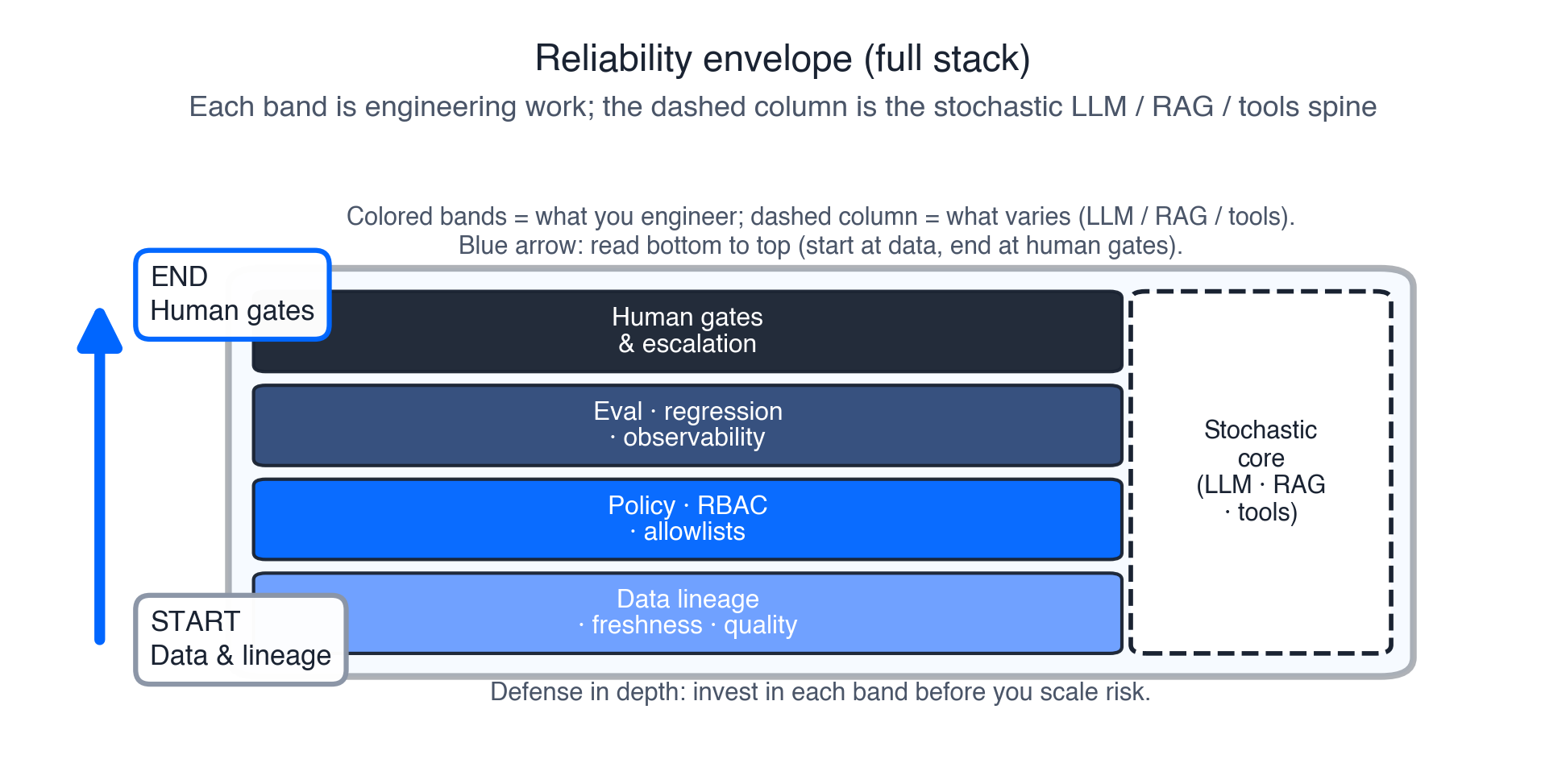
Figure 2: Reliability envelope
Outer shell = reliability envelope. Governance bands (data → policy → eval → human gates) sit beside the dashed stochastic core—the varying model/RAG/tools column every band must constrain. The left arrow runs bottom-to-top: START (data & lineage) → END (human gates).
The next figure zooms into the same idea from another angle: where variance lives versus what makes it signable in production.
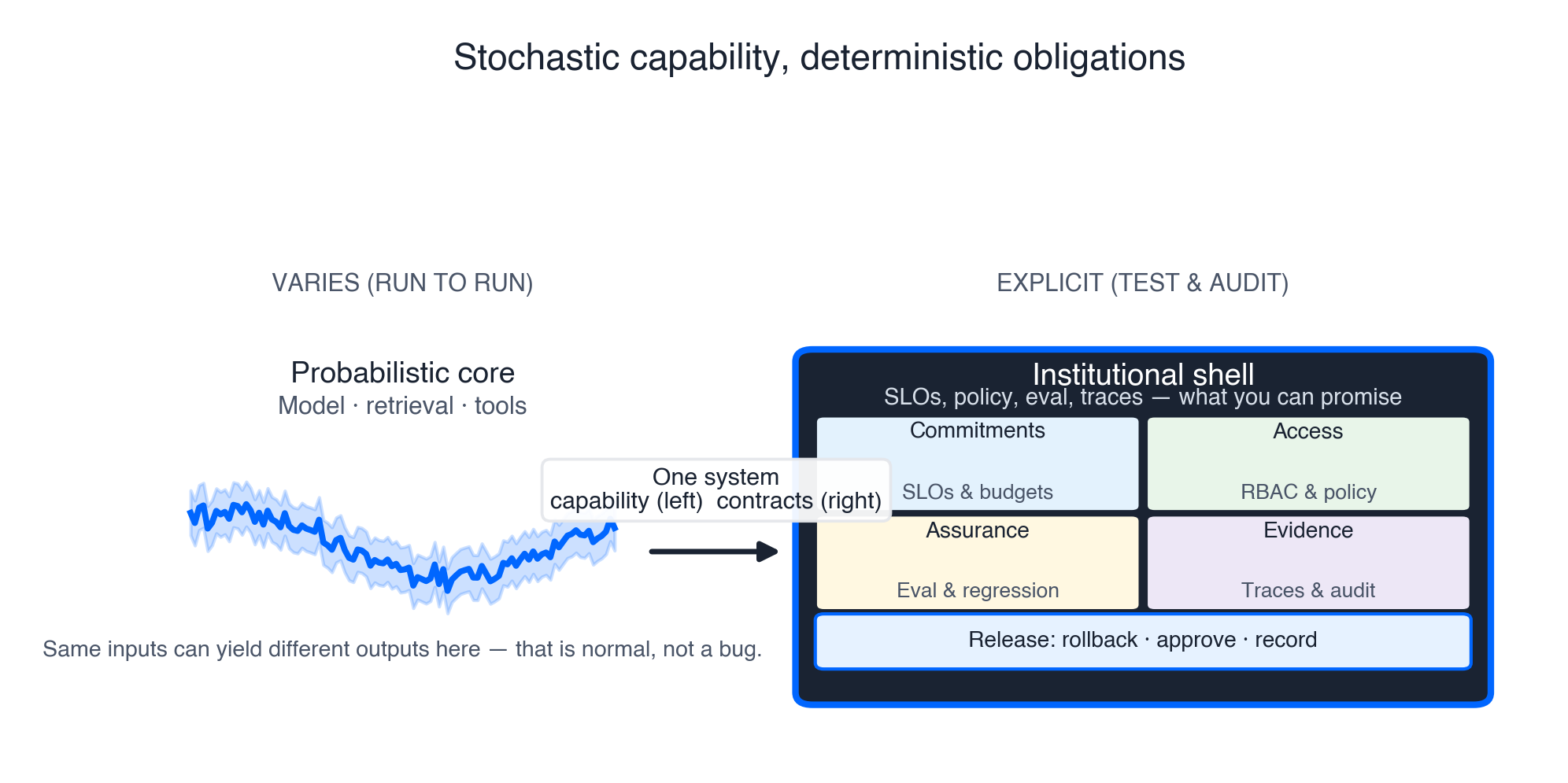
Figure 3: Probabilistic core, institutional shell
The left side is where variance is expected (model + retrieval + tool selection). The right side (institutional shell) is what you make testable and auditable: commitments (SLOs/budgets), access (RBAC/policy), assurance (eval/regression), evidence (traces/audit), and release discipline (rollback/approvals).
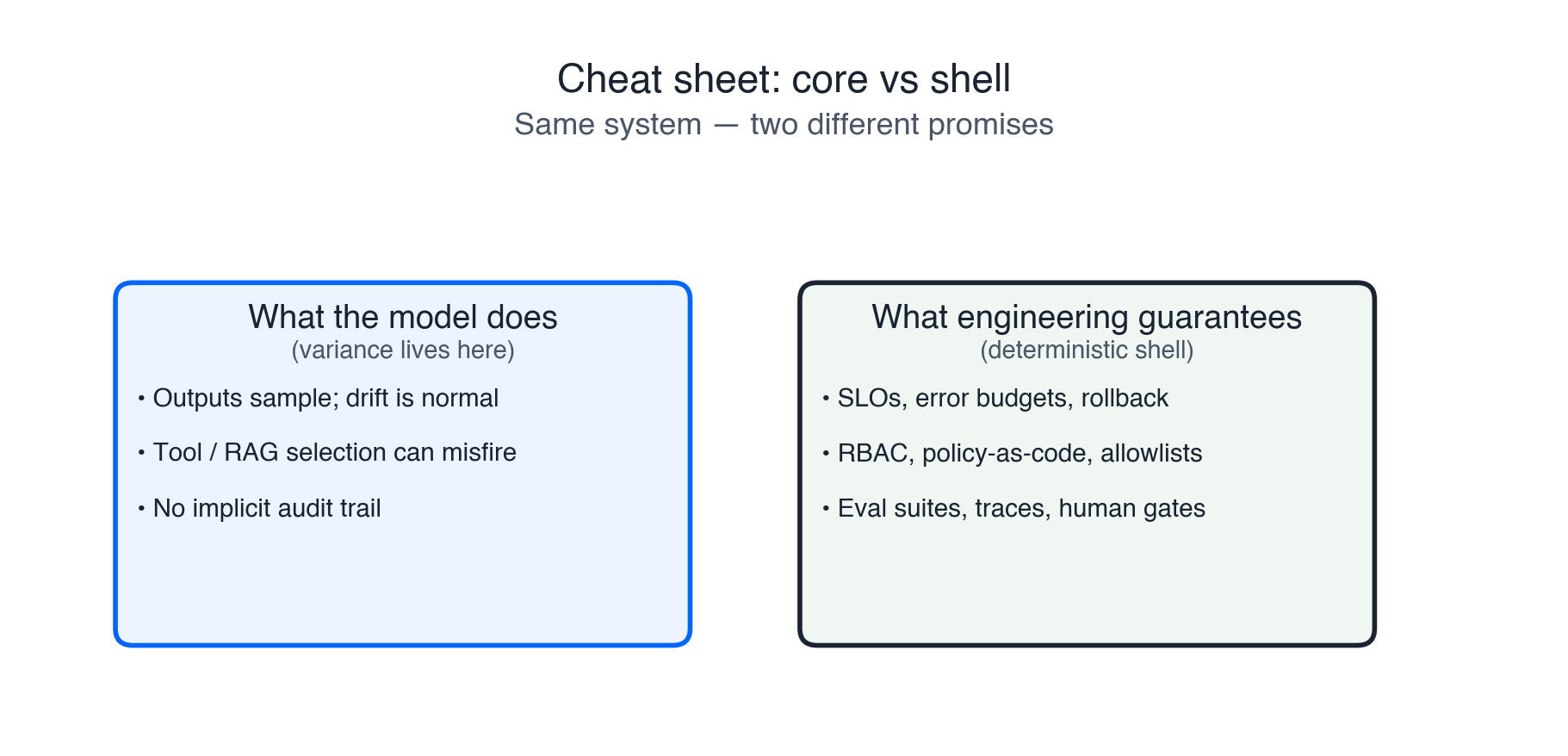
Figure 4: Core vs shell — cheat sheet
Scannable contrast: probabilistic behaviors versus the deterministic obligations engineering must make explicit.
Daily reality: variable prompts, mis-selected tools, and RAG (retrieval-augmented generation)—which grounds generations in retrieved documents but inherits whatever gaps live in the index (staleness, authority, coverage)—unless freshness and corpus policy are explicit (Lewis et al., 2020). Mature teams cluster mitigations into four moves:
Grounding and memory policy — allowed corpora, freshness rules, citation discipline, and refusal when evidence is insufficient.
Access and policy — RBAC (role-based access control: who may invoke which tools and see which data) on inference and tools, not only on dashboards.
Evaluation and regression testing — behavioral metrics (quality, safety, factuality proxies) tied to CI/CD, not one-off manual review before a keynote.
Observability — tracing through chains and tool calls so failures are debuggable engineering events, not anecdotes.
That bundle is LLM ops: versioned artifacts and continuous operation—the same SEI habits encoded in the practice table above, expressed for generative systems. Mature practice treats prompts, tools, retrieval connectors, and policy as version-controlled configuration behind evaluated endpoints.
Shift-left testing in this world has four layers: (1) automated CI tests when weights, prompts, or RAG connectors change; (2) property-style or synthetic tests where maturity allows; (3) behavioral metrics (toxicity, PII (personally identifiable information) leakage, factuality/rubric scoring, plus human spot checks for high-stakes use); and (4) auditability via feedback registries and traces—consistent with model reporting norms that tie deployments to documented performance and limitations (Mitchell et al., 2019). The goal is simple: turn production failures into inputs for the next prompt or policy revision, not one-off firefighting.
Contracts, not vibes. Ops teams speak in service-level objectives—numeric promises about availability and behavior over time—and manage tradeoffs with error budgets (see site reliability engineering treatment in Beyer et al., 2016). Model teams speak in distributions. AI engineering translates: which indicators prove “good enough,” how much budget you spend on experiments, and when an evaluation dip blocks release vs becomes a research ticket. Skip that bridge and a single accuracy number becomes undefined pain for the people shipping fixes.
Outcome metrics for mission systems usually include more than headline accuracy:
Latency percentiles (for example, 90th and 99th percentile), not only means—tail behavior is where customer trust dies.
Availability and error budgets spent on change versus firefighting.
Eval regression gates and policy/version checks on every promote.
Fail-closed or deny-by-default success rates when policy or retrieval is ambiguous—how often the system refuses rather than hallucinates a path.
Audit completeness: share of high-stakes actions with trace ids, policy versions, and human decisions attached.
That list is cousin to classic software quality: state the requirements, measure behavior, control change—SWEBOK in a nutshell—just with a stochastic core.
Case study (composite): A day in production. In the morning, a team promotes a new prompt template with a stricter tool allowlist. Golden-set evaluations pass in continuous integration. Canary traffic looks clean for an hour—then support sees mis-routed refunds. An on-call engineer follows the trace id: a connector returned a partial schema; the model improvised a field mapping. Rollback to the previous release takes minutes because prompts, tool manifests, and evaluation thresholds are versioned like code. The incident is boring in the best sense—recoverable because the loop exists.
HITL as MLOps data (composite). In a regulated workflow, a domain expert overrides a bad draft: the correction is stored with the same trace id, de-identified as required, and reviewed weekly. Approved rows merge into an offline golden set used in CI; thresholds block promotion if regressions appear. Human-in-the-loop is not only a safety gate—it is a labeled signal that closes the loop between production reality and the next prompt or policy revision (the same flywheel offline teams call continuous improvement).
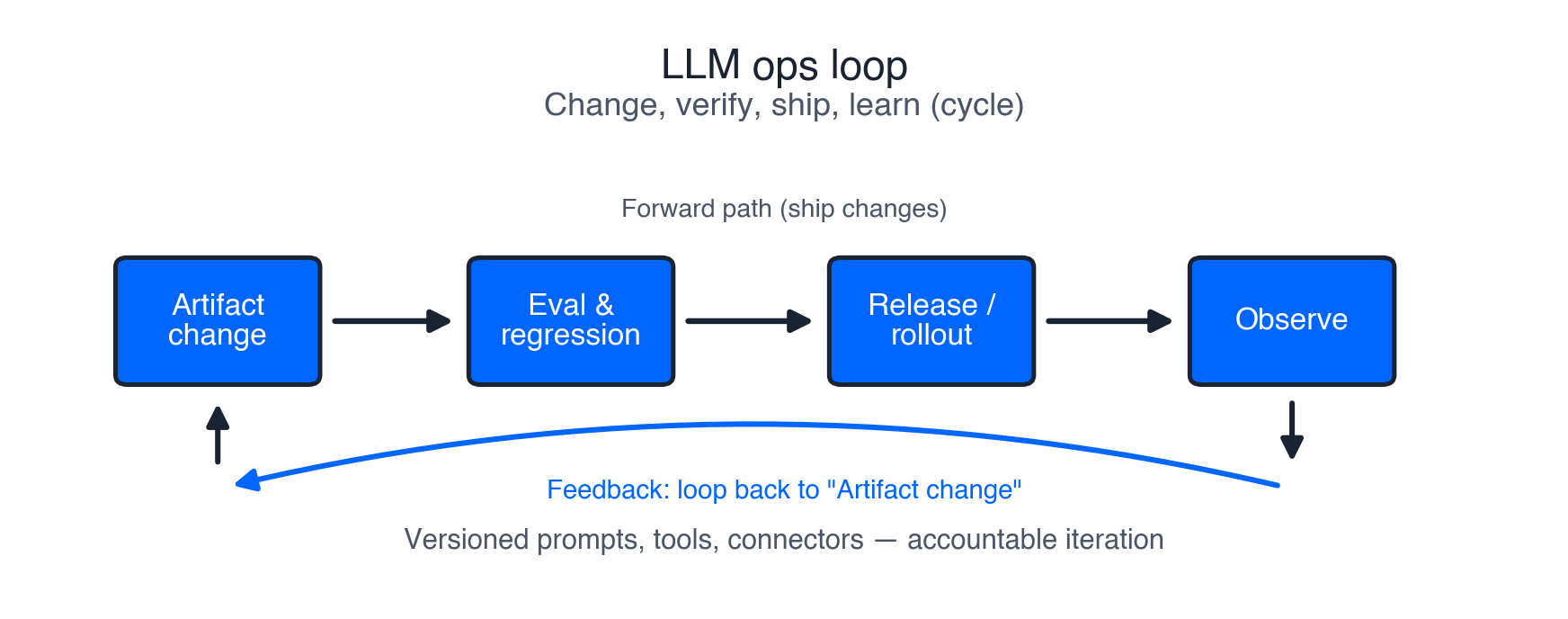
Figure 5: The LLM ops loop
A production loop for prompts/tools/connectors: version a change → evaluate/regress → stage/roll out → observe traces and outcomes → learn and iterate. The value is recoverability: regressions become rollbacks, not mysteries.
When the story breaks (composite failure). An internal agent reaches a customer record via an over-privileged tool, answers from a stale RAG index, and takes an action no trace ties to a human-approved policy version. Root causes differ, but the pattern is constant: missing policy, missing lineage, missing trace. AI engineering is the work of making those omissions structurally harder—not merely “against the rules.”
Systems rigor in practice
Leaders often ask for scale, robustness, security, and human-centered oversight in one breath. Under the hood that is registries, drift-aware monitoring, threat models and signing, and HITL runbooks—not slide bullets.
What they ask for: Scalability · What engineering builds: Reuse models, data products, policies · Examples: Registries, feature stores, shared eval suites
What they ask for: Robustness · What engineering builds: Stable behavior when the world shifts · Examples: Drift monitors, calibration, escalation rules
What they ask for: Security · What engineering builds: Tamper and exfil resistance · Examples: Threat modeling, red team, dependency signing
What they ask for: Human-centered ops · What engineering builds: Clear human–machine handoffs · Examples: Runbooks, HITL gates, role-specific UX
Hidden debt mitigation
Papers celebrate accuracy. Production pays for everything else. Sculley et al. (2015) show how technical debt in real ML systems accumulates across data, code, and glue—so ongoing maintenance and boundary code routinely dominate the cost of the first model artifact (Sculley et al., 2015). LLM stacks repeat the lesson: prompts, tools, and retrieval are config with their own aging curves.
Debt (Sculley et al.): Entanglement · What you see: Change one piece, break something “unrelated” · What AI engineering leans on: Versioned prompts/tools/connectors, modular eval, loose coupling (SEI 9)
Debt (Sculley et al.): Data dependencies · What you see: Silent drift, flaky labels, orphan pipelines · What AI engineering leans on: Data versioning, lineage, curated corpora with freshness rules
Debt (Sculley et al.): Configuration debt · What you see: Mystery flags, “works on my laptop” settings · What AI engineering leans on: Config-as-code, manifests in CI, tracked deps for models and tools
Debt is not shame. It is inventory. Name it so you can fund paydown before the outage names you.
When one agent becomes many: treat it like distributed systems
So far we discussed single chains. Agents add concurrency: partial failures, double sends, muddy handoffs, runaway fan-out. That is not “hype.” It is distributed systems with language in the middle.
You still see supervisor–worker, hierarchy, peer negotiation, blackboard shared state, and swarm parallelism—each swaps coupling for flexibility in a different way.
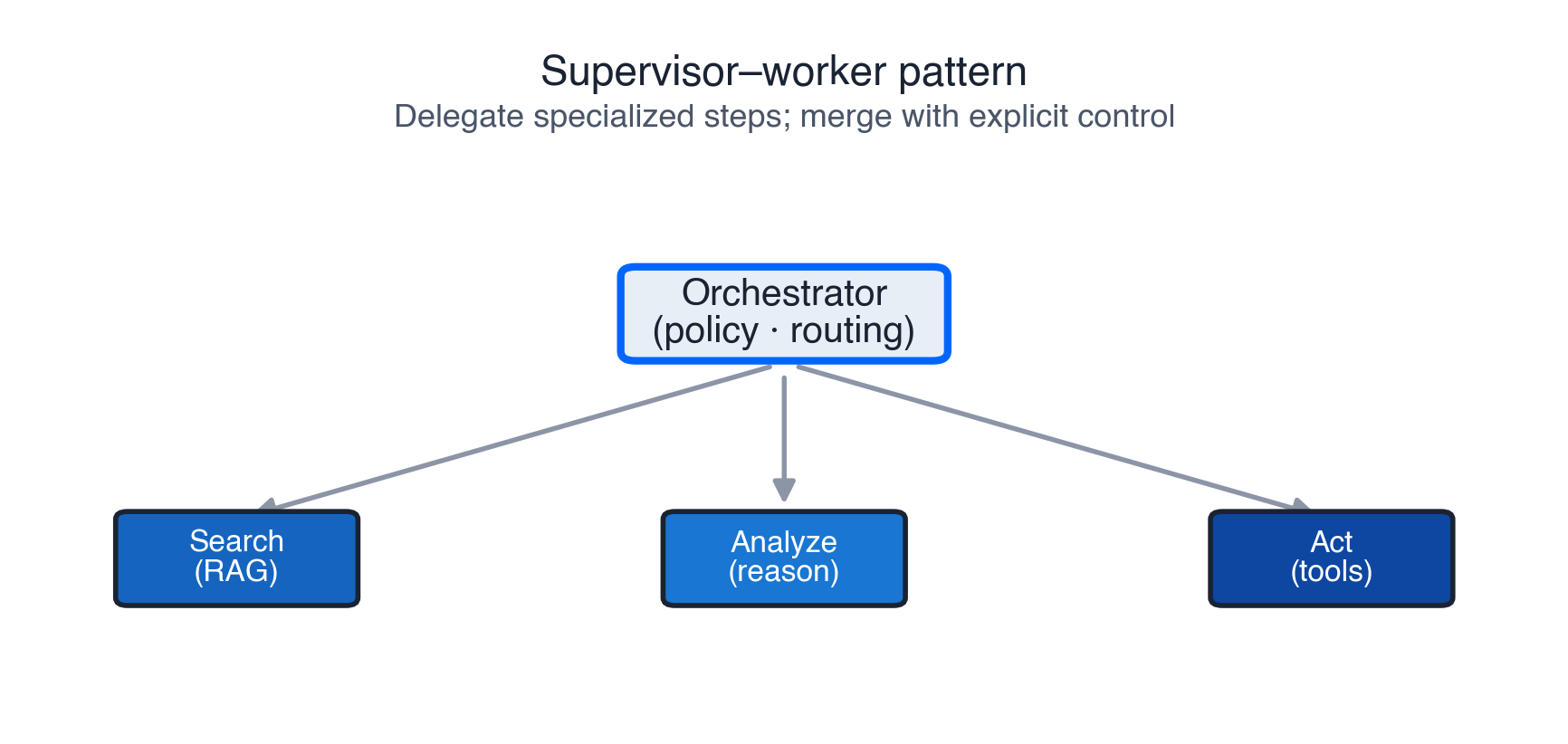
Figure 6: Orchestrator and specialist workers
A safe autonomy pattern: a central orchestrator coordinates and enforces policy; specialists do bounded work (search/RAG, reasoning, tool execution). Separation of concerns makes failures easier to trace and actions easier to gate.
If you already run microservices, borrow their discipline: idempotency (the same request twice should not corrupt state), timeouts (fail closed, not hung), and compensation (how to undo or contain a bad tool effect). Agents without those habits look heroic in demos and expensive in production.
Fan-out costs you in ways decks skip: every hop adds tokens, tools, and wait time. A “modest” supervisor can spawn dozens of sub-calls. Good judgment is knowing when to batch, when to cache retrieval, when to merge agents into one tool surface, and when parallel work is worth the coordination tax—same instinct that keeps microservices from talking forever.
MCP-style interfaces and agent-to-agent patterns try to define auditable seams between tools and data so glue is testable, not tribal knowledge. Treat roadmaps and vendor throughput claims as directional until your workloads say otherwise.
Manual handoff for every routine step is not governance at scale—it is a latency and error budget leak.
Agent topologies: fit and failure modes
One practical way to use these diagrams: treat each as a debugging promise. If this system fails under pressure, you should still be able to identify which component acted, why it acted, and how to contain the damage.
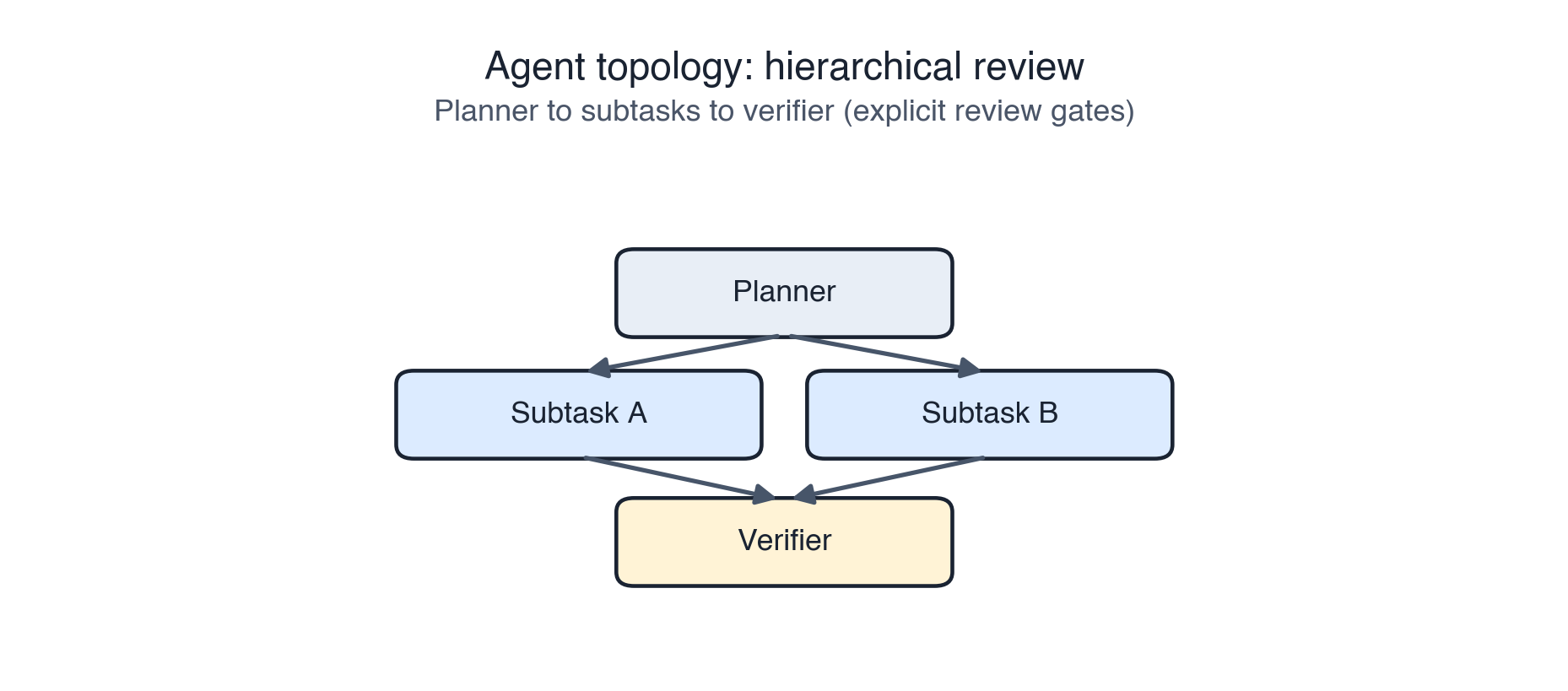
Figure 7a: Hierarchical review topology
A planner delegates subtasks; a verifier gate checks before outcomes propagate.
When to use: when review is non‑negotiable and you want explicit gates.
Example: regulated workflows (insurance claim triage, loan-doc review, clinical note summarization) where an agent drafts/decomposes but a verifier blocks release on policy/eval failure.
Watch for: hidden retries, state leakage, and slow tails that turn “safety” into unbounded latency.
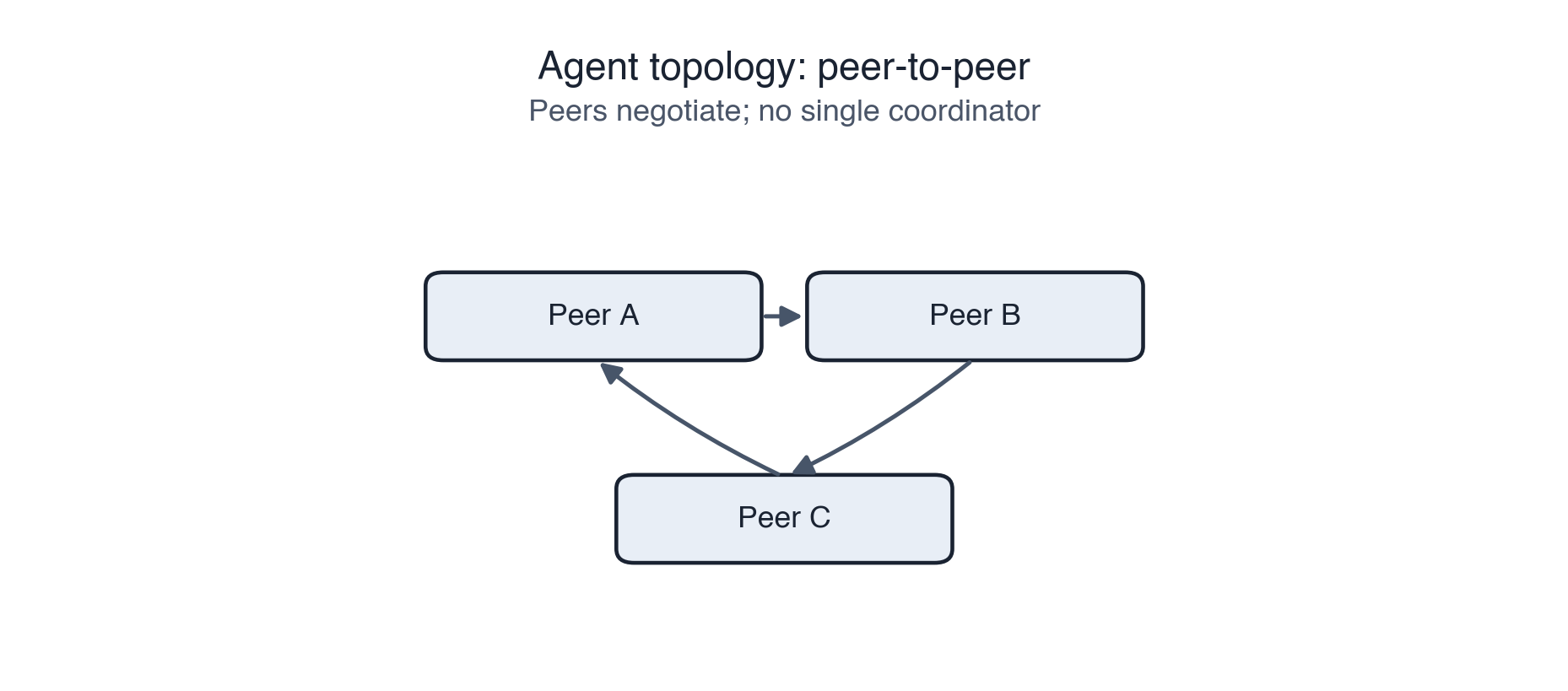
Figure 7b: Peer-to-peer topology
Peers negotiate without a single coordinator.
When to use: when the hard part is negotiation across constraints, not step execution.
Example: procurement or planning where finance/ops/legal peers propose tradeoffs and converge on an explainable plan (“who argued what, and why we chose X”).
Watch for: consensus failure, unclear trace ownership, and circular debates without termination criteria.
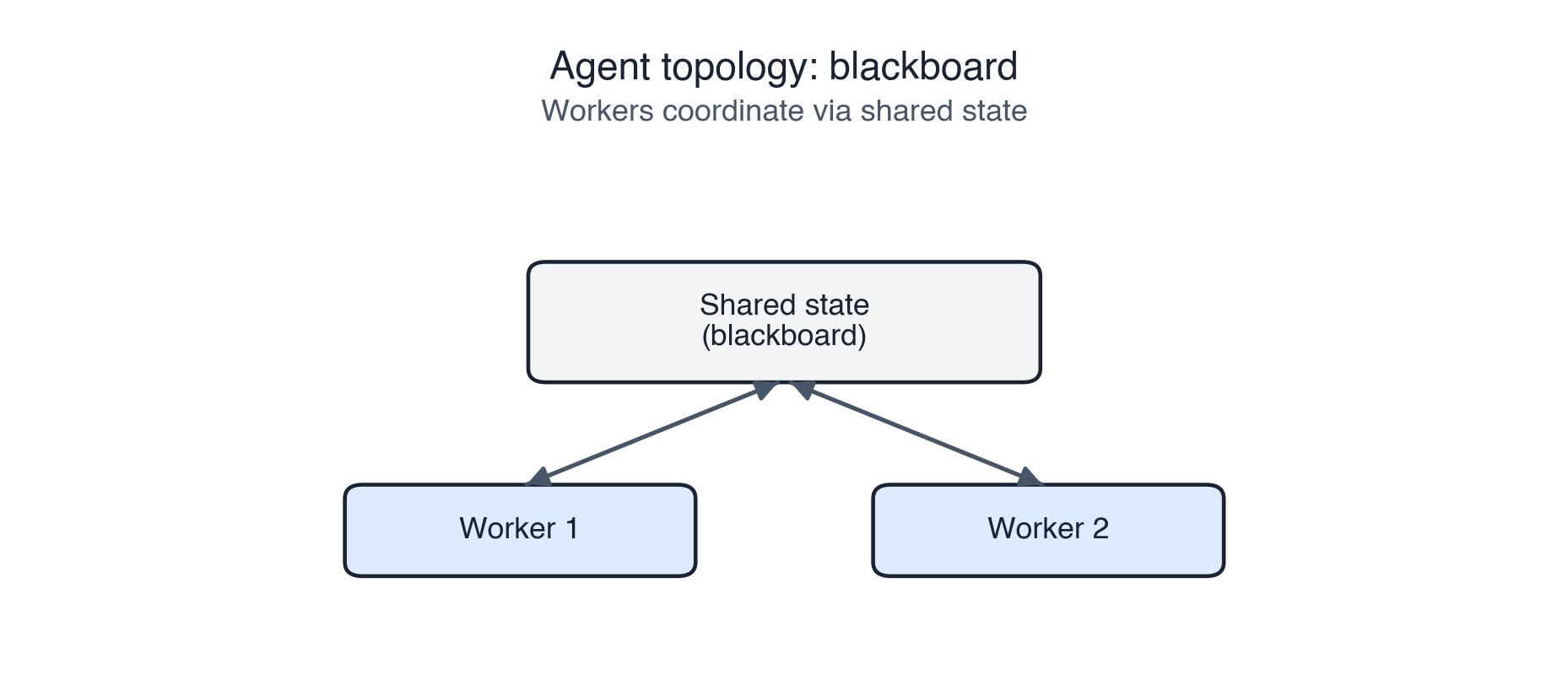
Figure 7c: Blackboard topology
Workers coordinate by writing to shared state.
When to use: when partial signals must accumulate into shared context over time.
Example: incident response or complex migrations where workers contribute facts (logs, configs, runbook steps) into a shared case file—one source of truth for “what we know” and “what we tried.”
Watch for: contention, race conditions, and inconsistent world models that make shared state a failure amplifier.
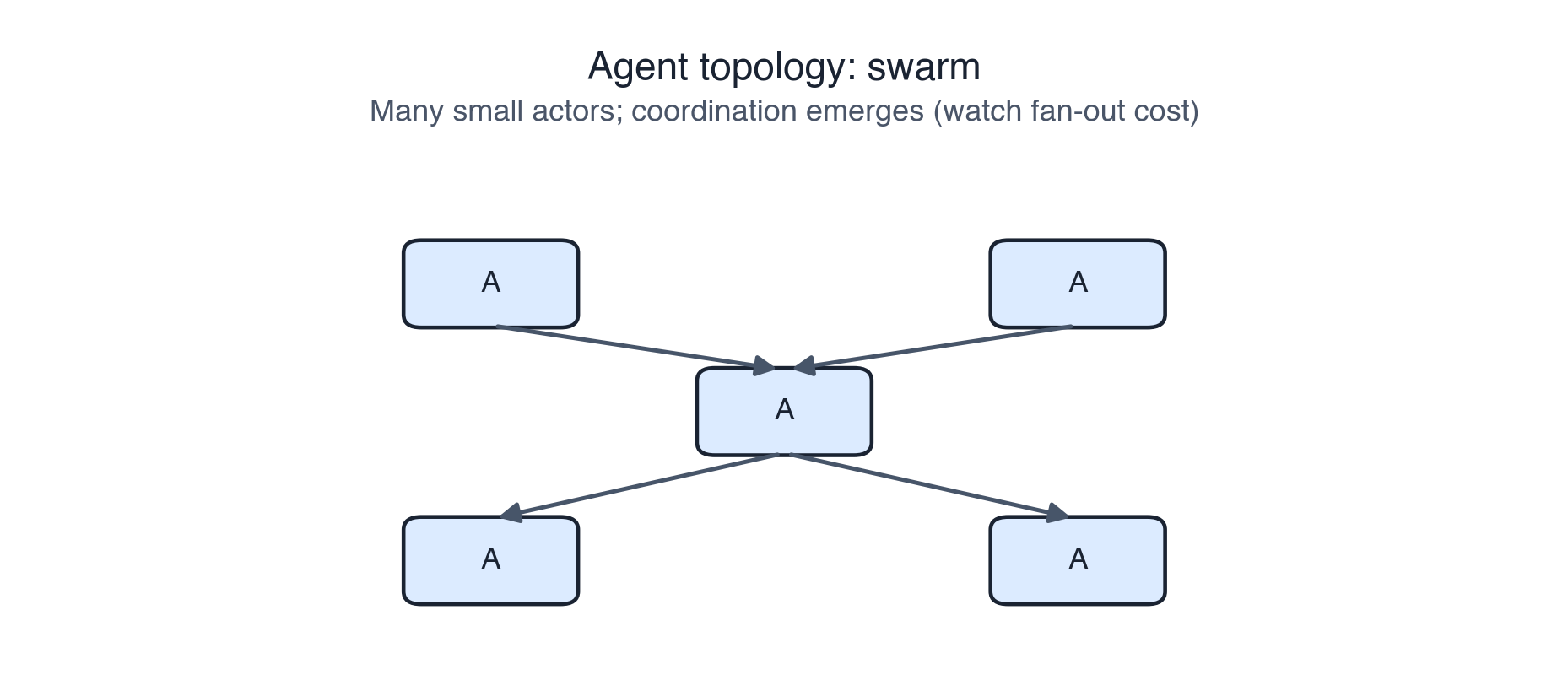
Figure 7d: Swarm topology
Many small actors explore in parallel.
When to use: when you need breadth (enumerate, search, generate candidates) more than a single deep chain.
Example: theme mining across support transcripts, candidate test generation, or scanning a large codebase for relevant APIs—where coverage matters and you can cap cost.
Watch for: emergent behavior, runaway fan‑out cost, and weak attribution (“which actor caused this?”).
At-a-glance patterns (pairs with Figures 7a–7d):
Pattern: Orchestrator (supervisor) · Fit when…: Clear split into specialists · Risk to watch: Single point of failure or overload
Pattern: Hierarchical · Fit when…: Deep flows with review layers · Risk to watch: Hidden state, opaque retries
Pattern: Peer-to-peer · Fit when…: Decentralized tradeoffs · Risk to watch: Consensus fights, hard debugging
Pattern: Blackboard · Fit when…: Facts accumulate in one place · Risk to watch: Contention, divergent world models
Pattern: Swarm · Fit when…: Many cheap parallel explorers · Risk to watch: Emergent behavior, cost blowouts
Supervisor–worker vs swarm. A supervisor centralizes policy and routing: attribution is cleaner (“the coordinator picked that tool”), RBAC and budgets land at one choke point—but the hub can fail or slow everyone. A swarm spreads work: great breadth, fuzzy who caused what, and easy cost spikes if fan-out is uncapped. Match the pattern to blast radius and how much trace you can afford. High-stakes paths usually want supervisor-shaped seams; exploration may accept swarms behind hard cost caps and sampling.
Pick frameworks for blast radius, not hype
State-graph frameworks bias toward recoverability and replay-friendly debug. Conversation-first frameworks bias toward fast prototypes. Pick by what a miss costs: wrong chat suggestion vs automated trade vs care pathway vs filing with a regulator. High blast radius wants explicit state, checkpoints, replay; low blast radius can stay light with tight scope and sandboxed tools.
Many teams run two spines on purpose: a prototype spine for speed and a production spine with stricter guarantees. That is not waste. Discovery and liability move on different clocks. The failure mode is calling the prototype production because happy-path demos kept working.
The SDLC: accountability doesn’t shrink—it shifts
Agents change who pounds out rote steps. They do not remove accountability for architecture, risk, or outcomes. A small senior team with strong platform—data contracts, evals, policy-as-code—often beats a big team without it. Fragile speed looks like great demos and a long, expensive tail.
Institutional views line up: Stanford HAI’s *AI Index* shows fast adoption next to governance gaps. SEI and NIST keep saying the durable edge is orchestration, evaluation, and governance—not a leaderboard trophy.
Stress-test four trends on your roadmap: efficiency–use dynamics (when unit cost drops, aggregate demand for automation can rise—conceptually parallel to Jevons-style rebounds analyzed in resource economics; Alcott, 2005), discovery-first work (right problem before a model bake-off), systems that learn in ops (not only in training), and governance at deploy cadence. Outside forecasts stay directional. Your incidents, eval regressions, and cost curves are the real evidence.
The reliability envelope: where demos become products
Capability without an envelope is theater. The figure sequence is intentional: the reliability envelope appears first, then core-vs-shell mechanics, operations loops, orchestration, and multi-agent topology choices. Each figure adds one operational layer of AI engineering rather than introducing a new thesis. The through-line does not change: demos can rent excitement for a quarter, but only lineage, policy, evaluation, traces, and human gates earn trust for years.
The boundaries: bad fits, brittle pilots, and organizational traps
Not every product needs agents—or even LLMs. A clear “no AI here” when rules and code suffice is a high-value call: less risk, lower cost, and more air for problems where stochastic parts truly earn their place.
Pilot purgatory is not healthy experimentation. It is endless maybe: no owner for data quality, no versioning, no eval that matches real harm, no date when “learning” turns into operate or stop. Short pilots teach. Infinite pilots often mean nobody will own failure modes under real traffic. Maturity looks like named owners for lineage, eval suites, and tool policy—the SEI list, expressed as org design not wallpaper. Self-score the eleven practices: a wall of nos predicts incidents better than your model pick.
Agents on bad data or muddy authority will disappoint. Bounded autonomy needs a real business contract: what “good” means, how to escalate, where humans must say yes, and artifacts an auditor can read—not chat archaeology.
Training rubrics can align hiring words. They do not replace judgment. The reliability envelope is architecture and org design: stronger lower layers buy you safer speed above—so velocity does not become scandal.
Conclusion
Restating the definition. AI engineering operationalizes AI: it makes models, retrieval, tools, and agents safe to run under signed obligations by engineering lineage, policy, evaluation, observability, recovery, and human gates (the reliability envelope). This framing matches the Software Engineering Institute pillars, the NIST AI Risk Management Framework functions, and systems life-cycle practice in ISO/IEC/IEEE 15288. Read through a systems lens, it is the work of specifying, integrating, and assuring an AI-heavy system across its life cycle—not only improving a model artifact.
How this paper supports that definition.
History showed why the gap appears: winters follow hype without measurement; public breakthroughs (Deep Blue, AlphaGo, foundation models) shift engineering surface area—never replacing the need for teams, budgets, and evidence. Arena demos were always systems outcomes (hardware, data, crews, procedure)—today’s stacks simply add stochastic cores and faster-moving artifacts.
Frameworks and standards (Software Engineering Institute practices, pillars, and the National Institute of Standards and Technology AI Risk Management Framework map) translate “good AI” into checkable habits—Govern / Map / Measure / Manage in institutional language.
Production is the core implementation (Figure 2 introduces the stack; Figures 3–6 cover core vs shell, large-language-model operations, and orchestration; Figures 7a–7d cover agent topologies): these sections show how prompts, tools, and connectors become versioned, evaluated services; why naming Sculley-style debt funds maintenance; and how distributed-systems discipline governs autonomy.
Boundaries round out socio-technical ethics and judgment: “no AI here,” pilot exits, and bounded autonomy are part of the discipline—not bolt-on pessimism.
Summation. Models deliver capability; AI engineering delivers ownership—the envelope that makes outputs explainable, actions reversible, and cost knowable. Ask for that envelope before you ask for a bigger model. Teams that build it compound; teams that skip it keep sprinting from launch to launch. The stochastic–deterministic paradox yields to layers you can test, ship, and audit—that is the through-line of this piece.
Key takeaways
Definition: AI engineering operationalizes AI so probabilistic cores meet signed obligations through an explicit reliability envelope (lineage, policy, evaluation, observability, recovery, human gates), consistent with Software Engineering Institute, NIST AI Risk Management Framework, and ISO/IEC/IEEE 15288 guidance.
Paradox → practice: deterministic expectations meet a probabilistic core; bridge with grounding, role-based access control, evaluation, traces, and written contracts.
Envelope: data/lineage → policy/access → evaluation/observability → human gates—the spine for the production sections.
Discipline in practice: large-language-model operations is the generative-era operating habit; Figure 2 remains the single-stack picture that ties data, policy, evaluation, and human oversight into one accountable system.
Agents: treat them like distributed systems—fan-out, idempotency, timeouts, topology fit; supervisor vs swarm trades attribution and cost for blast radius (see topology summary table).
Boundaries: “no AI here” can be the right call; pilots without owners are a trap.
Outcome: the envelope turns capability into infrastructure; without it, you still have theater.
Trust: favor dated, citable sources (standards, peer-reviewed systems/HCI/NLP work, institutional reports) over hype; sector trends stay directional unless you measure them yourself.
Quick reference (terms for handoffs)
Share this slice with legal, policy, or business leads who need shared words, not a second manual.
Term: Agent · In one line: Plans steps, calls tools, keeps state—more than one prompt/answer.
Term: Blast radius · In one line: How bad a wrong action can go—sets how strict controls must be.
Term: Golden set · In one line: Curated inputs (and rubrics) for regression before you promote.
Term: HITL · In one line: Human-in-the-loop review or approval on sensitive paths.
Term: Lineage · In one line: Where data came from, how it changed, which version ran.
Term: RAG · In one line: Retrieval-augmented generation—fetch evidence, then generate (when retrieval is healthy).
Term: RBAC · In one line: Role-based access control for people and automated tools.
Term: SLO / SLI · In one line: Service level objective / indicator—the promise and the meter that proves it.
Inclusive note. We use people-first wording on purpose (experts who review, teams who own). Clear docs, figure captions, and named escalation help more people than raw model scale alone.
References
Sources listed here appear in the body or support direct links in the narrative. Prefer the publisher, venue, or organization of record; URLs are current as of publication. Operator Notes aims for evidence over hype—verify anything safety- or compliance-critical in your own context.
Association for Computing Machinery. (2018). ACM Code of Ethics and Professional Conduct. https://www.acm.org/code-of-ethics
Alcott, B. (2005). Jevons’ paradox. Ecological Economics, 54(1), 9–21. https://doi.org/10.1016/j.ecolecon.2005.07.020
Amershi, S., Begel, A., Bird, C., DeLine, H., Gall, H., Kamar, E., Nagappan, N., Nushi, B., & Zimmermann, T. (2019). Software Engineering for Machine Learning: A Case Study. In Proceedings of the 41st International Conference on Software Engineering: Software Engineering in Practice (ICSE-SEIP) (pp. 291–300). IEEE. https://doi.org/10.1109/ICSE-SEIP.2019.00013
Beyer, B., Jones, C., Petoff, J., & Murphy, N. (2016). Site Reliability Engineering: How Google Runs Production Systems. O’Reilly Media. https://sre.google/sre-book/table-of-contents/
Bommasani, R., et al. (2021). On the Opportunities and Risks of Foundation Models. Stanford Center for Research on Foundation Models. https://crfm.stanford.edu/report.html
Brown, T., et al. (2020). Language Models are Few-Shot Learners. Advances in Neural Information Processing Systems (NeurIPS). https://proceedings.neurips.cc/paper/2020/hash/1457c0d6bfcb4967418bfb8ac142f64a-Abstract.html
Deng, J., et al. (2009). ImageNet: A Large-Scale Hierarchical Image Database. IEEE Conference on Computer Vision and Pattern Recognition (CVPR). https://www.image-net.org/static_files/papers/imagenet_cvpr09.pdf
Horneman, A., Mellinger, A., & Ozkaya, I. (2019). AI Engineering: 11 Foundational Practices. Carnegie Mellon University, Software Engineering Institute. https://www.sei.cmu.edu/library/ai-engineering-eleven-foundational-practices/
IEEE Computer Society. (2014). Guide to the Software Engineering Body of Knowledge (SWEBOK Guide), Version 3.0. https://www.computer.org/education/bodies-of-knowledge/software-engineering/v3
ISO/IEC/IEEE. (2023). Systems and software engineering — System life cycle processes (ISO/IEC/IEEE 15288:2023). International Organization for Standardization / IEEE. https://www.iso.org/standard/63711.html
IBM Research. (n.d.). Deep Blue. https://research.ibm.com/deep-blue/
Jelinek, F. (1998). Statistical Methods for Speech Recognition. MIT Press. (See also IEEE Xplore record: https://ieeexplore.ieee.org/document/720448)
Kreuzberger, D., Kühl, N., & Hirschl, S. (2023). Machine Learning Operations (MLOps): Overview, Definition, and Architecture. IEEE Access, 11, 31844–31867. https://doi.org/10.1109/ACCESS.2023.3295418
Krizhevsky, A., Sutskever, I., & Hinton, G. E. (2012). ImageNet Classification with Deep Convolutional Neural Networks. Advances in Neural Information Processing Systems (NeurIPS). https://proceedings.neurips.cc/paper_files/paper/2012/file/c399862d3b9d6b76c8436e924a68c45b-Paper.pdf
Lighthill, J. (1973). Artificial Intelligence: A general survey. In Artificial Intelligence: A Paper Symposium. UK Science Research Council.
Lewis, P., et al. (2020). Retrieval-Augmented Generation for Knowledge-Intensive NLP Tasks. Advances in Neural Information Processing Systems (NeurIPS), 33. https://proceedings.neurips.cc/paper_files/paper/2020/hash/6b493230205f780e1bc2692db9477d07-Abstract.html
McCarthy, J., Minsky, M. L., Rochester, N., & Shannon, C. E. (1955). A Proposal for the Dartmouth Summer Research Project on Artificial Intelligence. Dartmouth College. https://www.dartmouth.edu/ai50/homepage/original_letter.html
McCulloch, W. S., & Pitts, W. (1943). A logical calculus of the ideas immanent in nervous activity. Bulletin of Mathematical Biophysics. https://doi.org/10.1007/BF02478259
Mitchell, M., et al. (2019). Model Cards for Model Reporting. In Proceedings of the Conference on Fairness, Accountability, and Transparency (FAccT) (pp. 220–229). ACM. https://doi.org/10.1145/3287560.3287592
National Institute of Standards and Technology. (2023). Artificial Intelligence Risk Management Framework (AI RMF 1.0). NIST AI 100-1. https://www.nist.gov/itl/ai-risk-management-framework
NVIDIA Technical Blog. (2025). How to Connect Real-Time IoT Data to Digital Twins for 3D Remote Monitoring. https://developer.nvidia.com/blog/connect-real-time-iot-data-to-digital-twins-for-3d-remote-monitoring/
Parasuraman, R., & Manzey, D. H. (2010). Complacency and bias in human use of automation: An attentional integration. Human Factors, 52(3), 381–410. https://doi.org/10.1177/001872081110605010
Sculley, D., et al. (2015). Hidden Technical Debt in Machine Learning Systems. Neural Information Processing Systems (NeurIPS), workshop. https://papers.nips.cc/paper/5656-hidden-technical-debt-in-machine-learning-systems.pdf
Shneiderman, B. (2020). Human-centered artificial intelligence: Reliable, safe & trustworthy. International Journal of Human–Computer Interaction, 36(6), 495–504. https://doi.org/10.1080/10447318.2020.1741118
Silver, D., et al. (2016). Mastering the game of Go with deep neural networks and tree search. Nature. https://doi.org/10.1038/nature16961
Software Engineering Institute. Pillars of AI Engineering Assets. Carnegie Mellon University. https://www.sei.cmu.edu/library/pillars-of-ai-engineering-assets/
Stanford Graduate School of Business. (2017). Andrew Ng: Why AI Is the New Electricity. https://gsb.stanford.edu/insights/andrew-ng-why-ai-new-electricity
Stanford University, Institute for Human-Centered Artificial Intelligence. Artificial Intelligence Index Report (annual). https://aiindex.stanford.edu/report/
Sutton, R. S. (2019). The Bitter Lesson. University of Alberta. http://www.incompleteideas.net/IncIdeas/BitterLesson.html
Turing, A. M. (1950). Computing Machinery and Intelligence. Mind, 59(236), 433–460. https://doi.org/10.1093/mind/LIX.236.433
Vaswani, A., et al. (2017). Attention Is All You Need. Advances in Neural Information Processing Systems (NeurIPS). https://proceedings.neurips.cc/paper/2017/hash/3f5ee243547dee91fbd053c1c4a845aa-Abstract.html
Wooldridge, M. (2009). An Introduction to MultiAgent Systems (2nd ed.). John Wiley & Sons. https://doi.org/10.1002/9780470519722
Xi, Z., et al. (2023). The Rise and Potential of Large Language Model Based Agents: A Survey. arXiv preprint arXiv:2309.07864. https://arxiv.org/abs/2309.07864
Washington University Law Review Online. (2025). AI’s Hippocratic Oath. https://wustllawreview.org/2025/03/26/ais-hippocratic-oath/
<div class="article-footer-note">
<p>This article is an <strong>interpretive synthesis</strong>—it connects SEI and NIST guidance, ISO life-cycle norms, software-engineering bodies of knowledge, and peer-reviewed work on ML systems, MLOps, human factors, and NLP/RAG with field judgment about agents and production practice. It is offered for operators, not as legal, medical, or investment advice. Validate safety- and compliance-critical claims in your own organization and jurisdiction. Primary credit belongs to the cited authors and institutions; future editions may refine emphasis as practice evolves.</p>
<p>Sector-wide statistics and vendor narratives mentioned in passing remain <strong>directional</strong> unless you reproduce them with your own measurements.</p>
</div>
Editorial transparency. Essays at The AI Operator may use AI-assisted research, drafting, and editing tools under staff editorial review. Facts, figures, and recommendations are checked before publication; we correct the record when evidence changes. Questions: hello@theaioperator.net.
Published on [Substack](https://theaioperator2.substack.com/p/ai-engineering).