


Executive Summary
Operator Trilogy, Part 3 of 3: a practical playbook for shipping agentic workflows without shipping silent failure modes.
About the series. Part 1 covers prompting for decision-grade output; Part 2 covers what changes when AI acts (beyond Generative AI). Each part stands alone; reading all three in order builds the full arc.
Purpose. This playbook focuses on how to run a system of agents in production: governance, safety, and scaling so that your agents—individually and together—are governable, scalable, and aligned with how your organization thinks and decides. You will learn who decides what agents can do, how to extend prompt literacy into agentic literacy (tool registries, playbooks, behavior evaluation), when to patch versus rebuild, and how to build trust through transparency and human oversight. Theme: governance and scaling—making a system of agents something you can control, audit, and improve. It is the third of a three-part series; the first covers prompting for decision-grade output; the second covers what changes when AI acts (beyond Generative AI). Whether you've read those or not, this playbook stands alone as a practical guide to running a system of agents responsibly.
Why This Playbook
Organizations that have built prompt literacy and understood the shift to agentic AI—or are building or buying a system of agents that act on their behalf—face a next question: How do we embed this system of agents in the organization so it's reliable, auditable, and aligned with our standards? A system of agents doesn't just return text—it takes actions across workflows, tools, and sometimes multiple agents. That makes governance, approval workflows, and accountability non-negotiable. Research from Harvard Business Review and MIT Sloan Management Review [2–6] underscores another imperative: trust. Worker trust in AI—especially in systems that act autonomously—drops sharply when governance and transparency are missing; rebuilding trust requires deliberate governance, explainability, and human oversight. This playbook draws on researched frameworks from GARP (Risk and AI / Responsible AI) [1], HBR's responsible-AI checklist [2, 3], and MIT Sloan's governance playbook [4–6] to give operators and leaders a practical, reputable basis for getting there.
Governance: Who Decides What Agents Can Do?
Agentic AI can call tools, update data, and trigger real-world outcomes. The first requirement is clear governance: who decides what agents are allowed to do, under what conditions, and with what human oversight? Frameworks from GARP's Risk and AI (RAI) curriculum [1] and Harvard Business Review's responsible-AI checklist [2] align on this: enterprise-wide policy, governance structures, roles and responsibilities, and clear processes are the foundation for responsible deployment—not ad-hoc rules.
Approval workflows (decision gates). Define which agent actions require human approval before execution. Using a decision gate (diamond) in your process flow—low risk vs. high risk—keeps the logic clear: low-risk actions (e.g., internal search, summarization) may be fully autonomous; high-risk actions (e.g., sending external communications, changing financial data, deploying code) should flow through an approval gate or require post-hoc review.
Use-case boundaries. Not every process should be agentic. Maintain a registry of approved use cases with explicit boundaries: what the agent can and cannot do, which tools it can call, and under what constraints. Revisit this registry when you add new tools or capabilities.
Human-in-the-loop rules. Specify where humans must remain in the loop: for example, any action that commits the organization legally, financially, or reputationally should have a defined human checkpoint. The goal is not to bottleneck everything, but to place checkpoints where the cost of a mistake outweighs the cost of delay. This aligns with intelligent choice architecture: systems that present options and empower human decision makers rather than replacing them [7]. MIT Sloan's guidance on building trusted AI [4, 5] stresses explainability and proactive governance—so that stakeholders understand how and why agents act.

Figure 1: System of Agents—Workflow and Governance
A simple workflow: request → plan → agents + tools, then through an approval gate. Low-risk actions execute automatically; high-risk actions go to human review before execution. Outcomes are logged. This keeps the system of agents and governance in one picture—aligning with frameworks from GARP [1], HBR [2], and MIT Sloan [4–6].

Figure 2: Agentic AI Workflow with Multi-Agency
A multi-agency workflow: a request is routed to an orchestrator, which coordinates multiple agents; agents share tools and produce a single outcome. This visualization supports governance and playbook design by making the roles of orchestrator, agents, and shared tools explicit.
From Prompt Literacy to Agentic Literacy
Prompt literacy—curated prompt libraries, prompt champions, and evaluation criteria for prompt quality—is the foundation many organizations build first. With a system of agents, the same logic extends to agentic literacy: the organization needs shared understanding of how agents are configured, what tools they use, and how their behavior is evaluated—both per agent and across the system.
Curated tool sets. Agents should only have access to the tools they need for their approved use case. Maintain a tool registry with clear ownership and risk classification. New tools should be vetted (security, compliance, misuse potential) before being exposed to agents.
Agent playbooks. Document, for each major agent use case, the intended workflow, allowed tools, guardrails, and escalation path. These playbooks serve as both training material and audit documentation. When something goes wrong, the playbook should make it clear whether the agent operated within its design.
Evaluating agent behavior. Prompt quality is one input; agent behavior is another. Define what "good" looks like for agentic workflows: completion rate, error rate, frequency of human override, and adherence to guardrails. Track these over time and tie them to the same governance artifacts (use-case registry, playbooks) so that evaluation is consistent and actionable.
Governance and Reasoning Patterns
Your system of agents may use patterns such as chain-of-thought (CoT), ReAct (reasoning + acting), or RAG (retrieval-augmented generation)—Part 2 explains these in detail. For governance, document which patterns your agents use and ensure playbooks and approval workflows require the right level of transparency: e.g., logging reasoning steps and actions for high-risk use cases so you can audit and debug. Figure 1’s workflow (request → plan → agents + tools → approval gate) applies regardless of pattern; the patterns affect what you log and how you scope use-case boundaries.
Measuring and Improving Your System of Agents
Governance isn’t only about approval gates and playbooks—it’s also about learning from how the system behaves. Define metrics that matter: completion rate, error rate, frequency of human override, and adherence to guardrails. Tie these to your use-case registry and playbooks so each use case has clear success and failure criteria.
Review cycles. Periodically review agent behavior with the owners of each use case and with risk and compliance. Use overrides, escalations, and near-misses to update playbooks and guardrails. Treat the system of agents as something you iterate on, not set once and forget.
Learning from incidents. When something goes wrong—an agent acted out of scope, used the wrong tool, or produced an outcome that required rollback—capture what happened, update the playbook or tool boundaries, and communicate to agent stewards. Accountability (who owns each use case) makes this possible; without it, the same failure repeats.
When to Patch vs. Rebuild
The cost-curve idea applies to a system of agents as it does elsewhere: quick patches start cheap but become exponentially expensive as technical debt compounds; full rebuilds start costly but flatten at scale. Operator skill is knowing where you are on that curve.
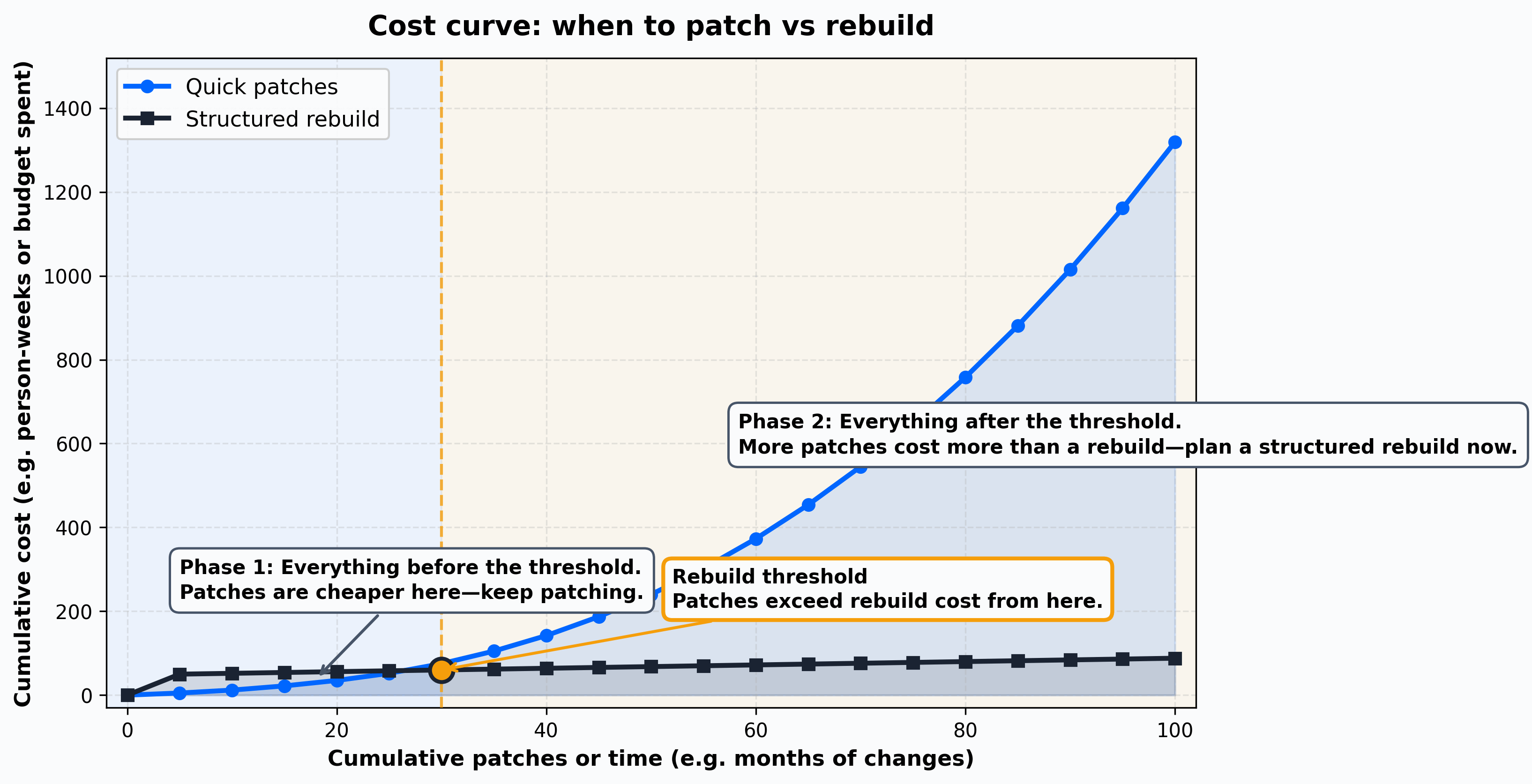
Figure 3: Cost Curve—Patch vs. Rebuild
Quick patches (blue) start cheap but accelerate as technical debt compounds; structured rebuilds (navy) start costly but flatten at scale. The rebuild threshold marks where rebuilds become cheaper than continued patching. X-axis: cumulative patches or time (e.g. months of changes). Y-axis: cumulative cost in your own units (e.g. person-weeks or budget). Left of the threshold, patching is cheaper; right of it, plan a rebuild.
How to use this in practice. Track what you actually spend: person-weeks or dollars per patch (or per release), and your one-time estimate for a full rebuild (clear tool set, governance, playbooks). When cost per patch approaches 30–40% of that rebuild estimate, or when patches take 2–3× longer than they did a year ago, you're near or past the threshold. Actionable triggers: each new use case requires another workaround; team velocity is dropping; system reliability is slipping despite fixes. When those show up, invest in the rebuild—define boundaries, tool set, and governance once—rather than one more patch.
If you're layering agentic capabilities onto legacy workflows with ad-hoc fixes, ask: Are we past the point where a structured rebuild (clear tool set, governance, playbooks for the whole system of agents) would be cheaper than one more patch? If every new use case requires another exception or workaround, you're likely on the wrong side of the curve. Invest in the rebuild: define boundaries, tool sets, and governance once, then scale within them.
Culture and Capability: From Prompt Champions to Agent Stewards
Prompt champions—roughly 10–15% of the workforce who coach others, maintain prompt libraries, and translate business needs into effective AI interactions—are a pattern many organizations adopt. With a system of agents, the same role expands to agent stewards: people who understand both the business use case and the technical and governance constraints of the system of agents.
Human-centric design and intelligent choice architecture. Research on intelligent choice architectures (ICAs) emphasizes keeping humans at the center: systems should create, refine, and present choices for human decision makers rather than automating decisions away [7]. Applied to a system of agents, this means designing workflows so that agents surface options, recommendations, and trade-offs—and humans retain decision rights where it matters. Approval gates, use-case boundaries, and human-in-the-loop rules are not just control mechanisms; they are the structure of a decision environment that amplifies human judgment instead of replacing it. TCS and MIT Sloan Management Review frame ICAs as enabling "better choices" that lead to better decisions and outcomes, with explainability and transparency embedded [7]. Aligning your system of agents with this human-centric view strengthens trust and ensures governance serves people, not the other way around.
Institutionalizing security by design. Security and compliance should be part of the design of agentic workflows, not an afterthought. Agent stewards should work with risk, compliance, and audit teams to ensure that use-case boundaries, tool sets, and human-in-the-loop rules are aligned with organizational policy.
Accountability for agent actions. When an agent takes an action, someone must be accountable. That might be the owner of the use case, the team that configured the agent, or a designated steward. Clear accountability makes it possible to learn from failures and iterate on playbooks and guardrails.
Trust through transparency and governance. HBR [2, 3] and MIT Sloan [4–6] both emphasize that trust in AI erodes when systems act without clear governance and explainability. Building trusted AI means making governance visible: who owns what, which decisions are automated vs. human-approved, and how outcomes are reviewed. GARP's RAI curriculum [1] frames "Data and AI Model Governance" and "Responsible and Ethical AI" as core pillars—the same pillars that support trust at scale.
Practical Steps: Checklist for Operators
Define governance. Document who approves what. Establish a use-case registry and approval workflow for high-risk agent actions. Assign owners for each agent use case.
Curate tools and playbooks. Maintain a tool registry and agent playbooks. Vet new tools before exposing them to agents. Document intended workflows and escalation paths.
Set evaluation criteria. Define metrics for agent behavior (completion, errors, overrides, guardrail adherence). Tie these to governance reviews and playbook updates.
Run review cycles and learn from incidents. Periodically review agent behavior with use-case owners and risk/compliance. Use overrides and incidents to update playbooks and guardrails.
Invest in agent stewards. Identify and empower people who can bridge business needs and agentic design. Embed them with risk and compliance so security by design is the default.
Know your cost curve. Periodically ask whether you're patching past the efficient frontier. If so, plan a structured rebuild (boundaries, tool set, governance) rather than another one-off fix.
Maintain human-centered leadership. Use your system of agents to free capacity for judgment, stakeholder management, and creativity. Design for intelligent choice architecture [7]: present choices and options to humans where it matters rather than automating decisions away. Governance and stewardship should amplify human effectiveness, not replace it.
Conclusion: Governance as the Enabler of Trust and Scale
This playbook gave you how to run a system of agents so it's governable, scalable, and trusted—aligned with how your organization thinks and decides. Approval workflows, use-case boundaries, human-in-the-loop rules, tool registries, agent playbooks, and agent stewards turn "what acts" into "what we control and improve."
Taken alone, the playbook stands as a practical guide to running a system of agents responsibly. As the third of a three-part series, it completes an arc: the first piece focused on how to ask (prompting for decision-grade output); the second on what changes when AI acts (the shift to agency); this one on how to run a system of agents. Together they answer one question: How do we get value from AI—and run it responsibly—from the first prompt to a production system of agents? The answer is capability at every layer: prompt literacy, understanding the agentic shift, and governance and stewardship at scale—grounded in frameworks from GARP [1], HBR [2, 3], MIT Sloan [4–6], and human-centric intelligent choice architecture [7]. Organizations that build all three and invest in trust (transparency, explainability, human oversight) will outperform those that treat AI as plug-and-play.
One question to take away: For our system of agents, do we have clear governance, playbooks, and accountability—and do we know when to patch versus rebuild? If that question lands, you've understood why this playbook exists: it's not about using agentic AI more, but about using it with intention so that your strategy, your risk posture, and your quality standards show up in every action your organization's agents take.
Key Takeaways
Part 3 is about a system of agents. Governance, safety, and scaling apply to how multiple agents work together—tool registries, playbooks, and accountability span the whole system.
Governance is non-negotiable. Define approval workflows, use-case boundaries, and human-in-the-loop rules so that agent actions are authorized and auditable.
Agentic literacy extends prompt literacy. Curated tool sets, agent playbooks, and behavior evaluation turn individual capability into organizational capability for your system of agents.
Know your cost curve. When patching becomes more expensive than rebuilding, invest in structured boundaries, tool sets, and governance.
Agent stewards are the new prompt champions. Empower people who can bridge business needs and agentic design; embed security by design with risk and compliance.
Accountability matters. Every agent action should have a clear owner. Use playbooks and metrics to learn from failures and improve guardrails.
Trust is built through governance and transparency. Use decision gates (e.g., approval workflows), explainability, and human oversight so that stakeholders trust how and when agents act. Frameworks from GARP [1], HBR [2, 3], and MIT Sloan [4–6] support this.
Governance and reasoning patterns. Document which patterns your agents use (CoT, ReAct, RAG—see Part 2) and ensure playbooks require the right level of transparency for audit and debugging.
Human-centric design. Align your system of agents with intelligent choice architecture [7]: present choices and options to humans where it matters, and design governance so it amplifies human judgment rather than replacing it.
References
Sources cited or drawn on in this playbook. Numbers in the text (e.g., [1], [2–6], [7]) refer to these entries.
GARP. (2024–2026). RAI Certificate / Risk and AI. Global Association of Risk Professionals. https://www.garp.org/rai
Harvard Business Review. (2024, December 5). Designing a responsible AI program? Start with this checklist. Blackman, R., & Vasiliu-Feltes, I. Harvard Business Review. https://hbr.org/2024/12/designing-a-responsible-ai-program-start-with-this-checklist
Harvard Business Review. (2025, November). Workers don't trust AI. Here's how companies can change that. Harvard Business Review. https://hbr.org/2025/11/workers-dont-trust-ai-heres-how-companies-can-change-that
MIT Sloan Management Review. (2024). GenAI: The governance playbook—what leaders must do to build trusted AI. MIT SMR Connections. https://sloanreview.mit.edu/mitsmr-connections/infographic-what-leaders-must-do-to-build-trusted-ai/
MIT Sloan Management Review. (2024). Building robust RAI programs as third-party AI tools proliferate. MIT Sloan Management Review. https://sloanreview.mit.edu/projects/building-robust-rai-programs-as-third-party-ai-tools-proliferate/
MIT Sloan. (2023). A framework for assessing AI risk. Ideas Made to Matter. https://mitsloan.mit.edu/ideas-made-to-matter/a-framework-assessing-ai-risk
Kiron, D., & Schrage, M. (MIT Sloan Management Review / TCS). Intelligent choices reshape decision-making and productivity. TCS Global Studies. https://www.tcs.com/insights/global-studies/intelligent-choice-architectures-reshape-decision-making
Editorial transparency. Essays at The AI Operator may use AI-assisted research, drafting, and editing tools under staff editorial review. Facts, figures, and recommendations are checked before publication; we correct the record when evidence changes. Questions: hello@theaioperator.net.
Published on [Substack](https://theaioperator.net/p/agentic-operator-playbook).