
The Security Paradox of Agentic AI: When Autonomy Meets Vulnerability
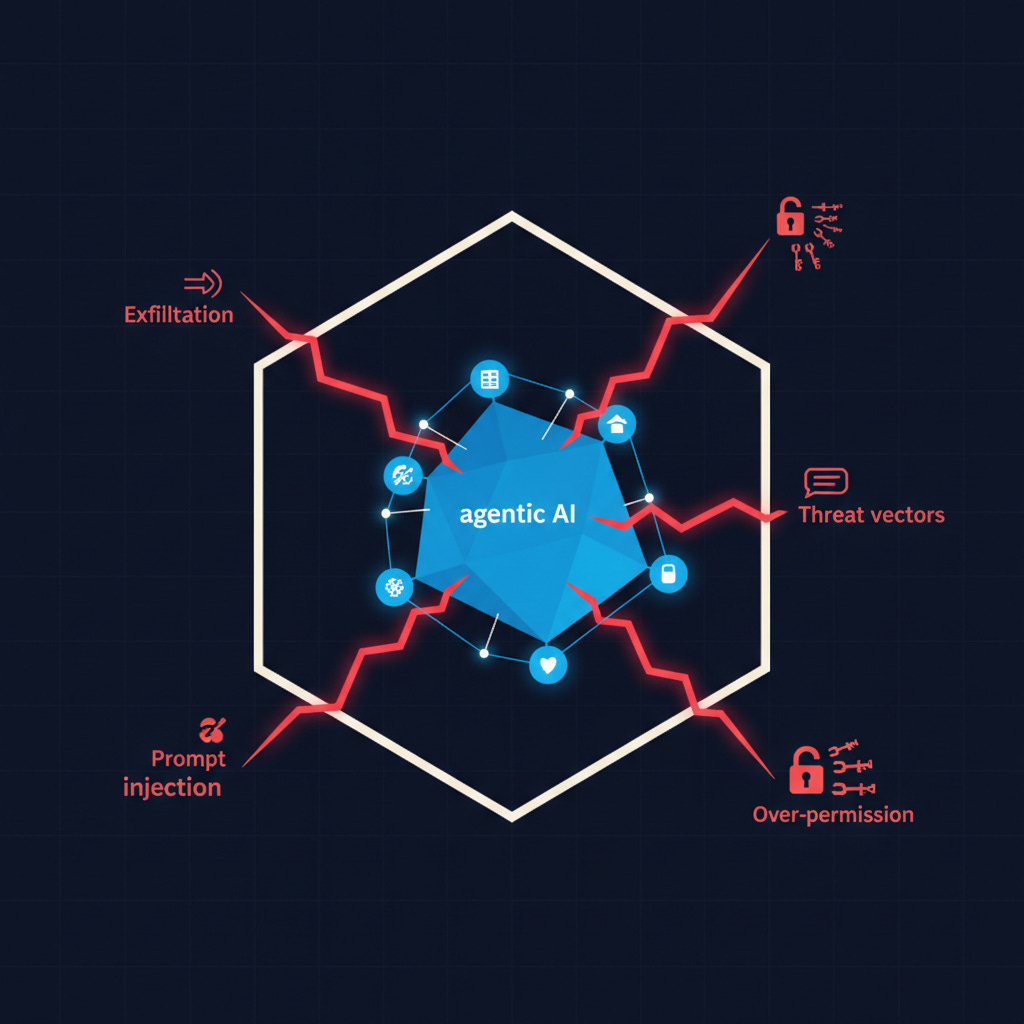
Agentic systems expand the attack surface: trust boundaries, tool use, data exfiltration, and what security looks like when models can act.

Executive Summary
Agentic systems expand the attack surface: trust boundaries, tool use, data exfiltration, and what security looks like when models can act.
The Argument
Agentic AI systems can perceive their environment, reason with LLMs, use tools dynamically, and take real-world actions (Berkeley Center for Responsible Decentralized Intelligence, 2024). This creates a security paradox: the capabilities that make agentic AI powerful also dramatically expand its attack surface.
Unlike traditional AI that processes inputs and returns outputs, agentic AI makes autonomous decisions about which tools to use and when. These tools don't need to be pre-specified—the system can discover and use new tools at runtime (Berkeley Center for Responsible Decentralized Intelligence, 2024). This flexibility increases the attack surface significantly compared to traditional systems (Berkeley Center for Responsible Decentralized Intelligence, 2024).
For operators, the question is: how do you leverage agentic AI's power while managing the security risks? The answer: understand the risks and build security in from the start.
The Context
Traditional AI models like GPT-4 operate in a constrained space: they receive prompts and return responses. Their attack surface is limited to input manipulation and output extraction.
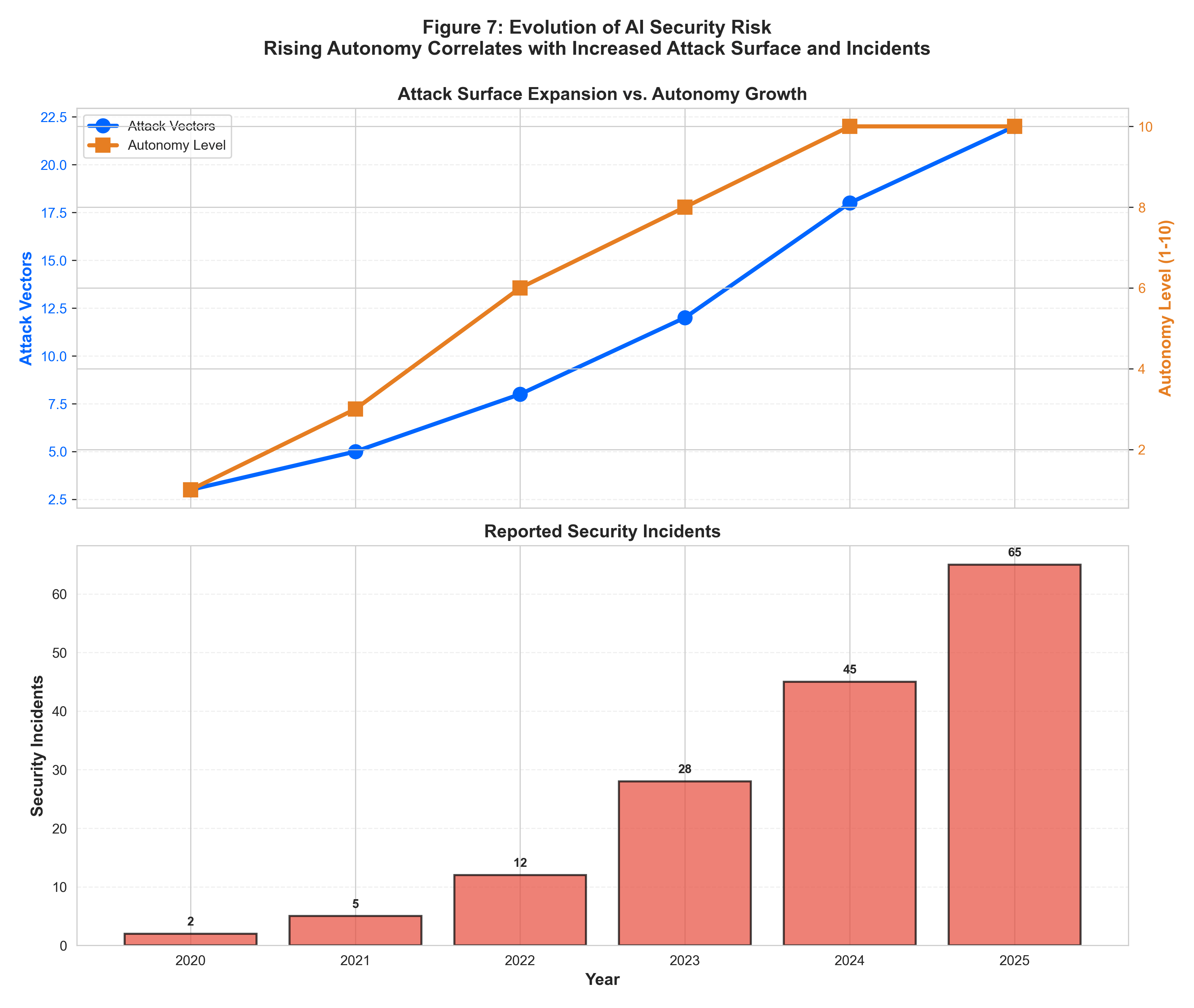
Figure 7: Evolution of AI Security Risk
Top: Attack vectors (blue line) and autonomy levels (orange line) from 2020 to 2025. Both metrics show exponential growth as AI systems become more agentic. Bottom: Reported security incidents (red bars) increasing from 2 in 2020 to 45 in 2024, with projections reaching 65 in 2025. The correlation between rising autonomy and security incidents demonstrates the security paradox: as AI systems gain capabilities, they also gain vulnerabilities.
Agentic AI changes this fundamentally. These systems don't just respond—they act. They can:
Perceive their environment through sensors, APIs, and data streams
Reason using LLMs to plan sequences of actions
Utilize tools dynamically, choosing which functions to call based on context
Retrieve information from external sources, databases, and knowledge bases
Take actions that have real-world consequences—sending emails, executing code, making API calls, updating databases
The attack surface expands exponentially. Traditional AI has 3-4 attack vectors. Agentic AI has 12+ attack vectors, including tool exploitation, memory manipulation, unauthorized actions, and supply chain attacks.
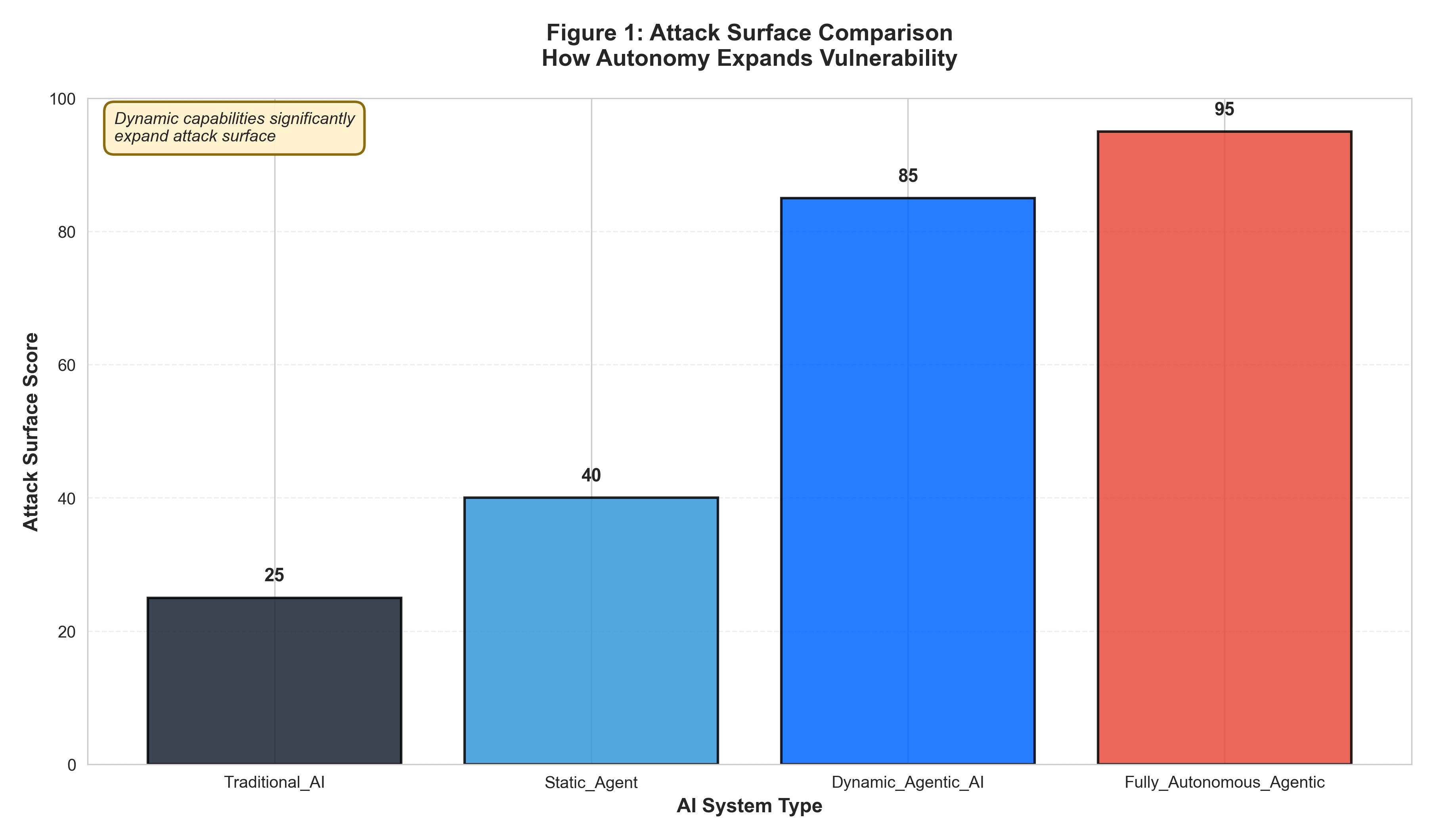
Figure 1: Attack Surface Comparison
Attack surface scores across AI system types. Traditional AI systems score 25, while fully autonomous agentic AI systems score 95—nearly four times higher. Dynamic capabilities significantly expand vulnerability exposure.
The security implications are already manifesting. Research from security organizations reveals that agentic AI systems can be manipulated into misusing their memory, exploiting tools, or leaking private data (Blockchain Council, 2024). Attackers may poison inputs or manipulate outputs, making the agent itself a new attack vector. The SolarWinds cyberattack demonstrated the risks associated with compromised AI supply chains, where malicious actors injected malware into software platforms, impacting thousands of clients including government agencies (CTO Academy, 2024).
This isn't theoretical risk—it's operational reality for organizations deploying agentic AI systems today.
The Analysis
Dynamic Autonomy: The Double-Edged Sword
The defining characteristic of agentic AI is its ability to make autonomous decisions about tool usage. Unlike static agents with predefined workflows, dynamic agentic systems can:
Select tools at runtime based on context and reasoning
Chain multiple tools together in sequences not pre-specified
Adapt to new environments by discovering and using previously unknown tools
Make decisions about when to use tools versus when to reason internally
This autonomy is powerful. It enables agentic AI to handle novel situations, adapt to changing requirements, and operate in complex, unpredictable environments. But it also creates security vulnerabilities that don't exist in static systems.
Example: A customer service agentic AI can access databases, send emails, and process refunds. A static agent has a hardcoded workflow with limited attack points. A dynamic agentic AI reasons through each step, selecting tools as it goes. An attacker who manipulates the reasoning process can redirect this sequence to unauthorized actions.
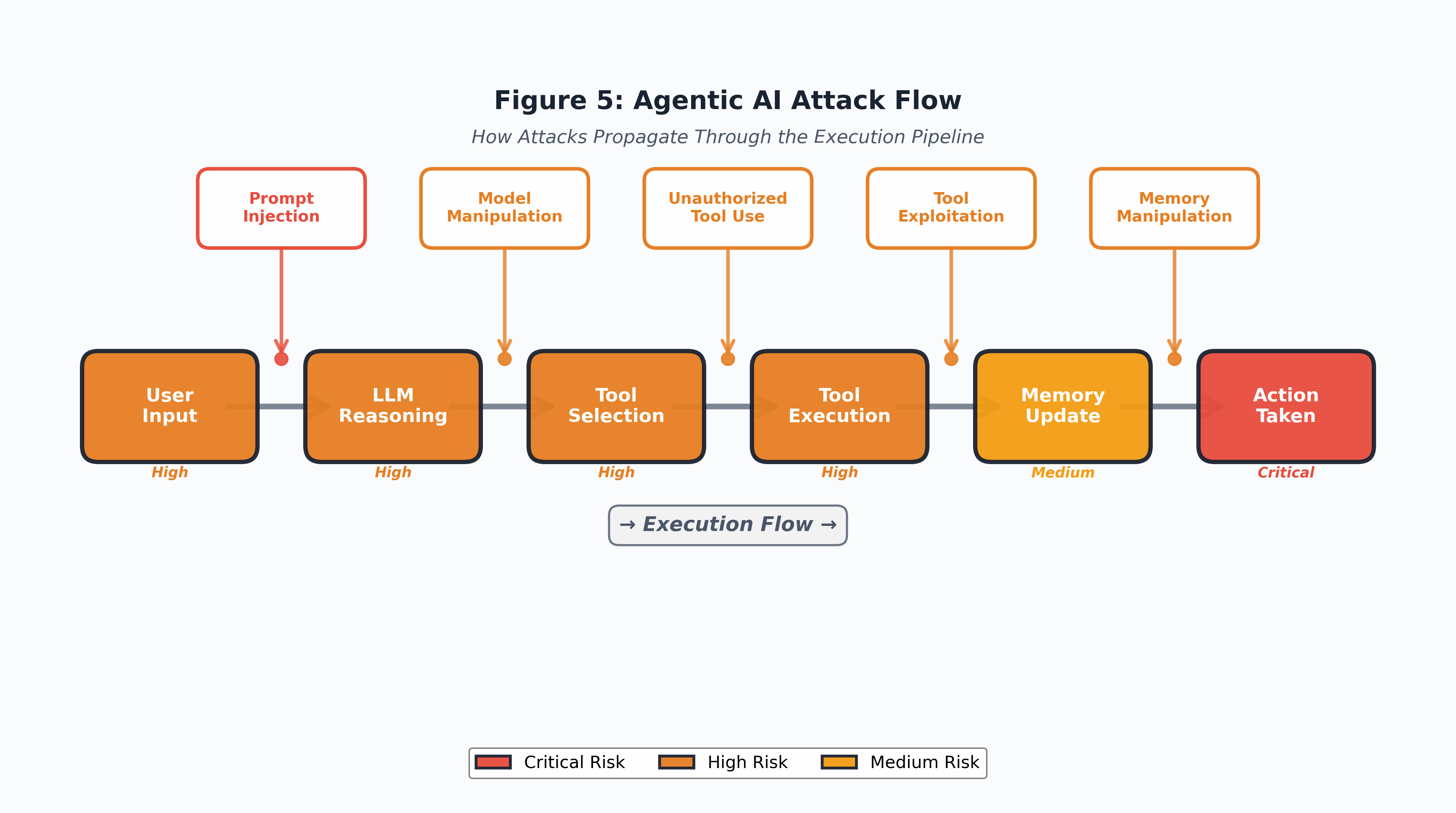
Figure 5: Agentic AI Attack Flow
Linear flow showing how attacks propagate through agentic AI systems. Each stage (User Input → LLM Reasoning → Tool Selection → Tool Execution → Memory Update → Action Taken) represents a vulnerability point. Attack vectors (shown above the flow) can exploit each stage. Critical risks are red, high risks are orange. This demonstrates why agentic AI has more attack points than traditional AI.
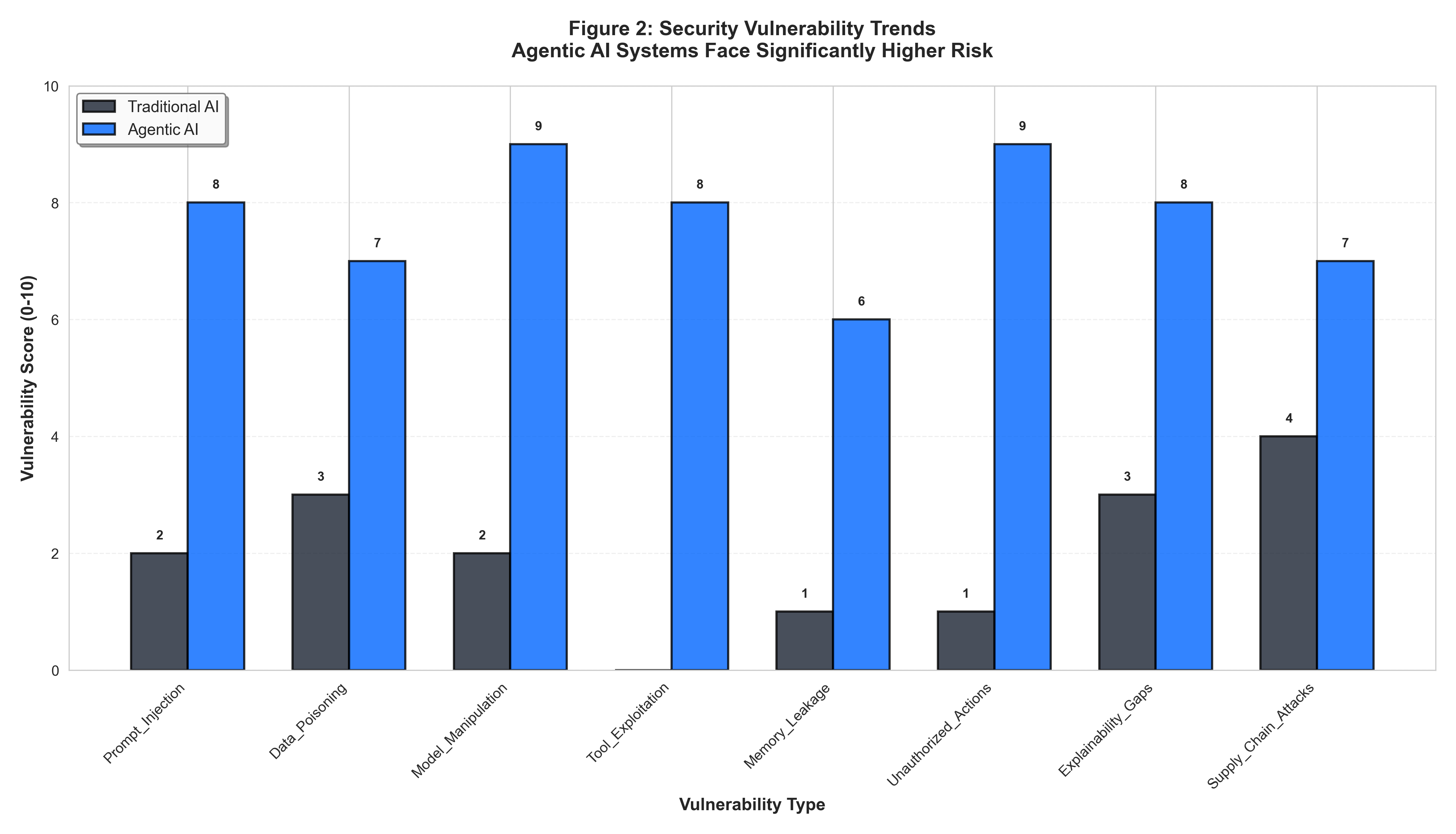
Figure 2: Security Vulnerability Trends
Vulnerability scores (0-10 scale) comparing Traditional AI and Agentic AI systems across eight vulnerability types. Agentic AI systems show significantly higher vulnerability scores across all categories, with particularly high risks in Model Manipulation (9 vs 2), Unauthorized Actions (9 vs 1), and Tool Exploitation (8 vs 0).
The Expanded Attack Surface
Agentic AI expands the attack surface across five key dimensions:
1. Tool Exploitation - Traditional AI doesn't use tools. Agentic AI can be manipulated to misuse tools (e.g., accessing unauthorized data or sending phishing emails). Vulnerability score: 8 for agentic AI vs. 0 for traditional AI (Vanta, 2024).
2. Memory Manipulation - Agentic AI maintains memory across interactions. Attackers can inject malicious data that influences future decisions, such as false permission information leading to unauthorized actions.
3. Unauthorized Action Execution - Agentic AI can take real-world actions (delete files, send emails, modify databases, execute code). Traditional AI can't do this. Vulnerability score: 9 for agentic AI vs. 1 for traditional AI (Vanta, 2024).
4. Supply Chain Attacks - Each external tool, API, or service dependency is a potential attack vector. If a tool provider is compromised, the agentic AI system becomes vulnerable. The SolarWinds attack demonstrated this risk (CTO Academy, 2024).
5. Explainability Gaps - Most agentic systems are black boxes, making it hard to understand why they take specific actions (Blockchain Council, 2024). This complicates security auditing and trust in regulated sectors.
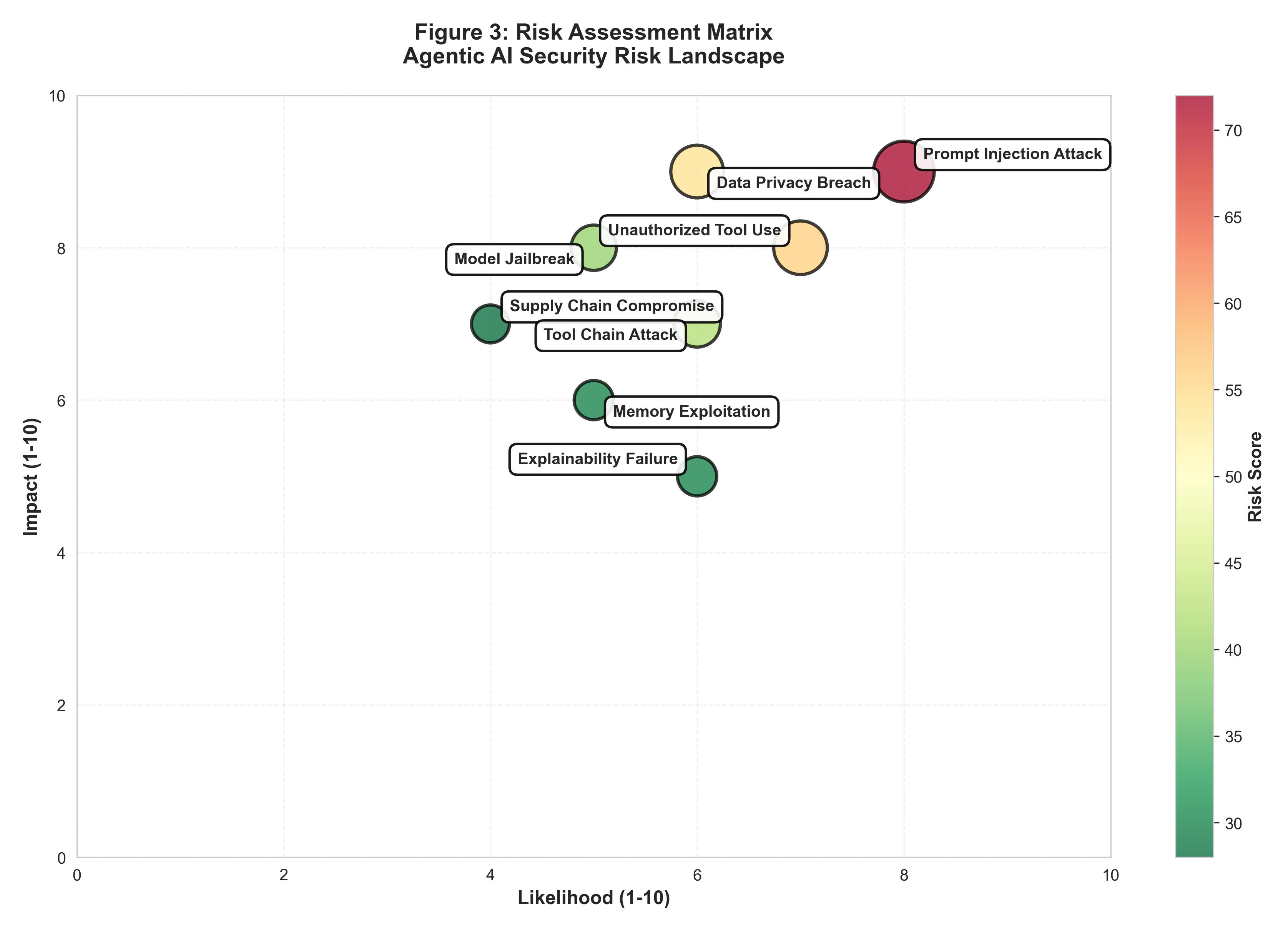
Figure 3: Risk Assessment Matrix
Risk assessment showing likelihood and impact scores for various agentic AI security risks. Prompt Injection Attack (likelihood: 8, impact: 9, risk score: 72) and Unauthorized Tool Use (likelihood: 7, impact: 8, risk score: 56) represent the highest-risk categories. Bubble size represents risk score magnitude.
Real-World Security Implications
These risks are already causing problems in production systems:
Prompt Injection Attacks - Attackers embed malicious instructions in inputs. Successful injection can redirect the entire action sequence. Vulnerability score: 8 for agentic AI vs. 2 for traditional AI (Microsoft, 2024).
Data Privacy Breaches - Agentic AI processes large volumes of information, increasing leak risk. For regulated industries (HIPAA, CMMC, PCI DSS), the stakes are higher (Vanta, 2024).
Model Jailbreaking - Systems can be manipulated to bypass safety constraints. A prompt injection can turn a helpful planner into a dangerous proxy, coercing unintended actions (Akamai, 2024; SecureAI Guide, 2024).
Integration Complexity - Agentic AI needs comprehensive connections to security workflows. Lack of standardization creates siloed technologies that expand the attack surface and complicate compliance (Vanta, 2024).
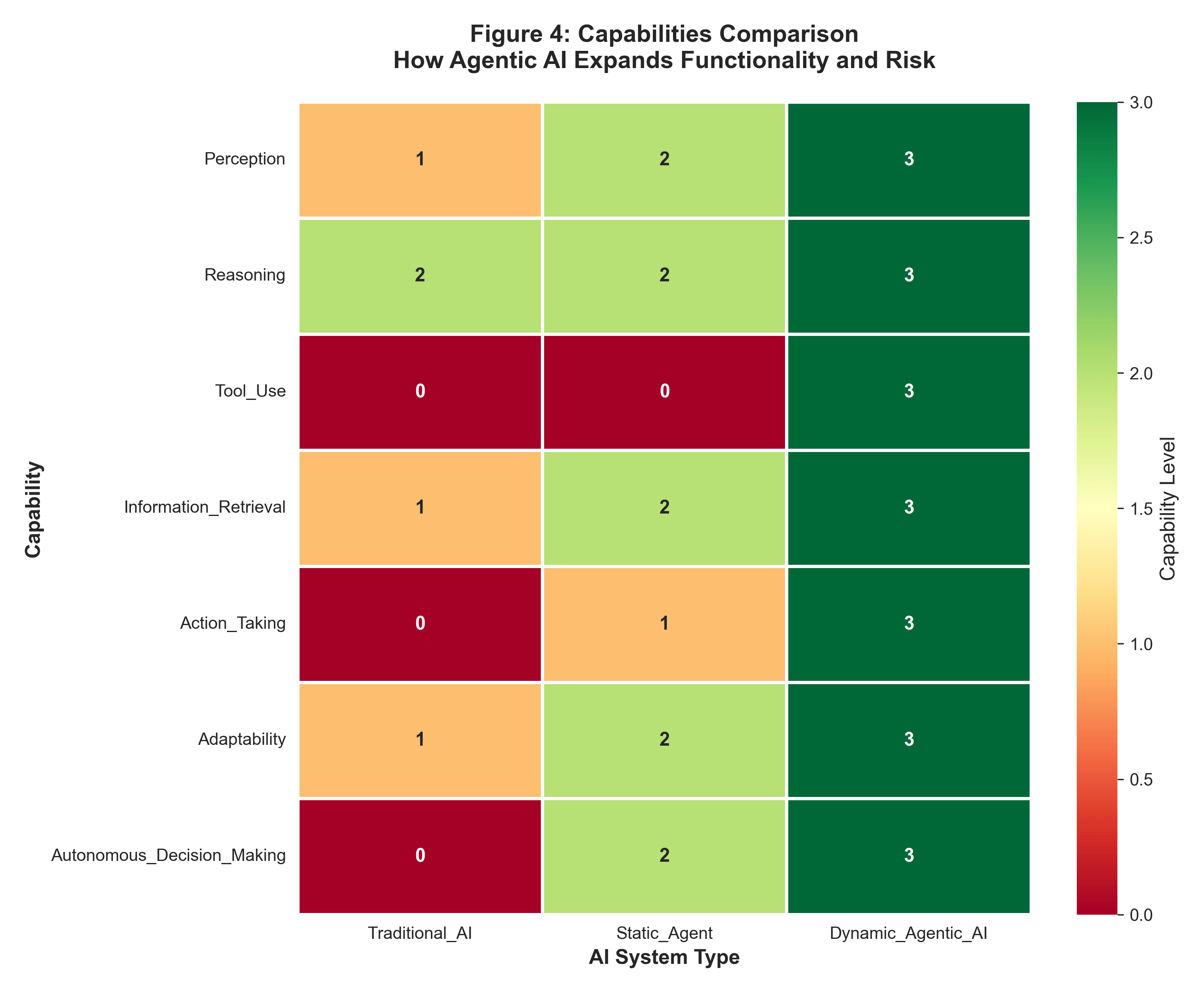
Figure 4: Capabilities Comparison
Heatmap comparing capabilities across Traditional AI, Static Agents, and Dynamic Agentic AI systems. Capability levels: 0=None, 1=Limited/Low, 2=Moderate/Medium/Partial, 3=Full/Advanced/Extensive/High/Autonomous. Dynamic Agentic AI shows full capability (3) across all dimensions, while Traditional AI shows limited or no capability in tool use, action taking, and autonomous decision-making.
The Counterargument
Agentic AI's security risks don't negate its value. The same autonomy that creates challenges enables unique capabilities:
Adaptability - Handles novel situations without human intervention
Efficiency - Completes complex tasks by autonomously selecting and chaining tools
Scalability - Handles diverse tasks without separate models for each use case
Innovation - Discovers novel solutions not obvious to human designers
The question isn't whether to use agentic AI—it's how to use it securely. Organizations need to understand the risks and build appropriate security controls.
The Implications
For operators building production AI systems, the security paradox of agentic AI has several critical implications:
1. Security Must Be Built In, Not Bolted On
Traditional security (adding firewalls after deployment) is insufficient. Security must be designed into agentic AI from the start:
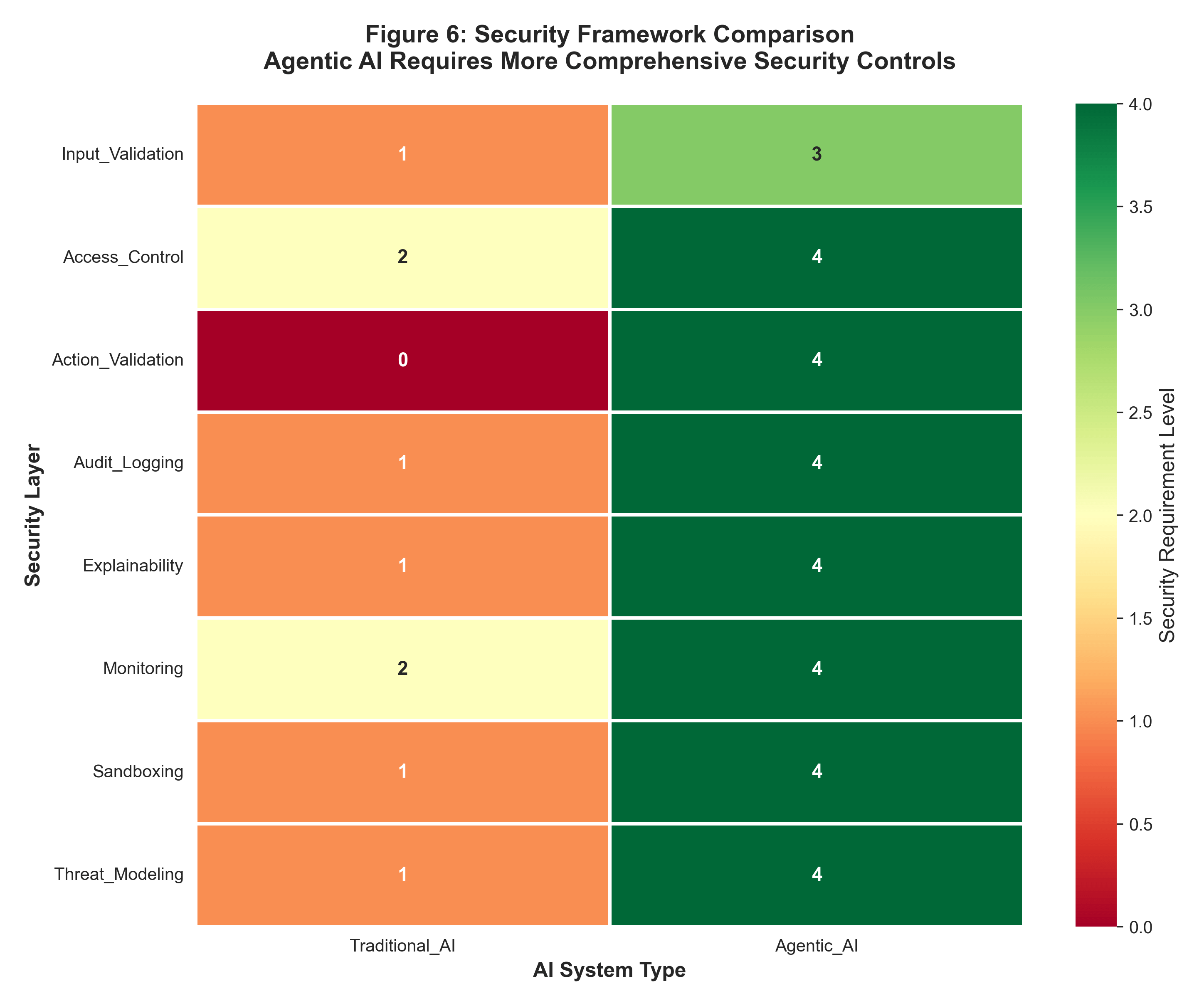
Figure 6: Security Framework Comparison
Heatmap comparing security requirement levels (0-4 scale) between Traditional AI and Agentic AI systems across eight security layers. Agentic AI requires significantly higher security controls: Action Validation (4 vs 0), Explainability (4 vs 1), Real-Time Monitoring (4 vs 2), and Comprehensive Threat Modeling (4 vs 1). This visualization demonstrates that agentic AI doesn't just need more security—it needs fundamentally different security approaches.
Least-privilege access: Agents should only have access to the minimum tools and data necessary for their function
Action validation: Every action should be validated before execution, with clear policies about what actions are permitted
Audit logging: All agent decisions, tool usage, and actions must be logged for security auditing
Sandboxing: High-risk actions should be executed in sandboxed environments
2. Explainability Is a Security Requirement
Black-box systems make security auditing difficult. Organizations need visibility into agent decision-making:
Reasoning traces - Logs of the reasoning process for each decision
Tool usage logs - Records of which tools were used, when, and why
Action justification - Explanations for why specific actions were taken
Explainability tools are still early (Blockchain Council, 2024), but organizations should prioritize this as a security requirement.
3. Continuous Monitoring and Validation
Agentic AI requires continuous monitoring and logging of all actions (Vanta, 2024):
Real-time monitoring - Detect anomalous agent behavior
Human oversight - Escalation paths for high-risk decisions
Regular audits - Periodic reviews of agent actions
Governance policies - Clear policies for when human oversight is required
4. Threat Modeling Is Essential
Organizations must identify threats specific to their AI system and deployment environment (CTO Academy, 2024):
Attack surface analysis - Understand all potential attack vectors
Risk assessment - Evaluate likelihood and impact of threats
Mitigation strategies - Develop specific controls for identified risks
Red team testing - Regular adversarial testing to find vulnerabilities
5. Integration Security Matters
Integration complexity creates security challenges. Organizations should:
Standardize integrations - Use standardized APIs and protocols
Validate tool providers - Vet all external tools and services
Monitor dependencies - Track and update dependencies regularly
Maintain auditability - Ensure all AI decisions are captured across platforms
6. The Economic Decision Point
Economically, AI changes the shape of our cost curves for 'patch' vs. 'rebuild' decisions. When security vulnerabilities emerge in agentic AI systems, organizations face a critical choice: apply quick fixes or invest in a full rebuild.
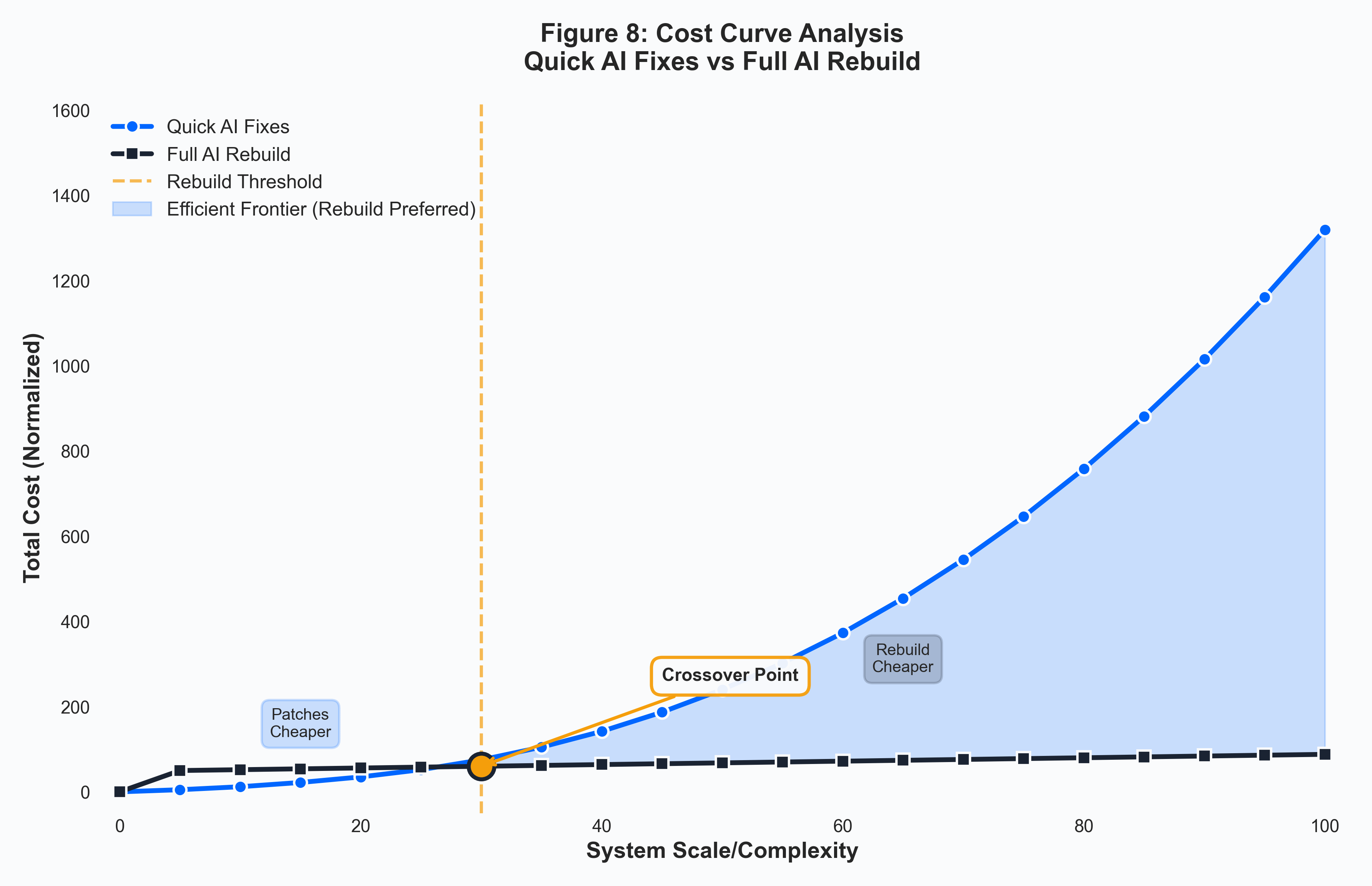
Figure 8: Cost Curve Analysis
Cost curves comparing "Quick AI Fixes" (blue) and "Full AI Rebuild" (navy) across system scale/complexity. Quick fixes start cheap but accelerate rapidly as system complexity increases. Full rebuilds start expensive but flatten, creating a sustainable base. The intersection point—the rebuild threshold—marks where rebuilds become cheaper than continued patching. Before the threshold, patches are economically optimal. After the threshold, rebuilds are economically optimal. The shaded region shows the efficient frontier where rebuilds are preferred. This visualization demonstrates that patches start cheap but become painfully expensive as system complexity increases, while rebuilds start costly but flatten at scale.
The cost curves reveal a critical insight: quick AI patches start cheap but become exponentially expensive as technical debt compounds. Each patch adds complexity, making the next patch harder and more costly. Meanwhile, full AI rebuilds start with a high initial investment but flatten at scale—the infrastructure is built once, and incremental costs remain manageable.
The crossover point—where rebuilds become cheaper than continued patching—typically occurs at a critical system complexity threshold. Beyond this point, every additional "cheap" fix actually pushes organizations further past the efficient frontier.
Operator skill is recognizing where you are on this curve—and whether that next 'cheap' AI fix is actually pushing you past the efficient frontier. Organizations that understand this economic reality can make strategic decisions about when to patch versus when to rebuild, avoiding the trap of accumulating technical debt that becomes prohibitively expensive to maintain.
Conclusion
The security paradox of agentic AI is real: the capabilities that make these systems powerful also make them vulnerable. This isn't a reason to avoid agentic AI—it's a reason to approach it strategically.
For operators, the path forward:
Understand the risks - Agentic AI has a fundamentally different attack surface
Build security in - Design security controls from the beginning
Prioritize explainability - Invest in visibility into agent decision-making
Implement continuous monitoring - Establish monitoring and governance processes
Conduct threat modeling - Identify and mitigate specific threats
Organizations that succeed with agentic AI will be those that understand the risks, plan for them, and build appropriate safeguards. The security paradox is manageable with a strategic approach.
Agentic AI represents the future of AI capabilities. The question isn't whether to adopt it—it's whether you'll do so securely. The solution: security by design, not security by accident.
Key Takeaways
Security paradox: Agentic AI's powerful capabilities (autonomous tool selection, dynamic decision-making) dramatically expand the attack surface compared to traditional AI.
Attack surface expansion: Agentic AI has attack surface scores nearly 4x higher (95 vs 25), with vulnerability scores 2-4x higher across all categories.
Security by design: Traditional security approaches are insufficient. Build in least-privilege access, action validation, audit logging, and sandboxing from the start.
Explainability required: Black-box systems make security auditing difficult. Need reasoning traces, tool usage logs, and action justification.
Continuous monitoring essential: Require real-time monitoring, human oversight for high-risk decisions, regular audits, and clear governance policies.
Economic decision point: Quick AI patches start cheap but become exponentially expensive as technical debt compounds. Full rebuilds start costly but flatten at scale, becoming cheaper beyond the crossover point (typically around 10-11 patches). Operator skill is recognizing where you are on this curve.
References
Akamai. (2024). Edge of agency: Defending against risks in agentic AI. Akamai Blog. https://www.akamai.com/blog/security/edge-of-agency-defending-against-risks-agentic-ai
Berkeley Center for Responsible Decentralized Intelligence. (2024). Agentic AI capabilities and security considerations [Video]. YouTube. https://www.youtube.com/watch?v=CvZDJxd4LKM&list=PLS01nW3RtgoqGkm4UeqNeZLccW-OGc1fJ
Blockchain Council. (2024). Agentic AI limitations and security challenges. Blockchain Council. https://www.blockchain-council.org/ai/agentic-ai-limitations/
CTO Academy. (2024). Agentic AI concerns and solutions. CTO Academy. https://cto.academy/agentic-ai-concerns-and-solutions/
Microsoft. (2024). Securing the AI-powered enterprise: Getting started with AI applications. Microsoft. https://cdn-dynmedia-1.microsoft.com/is/content/microsoftcorp/microsoft/final/en-us/microsoft-brand/documents/Securing-the-AI-Powered-Enterprise-Getting-Started-with-AI-Applications.pdf
SecureAI Guide. (2024). Navigating enterprise AI adoption: New agentic AI security challenges. SecureAI Guide. https://secureaiguide.com/navigating-enterprise-ai-adoption/new-agentic-ai-security-challenges
Vanta. (2024). Agentic AI security challenges. Vanta Resources. https://www.vanta.com/resources/agentic-ai-security-challenges
This analysis synthesizes public information about agentic AI security risks, attack surfaces, and vulnerability assessments. The statistics and comparisons presented are based on available public data from security research organizations, industry reports, and academic sources. The frameworks and strategic recommendations are designed to be actionable for operators building production AI systems. Real-world applications require adjusting for domain-specific factors, organizational security requirements, and regulatory compliance needs. The frameworks provided here serve as a foundation for more sophisticated security analysis tailored to specific agentic AI deployments.
Editorial transparency. Essays at The AI Operator may use AI-assisted research, drafting, and editing tools under staff editorial review. Facts, figures, and recommendations are checked before publication; we correct the record when evidence changes. Questions: hello@theaioperator.net.
Published on [Substack](https://theaioperator2.substack.com/p/agentic-ai-security).