Agent Sandbox to Production: Five Gates That Survive a Quarterly Business Review
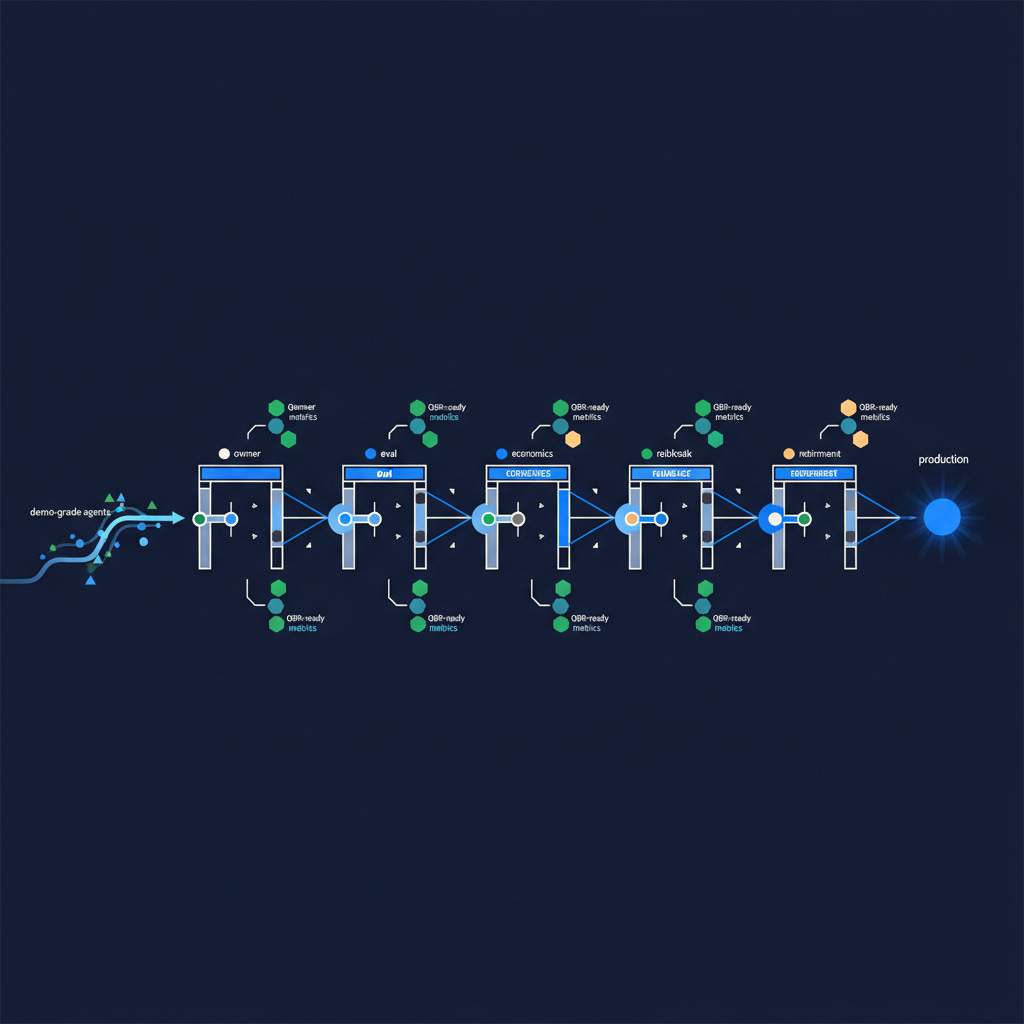
A fraud agent that clears five gates in the sandbox still fails QBR if promotion skips ownership, eval, economics, rollback, or retirement.
Executive Summary
Lena Park, Director of AI Innovation, had a fraud agent demo that saved $4M on a slide—and a production promotion that died in risk review because nobody owned the P&L, the eval scorecard, or the rollback bundle. Marcus Reid, CRO, blocked it. Jordan Hale, CFO, would not fund what he could not price per case. When Lena's team ran five non-negotiable gates—ownership, evaluation, economics, rollback, retirement—the same agent shipped in 90 days with 38% less surprise spend (illustrative composite).
Composite operators / illustrative scene — not one customer's books.
The promotion that failed quietly
Lena's team celebrated the sandbox score: 94% precision on historical fraud cases [1]. The production gate failed on simpler questions: Who owns the invoice? What is cost-per-case-reviewed? What is policy_version when the model drifts? NIST's Govern function expects those answers before write access expands [2]. The agent never reached customers—not because the model was weak, because the operating model was missing.
Figure 1: Sandbox to production gates
Illustrative—each gate must pass before write access expands.
The five gates
The first question for any new agent must be: Who owns the P&L? Not the technical owner, but the business leader whose budget will be hit by its costs and credited with its value. Without a named P&L owner, an AI agent is an orphan asset, destined to be shut down during the first budget review.
In our composite, the fraud detection agent was initially owned by the innovation team. To pass this gate, ownership was formally transferred to the VP of Fraud Operations. This single move changed the entire dynamic. The VP immediately began asking critical questions about cost-per-case-reviewed and the model's false positive rate, as these metrics directly impacted her department's operating margin.
This gate requires creating a Decision Ledger: a simple, auditable record that ties every agent to a business owner, a cost center, and a business case. It is the foundational document for moving from a cost center model to a value creation model.
Figure 3: Ownership Model vs Primary Responsibility vs Key Metric
This gate requires creating a Decision Ledger: a simple, auditable record that ties every agent to a business owner, a cost center, and a business case.
Ownership Model: Central IT/Platform · Primary Responsibility: Manages infrastructure, provides API keys. · Key Metric: Platform uptime, API latency. · Common Failure Mode: Moral hazard; business teams consume resources without accountability.
Ownership Model: Embedded Product Team · Primary Responsibility: Builds and operates the agent within a product line. · Key Metric: Feature adoption, user engagement. · Common Failure Mode: Local optimization; agent costs are buried in the product's overall COGS.
Ownership Model: P&L Owner (Chargeback) · Primary Responsibility: Business unit owns the agent's budget and outcomes. · Key Metric: Cost-per-decision, ROI. · Common Failure Mode: Requires mature FinOps; can create overhead if not automated.
We moved from the Central model to the P&L Owner model for any agent intended for production. Sandbox environments remained on the central budget, but the moment an agent was proposed for a production workflow, it had to have a business sponsor willing to accept the chargeback.
Gate 2: The Evaluation Gate
Sandbox evaluations do not survive production pressures. Academic benchmarks like accuracy or F1-score are insufficient. This gate demands that every agent is measured against a scorecard of business-relevant metrics. The evaluation is the contract between the agent and the business.
For the fraud agent, the initial evaluation was based on its ability to correctly identify known fraud patterns in a test dataset. To pass Gate 2, we built a new scorecard with the VP of Fraud Operations:
Cost Per Case Reviewed: The total inference and data cost divided by the number of cases processed. The target was set at $0.15, 80% lower than the cost of a junior human analyst.
True Positive Rate (at 99.5% Precision): The percentage of actual fraud cases correctly identified, holding the rate of false accusations extremely low.
Analyst Override Rate: The percentage of times a human analyst overruled the agent's recommendation. This measures trust and identifies edge cases.
Time to Decision: The latency from case ingestion to final recommendation.
This scorecard aligns the agent's performance with the operational goals of the business unit. It moves the conversation from "how good is the model?" to "how much value is this system creating for the business?"
Gate 3: The Economics Gate
Visibility precedes control. This gate is about instrumenting every single inference call with the telemetry needed for financial management [3]. It makes the cost of every decision visible, allocatable, and predictable.
The minimum viable telemetry set we enforced was:
workflow_id: The unique business process the call serves (e.g.,fraud_case_review_L1).owner_cost_center: The budget code of the P&L owner.model_id: The specific model and version used (e.g.,claude-3-sonnet-20240229).policy_version: A hash or version number for the prompt, rules, and retrieval configuration.input_token_count&output_token_count: The raw units of consumption.human_override: A boolean flag indicating if the decision was escalated or changed by a person.decision_outcome: The final result of the workflow (e.g.,approved,flagged_for_review).
Implementing this logging was a non-negotiable prerequisite for getting production API keys. Once in place, we could move from a hazy "showback" model (telling teams what they spent) to a direct "chargeback" model (invoicing their cost center).
This gate also forced a critical design choice: tiered inference routing. Instead of using the most powerful (and expensive) model for every task, we designed a routing system. Simple, low-stakes decisions were handled by smaller, cheaper models. Only complex or high-risk cases were escalated to flagship models like GPT-4 or Claude 3 Opus. This alone cut projected inference costs for the support router agent by over 40%.
Figure 4: Option vs Upside vs Downside
This gate also forced a critical design choice: tiered inference routing.
Option: Central pool · Upside: Fast demos, low initial friction for developers. · Downside: Moral hazard, opaque $/decision, leads to massive surprise bills.
Option: Showback · Upside: Creates visibility into costs per team/workflow. · Downside: No direct financial pressure; often ignored by teams without budget ownership.
Option: Chargeback + validators · Upside: Enforces direct accountability, operable at scale. · Downside: Requires significant allocation and instrumentation overhead upfront.
We concluded that for any system operating at scale, the overhead of implementing chargeback and validators is a necessary investment to avoid the technical and financial debt that a central pool model creates.
Gate 4: The Rollback Gate
A production system that cannot be safely rolled back is a liability. In AI systems, a "change" is not just a new model. It is a bundle of components: the model, the prompt template, the retrieval documents, and the business logic rules [1]. Google SRE practice treats versioned rollback bundles as production hygiene—not optional tooling [4].
Gate 4 requires that every production deployment is treated as an immutable, versioned bundle. We enforced this by tying the policy_version tag from our telemetry to a specific commit in our version control system. This commit contained:
The prompt text file.
A manifest of the RAG (Retrieval-Augmented Generation) document versions.
The configuration for the rules engine.
The
model_idstring.
If the fraud agent’s performance suddenly degraded, rollback was not a frantic search through Slack messages to figure out who changed what. It was a single command: revert to policy_version: 2.1.4. This brought the entire decision-making apparatus back to a known good state in minutes. Aligning model risk, compliance, and product teams on this single definition of a "production change" was critical for building trust and ensuring audibility.
Gate 5: The Retirement Gate
Every production agent needs a funeral plan. No model performs perfectly forever [1]. Data drifts, business needs change, and new, more efficient models are released [2]. An agent without a retirement plan becomes legacy technical debt—too risky to touch, too expensive to run, and too embedded to easily replace.
This gate requires that the business case for any new agent includes a section on its end-of-life criteria. For the fraud agent, we defined the following retirement triggers:
Economic Trigger: If the cost-per-case-reviewed rises above 75% of the cost of a human analyst for two consecutive months.
Performance Trigger: If the Analyst Override Rate exceeds 10% for a month, indicating a loss of trust or a significant drift in input data.
Replacement Trigger: When a new model or architecture can achieve the same business outcomes at a 30% or greater reduction in cost.
Having these criteria defined upfront makes the decision to sunset a model objective, not political. It ensures that the organization is continuously optimizing its portfolio of agents, rather than accumulating a graveyard of underperforming legacy systems.
The Results
Implementing these five gates transformed the AI program from a high-cost R&D function into a predictable, value-generating capability. The process was not without friction, but the clarity of the gates provided a clear path for teams to follow and a defensible framework for discussions with finance and risk.
Within 90 days of enforcement, the results were tangible:
Figure 5: Metric vs Before Gated Process vs After Gated Process (90 days)
Within 90 days of enforcement, the results were tangible:
Metric: Untagged Inference Spend · Before Gated Process: 45% of total AI spend · After Gated Process (90 days): < 5% of total AI spend · Business Impact: Finance gained full visibility; surprise invoices eliminated.
Metric: Time to Audit a Decision · Before Gated Process: 4–5 days (manual log search) · After Gated Process (90 days): < 2 minutes (queryable ledger) · Business Impact: Compliance and risk could satisfy auditor requests on demand.
Metric: Production Agents Launched · Before Gated Process: 1 (in prior quarter) · After Gated Process (90 days): 3 (fraud, support, claims L1) · Business Impact: Innovation velocity increased by moving from stalled pilots to production.
Metric: Fraud Agent ROI · Before Gated Process: N/A (stalled in pilot) · After Gated Process (90 days): On track for $4.2M annual savings · Business Impact: Unlocked a major value stream previously blocked by risk and cost concerns.
The most significant change was qualitative. The QBR conversations shifted from defending rising platform costs to discussing the ROI of the agent portfolio. The Director of AI was no longer seen as a cost center manager but as a business partner who could deploy technology to solve concrete operational problems.
What Went Wrong
Our first attempt at implementing Gate 3 (Economics) was incomplete, and it taught us a critical lesson. We successfully enforced the chargeback model, making costs visible to the business units. However, we did not initially implement hard budget caps or cost-based validators per workflow.
In the second month, a marketing analytics team, now responsible for their own budget, spun up a new agent to analyze customer sentiment from millions of reviews. The goal was valid, but the agent was inefficiently designed, creating millions of embeddings for a speculative R&D project. The cost was correctly charged back to their department, but the job consumed 60% of the entire company's quarterly AI budget in three days before finance could manually intervene.
The failure was realizing that visibility without control is insufficient. Chargeback worked—the right team got the bill. But the lack of an automated economic guardrail allowed a single workflow to create a massive cost overrun. This incident led to an immediate revision of Gate 3. We added a requirement for every new workflow to have a defined monthly budget cap and a fail-closed validator that would halt execution if the projected cost-per-decision spiked above a pre-set threshold. Ownership and visibility are necessary, but automated economic controls are what make the system safe to operate at scale.
Canonical scope
Archive note (June 2026): Public canonical for the production gates cluster. Five production gates that survive a QBR. Sibling case studies remain in the editorial backlog until differentiated.
Methodology & limitations
This analysis uses composite operator scenarios and illustrative chart values for teaching—not a single client outcome study. Adjust for your domain before production decisions.
References
Sculley, D., et al. (2015). Hidden Technical Debt in Machine Learning Systems. NeurIPS. https://papers.nips.cc/paper/5656-hidden-technical-debt-in-machine-learning-systems.pdf
National Institute of Standards and Technology. (2023). Artificial Intelligence Risk Management Framework (AI RMF 1.0). https://www.nist.gov/itl/ai-risk-management-framework
FinOps Foundation. (2024). FinOps Framework — Allocation and Chargeback. https://www.finops.org/
Google. (2018). Site Reliability Engineering Workbook — Monitoring distributed systems. https://sre.google/workbook/monitoring/
Monday Morning Checklist
[ ] Assign a named P&L owner for
agent-sandbox-production-gatesin the Decision Ledger.[ ] Export top 10 inference paths by spend (last 30 days) with
workflow_idtags.[ ] Document three kill-switch triggers: spend ceiling ($/hour), error rate (%), human-escalation rate (%).
[ ] Stand up pre/post validators on one customer-data workflow; define three fail-closed reason codes.
[ ] Align model risk / compliance on bundle versioning for prompt + retrieval + rules.
[ ] Schedule 30-minute review with finance: walk Figure 1 ledger for agent sandbox production gates; agree showback vs. chargeback date.
Editorial transparency. Essays at The AI Operator may use AI-assisted research, drafting, and editing tools under staff editorial review. Facts, figures, and recommendations are checked before publication; we correct the record when evidence changes. Questions: hello@theaioperator.net.
Published on [Substack](https://theaioperator2.substack.com/p/agent-sandbox-production-gates).


